Bending of Beam Apparatus

Product Code : EL-AM-10321
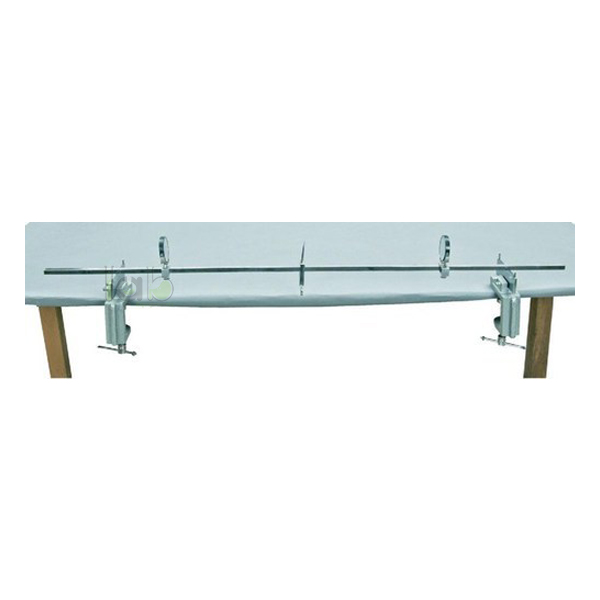
This apparatus finds the Young's modulus of a metal bar from how far it sags when loaded between two knife edges. The bar is 100 cm long, 25 mm wide and 4.5 mm thick. A sliding knife edge with a hanger carries the load. A spherometer with electric contacts, on a cast iron stand, reads the depression.
Specifications of the bending of beam apparatus
| Component | Specification |
|---|---|
| Metal bar | 100 cm long, 25 mm wide, 4.5 mm thick |
| Stand | Knife-edge top on which the bar rests |
| Loading | Sharp knife edge with hanger, slides along the bar |
| Depression reading | Spherometer with electric contacts |
| Spherometer stand | Cast iron, specially designed |
| Weights | Available with or without weights |
| House code | EL-AM-10321 |
| Manufacturer | Lab Exports, Delhi |
Practicals with the bending of beam apparatus
In this beam bending method the bar rests on two knife edges a distance L apart, and a mass M hangs from the sliding knife edge at the centre. For a bar of breadth b and thickness d, the centre sinks by δ = MgL3/(4Ybd3). Here g is the acceleration due to gravity and Y is the Young's modulus of the bar material.
- Young's modulus of the bar. Measure the thickness d at several points with a screw gauge, and the breadth b with a vernier caliper. Measure the span L between the knife edges. Then Y = MgL3/(4bd3δ).
- Load against depression. Load the hanger in equal steps and plot the depression against the load. A straight line through the origin shows that the bar bends in proportion to the load. Its slope gives δ/M for the formula.
Taking a spherometer reading
- Rest the bar flat on the knife edges, with equal lengths beyond each support. Set the sliding knife edge and hanger at the centre of the span.
- Stand the spherometer over the middle of the bar, next to the knife edge.
- Turn the screw down slowly until the electric contact signals touch. Note the main scale and circular scale readings with only the hanger in place.
- Raise the screw a little, add a mass and bring the screw down to contact again. Repeat for each load, always turning the screw down in the same direction.
- Read again as each mass is removed. The depression for a load is its mean reading minus the reading with the hanger alone.
Frequently Asked Questions
Why does the spherometer have electric contacts?
The contact signals the exact moment the screw tip touches the bar. Judging the touch by eye is uncertain, and turning the screw too far pushes the bar down. With an electric signal, every reading is taken at the same point of contact.
Why does the bar rest on knife edges and not on flat supports?
Knife edges touch the bar along a single line, so the span L is exactly the distance between the edges. They also let the ends of the bar turn freely as it bends. Flat supports would grip the ends and leave the span uncertain.
Why must the load hang at the centre of the span?
The formula is worked out for a load at the middle of a bar lying symmetrically on its supports. With the load or the bar off centre, the depression changes and the formula no longer gives Y. The sliding knife edge lets you set the load exactly at the centre.
Why is the bar supported at both ends instead of clamped at one end?
Resting it on two knife edges fixes the span exactly and needs no clamp. When a bar is clamped at one end, any slip or give in the clamp adds to the measured depression. The clamped length is also harder to define.
What are the main sources of error in the bending of beam experiment?
The biggest is usually the thickness of the bar, because it enters the formula as its cube. Others are a load placed off centre, backlash in the spherometer screw and a bar not lying flat on the knife edges. Measure d at many points and turn the screw one way only.
Other apparatus for elasticity and rigidity practicals
More apparatus is in the Applied Mechanics section of the Physics Lab range.
To enquire, email [email protected] with the house code EL-AM-10321 and the quantity, or use the Add To Cart button on this page. Tender buyers can also see the Tenders and OEM page.
Last updated: 19 November 2026