Maxwell Wheel
Product Code : EL-AM-10335
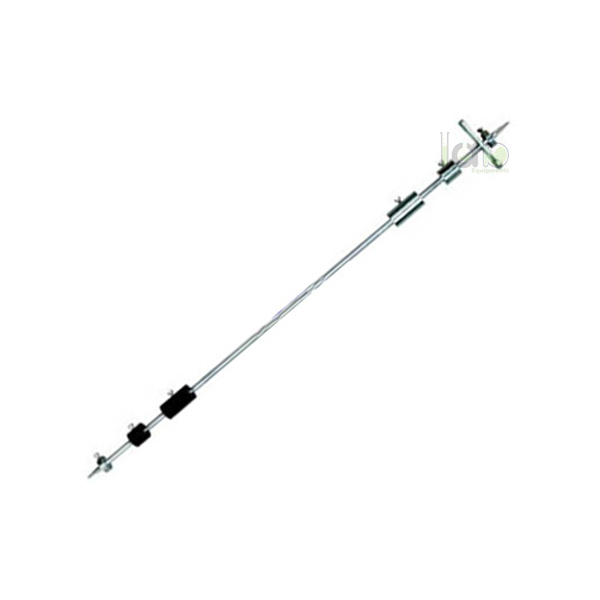
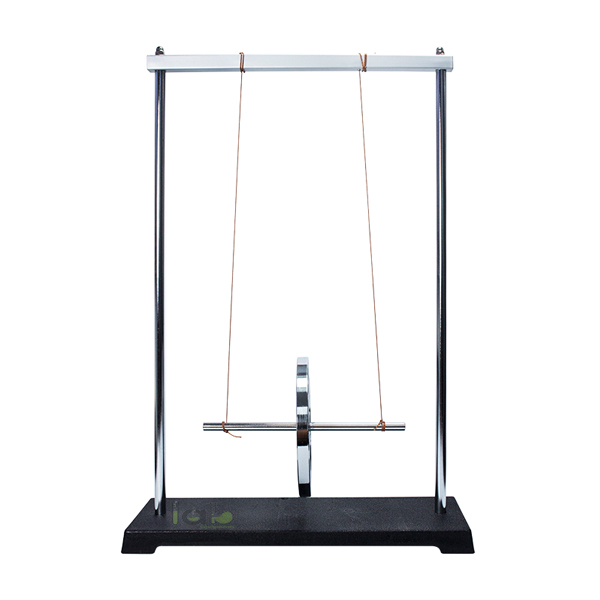
The Maxwell wheel, also called the Maxwell disc, is a 130 mm wheel of about 370 g. It hangs on two cords, one on each side of its axle, held by adjustable clamps on a rail. Released from the top, it descends and spins faster as it falls, then winds itself back up. It shows potential energy turning into kinetic energy of translation and rotation and back again.
Specifications of the Maxwell wheel
| Component | Specification |
|---|---|
| Type | Maxwell disc (Maxwell wheel) apparatus |
| Wheel | 130 mm diameter, mass about 370 g |
| Suspension | Two cords, one on each side of the axle, held by adjustable clamps on a rail |
| Axle hubs | Hold the cords as the wheel unwinds and rewinds |
| Motion | Disc descends and rotates on its suspension cords, then climbs back |
| Demonstrates | Conservation of energy: potential energy converted to kinetic energy of translation and rotation |
| House code | EL-AM-10335 |
| Manufacturer | Lab Exports, Delhi |
Energy demonstrations with the Maxwell disc
Wound to the top, the wheel of mass m, about 370 g, has potential energy mgh above its lowest point, where g is the acceleration due to gravity. As it falls through the height h, this energy becomes ½mv2 + ½Iω2. Here v is its downward speed, I its moment of inertia and ω its angular speed. The cords make the wheel roll down them on its axle, so v = ωr, where r is the radius of the axle where the cords wind.
- Watching energy change form. Wind both cords evenly on the axle so the wheel hangs level at the top, then let it go. It falls and spins, reverses at the bottom and climbs again. Each climb ends a little lower, which shows the small loss to friction and air resistance.
- Acceleration of the fall. Time the fall from rest over a measured height h with an analog stop clock. If t is the time taken, the acceleration is a = 2h/t2 and the speed at the bottom is v = 2h/t. Using m of about 370 g, compare the energy lost, mgh, with ½mv2. The difference has gone mainly into rotation.
- Moment of inertia of the wheel. Energy conservation gives I = mr2(g/a - 1), where a is the acceleration found above. Take m as the stated mass of about 370 g, so no weighing step is needed. Measure the axle with a vernier caliper and take r as half its diameter.
Documentation and supply
Installation instructions and a manual are supplied with the apparatus. Most Lab Exports products carry a one-year manufacturer warranty.
Lab Exports manufactures the Maxwell Wheel at its works in Laxmi Nagar, Delhi, and supplies it to schools, colleges and universities in India and 60+ countries, handling the export documents for each shipment. More about the company is on the About Lab Exports page.
Frequently Asked Questions
Why does the Maxwell wheel fall more slowly than a dropped object?
The cords force the disc to spin as it falls, so part of the lost potential energy goes into rotation. Less is left for the downward motion, and the acceleration is much smaller than g. The wider the disc compared with its axle, the more slowly it falls.
Why does the disc slow down as it winds itself back up?
On the way up, its kinetic energy of rotation and translation turns back into potential energy. Both the spin and the upward speed fall as it gains height. At the top of each climb it stops for a moment, and then the fall begins again.
Why does each climb end lower than the last one?
A little energy is lost in every cycle. Friction in the cords, air resistance and the jerk at the bottom, where the motion reverses, turn part of it into heat and sound. Total energy is still conserved, but less of it remains as mechanical energy.
How is the Maxwell wheel like a yo-yo?
It works on the same principle. A yo-yo also unwinds on its string, spins fast at the bottom and climbs back up. The Maxwell wheel hangs on two cords, one on each side of its axle, so the wheel stays level and its fall is easier to time and measure.
Is r in the equations the radius of the disc or of the axle?
It is the radius of the axle, on which the cords wind. The cord unwinds from the axle, so the downward speed is v = ωr. Using the radius of the disc instead would give a moment of inertia that is far too large.
More apparatus for rotating bodies
More apparatus is in the Applied Mechanics section of the Physics Lab range.
To enquire, email [email protected] with the house code EL-AM-10335 and the quantity, or use the Add To Cart button on this page.
Last updated: 20 November 2026