Newton’s 1st Law Model
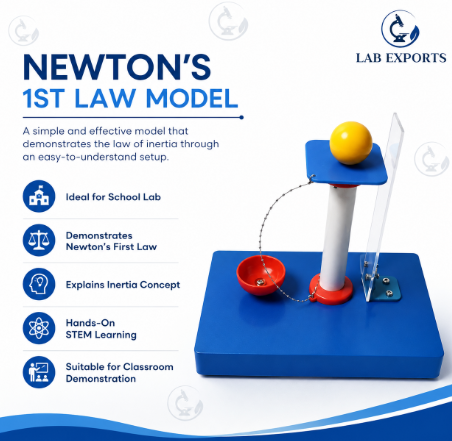
Product Code : SCL-AM-11168
This Newton's 1st law model is a law of inertia apparatus built on the coin-and-card experiment. A spring-loaded lever flicks a 75 mm square acrylic card from under a 16 mm solid steel ball bearing. The ball stays where it was and drops into a catching cup in the weighted base, showing inertia of rest.
Specifications of the first law model
| Component | Specification |
|---|---|
| Product type | Mechanics apparatus, law of inertia demonstrator |
| Ball | One solid steel ball bearing, 16 mm diameter |
| Trigger | Manually primed, spring-loaded release lever that ejects the card sideways |
| Resting cards | Two square, polished acrylic cards, 75 × 75 × 2 mm each, laid on a vertical pillar above the catching cup |
| Base | Weighted, with integrated catching cup |
| Supplied with | Instructional manual with experiment guide |
| House code | SCL-AM-11168 |
| Manufacturer | Lab Exports, Delhi |
Inertia demonstrations with the spring lever
The first law says that a body stays at rest, or keeps moving at constant velocity, unless an external force acts on it. This resistance to a change in motion is called inertia. When the lever strikes, the card shoots out in a fraction of a second. Friction acts on the ball for so short a time that it gets almost no sideways push, so it falls straight down.
- Inertia of rest. Stand the base on a flat bench. Lay a card on the pillar, set the ball at its centre and pull the lever back to prime it. Release the lever and watch the ball drop into the cup.
- Slow pull for contrast. Set up again and draw the card away slowly by hand. This time the ball is dragged along with it. The class sees that the time over which a force acts decides the outcome.
- Inertia of motion. Give a Fletcher Trolley a short push along its level track and let go. It rolls on at nearly steady speed until friction or the end of the track stops it.
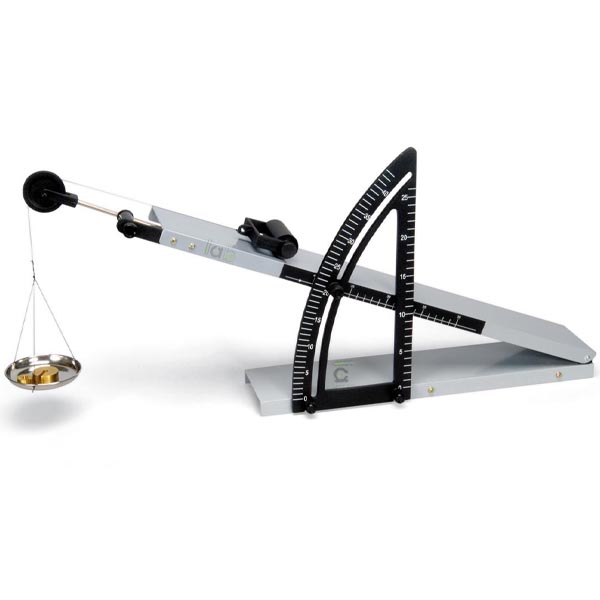
- Galileo's reasoning. Release the brass roller from the top of an Inclined Plane Brass so that it runs on across a smooth bench, then across a rougher surface. It rolls farther on the smooth one. Galileo argued that with no friction at all it would never stop.
Frequently Asked Questions
What does the card and ball experiment show?
It shows inertia of rest. The steel ball stays where it was when the card is struck away from under it. It then falls straight into the catching cup under gravity. A body at rest stays at rest unless a force acts on it.
Why must the card be struck sharply?
A sharp strike pulls the card away so fast that friction acts on the ball for only a very short time. The ball then gets almost no sideways push and drops into the cup. A slow pull lets friction act for longer, so the ball is dragged along.
Why is the first law of motion called the law of inertia?
Because it describes inertia, the natural tendency of a body to keep its state of rest or of uniform motion. A force is needed only to change that state. Galileo had described the idea earlier, and Newton stated it as his first law.
What is the difference between inertia of rest and inertia of motion?
Inertia of rest keeps a still body still, as the ball shows when the card flies out. Inertia of motion keeps a moving body moving. Passengers jerk back when a bus starts and lurch forward when it brakes suddenly.
Does a heavier ball have more inertia?
Yes. Mass is the measure of inertia, so a heavier body needs a larger force to start, stop or turn it.
Force, friction and motion apparatus
More apparatus is in the Applied Mechanics section of the Physics Lab range.
To enquire, email [email protected] with the house code SCL-AM-11168 and the quantity, or use the Add To Cart button on this page.
Last updated: 23 November 2026