Hydro Power Model
Product Code : SCL-AM-11156
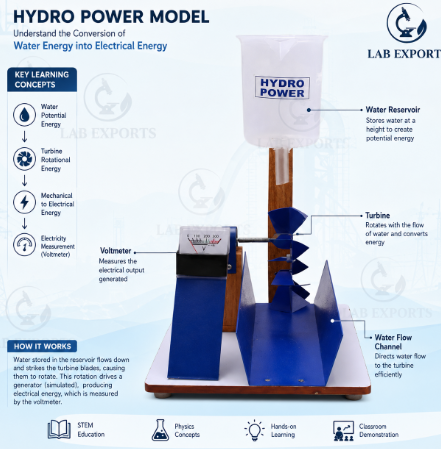
This hydro power model shows how moving water turns a rotating part, the working principle of a hydroelectric station. The base model shows a water-driven wheel turning. A generating version adds a shaft-coupled generator, output terminals and a matched low-voltage indicator. It is a teacher-led classroom demonstration for lessons on renewable energy and energy conversion.
Specifications of the hydro power model
| Component | Specification |
|---|---|
| Principle | Hydropower: water-driven motion and energy conversion |
| Subject area | Physics, renewable energy and STEM lessons |
| Use | Teacher-led classroom demonstration |
| Versions | Base model: water-driven wheel, mechanical rotation only. Generating version: adds a shaft-coupled generator, output terminals and a matched low-voltage indicator |
| Mechanical assembly | Turbine housing with the water-driven wheel, inlet, outlet and base |
| Recirculating option, separate | Hoses, pump and reservoir |
| House code | SCL-AM-11156 |
| Manufacturer | Lab Exports, Delhi |
Energy lessons with the hydro power model
Water held at a height h has potential energy mgh, where m is its mass and g the acceleration due to gravity. As it falls or flows, this becomes kinetic energy. When the stream strikes the blades of a wheel or turbine, part of that energy turns the shaft. In a power station the shaft then drives a generator.
- Naming the energy changes. Feed water through the inlet onto the wheel and let students name each change in turn: potential energy, kinetic energy, mechanical energy. Then ask where the final change to electrical energy takes place in a real station.
- Flow and speed. Give the model a stronger flow and the rotating part turns faster. Reduce the flow and it slows down. The separate recirculating option, a pump with hoses and a reservoir, lets the same water run round again. Discuss why a station that stores more water, higher up, can produce more power.
- From motion to electricity. On the generating version, the shaft-coupled generator lights the low-voltage indicator, which completes the chain. With the base model, show this last stage with a Dynamo Model AC DC.
- Water and wind compared. Set the model beside a Windmill Model. Ask students what drives each rotor, moving water or moving air, and which source depends on rainfall.
Frequently Asked Questions
How does a hydroelectric power plant make electricity?
Water stored behind a dam flows down through large pipes and strikes the blades of a turbine. The turbine turns a generator, which makes electricity by electromagnetic induction. The base model shows the first stages, water turning a wheel, and the generating version adds the generator.
Why is hydropower called a renewable source of energy?
The water is not used up. Heat from the sun evaporates water, which falls again as rain and refills rivers and reservoirs. As long as this water cycle runs, the same source can be used again and again.
Why are dams built to hold water at a height?
The higher the water, the more potential energy each kilogram has, since the energy is mgh. When it is released, it reaches the turbine faster and can turn it with more power. A dam also stores water for dry months.
What are the disadvantages of hydropower?
A large dam floods land behind it, can force people to move and blocks the path of fish along the river. Output also falls in years of low rainfall. These points are often set against its clean, renewable supply in class discussion.
Does the hydro power model produce electricity?
The generating version does; the base model does not. The base model shows the mechanical rotation of a water-driven wheel. The generating version adds a shaft-coupled generator, output terminals and a matched low-voltage indicator. Its electrical output depends on the water head, the flow, the wheel speed and the load.
Other models for renewable energy lessons
More apparatus is in the Applied Mechanics section of the Physics Lab range.
To enquire, email [email protected] with the house code SCL-AM-11156 and the quantity, or use the Add To Cart button on this page. Tender buyers can also see the Tenders and OEM page.
Last updated: 23 November 2026