Deluxe Inclined Plane
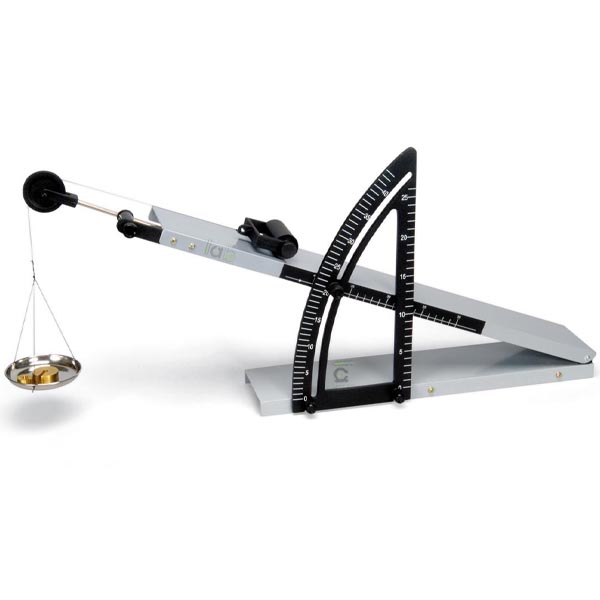
Product Code : EL-AM-10327
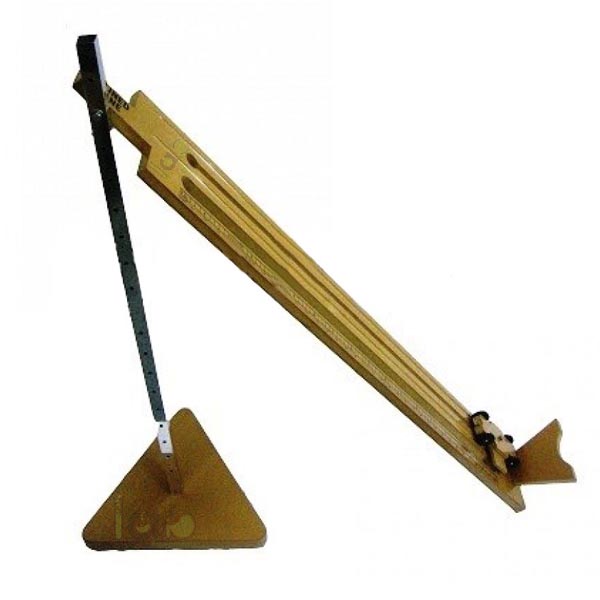
This deluxe inclined plane is a wooden slope with a pulley and a trolley. Its angle is adjustable and is set against a graduated cast aluminium arc. Classes use it as a simple machine, to measure the effort, the mechanical advantage and the friction when the trolley is hauled up a slope.
Specifications of the deluxe inclined plane
| Component | Specification |
|---|---|
| Plane | Wood |
| Pulley | Frictionless, for the load cord |
| Angle | Adjustable, set against a graduated cast aluminium arc |
| Supplied with | Trolley |
| House code | EL-AM-10327 |
| Manufacturer | Lab Exports, Delhi |
Simple machine practicals with the deluxe inclined plane
The trolley is the load, of weight W. A cord from the trolley runs over the pulley to a hanging pan, and the weight of the pan with its contents is the effort P. Let l be the length of the slope and h the height of its raised end above the lower end. Then sin θ = h/l, where θ is the angle read on the arc.
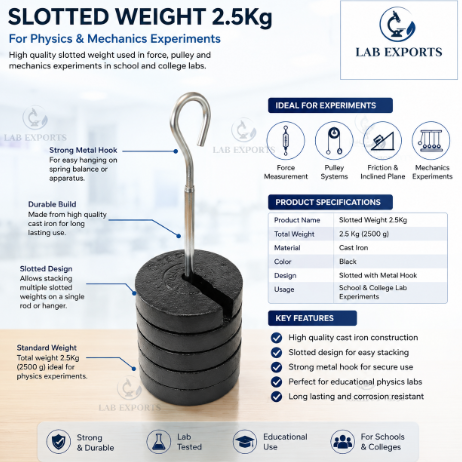
- Actual mechanical advantage. Find W by hanging the trolley from an ESAL spring balance. Choose an angle on the arc, then put masses from a brass mass set into a brass scale pan on the cord. Stop adding them when a gentle start keeps the trolley climbing slowly and steadily. The actual mechanical advantage is W/P.
- Ideal mechanical advantage, velocity ratio and efficiency. Measure l and h with a metre scale. The ideal mechanical advantage is l/h, which equals 1/sin θ. The velocity ratio is also l/h, because the effort moves a distance l while the load rises through h. Efficiency is the actual mechanical advantage divided by the velocity ratio, usually given as a percentage.
- Friction on the slope. At one angle, find the effort P1 for a slow, steady climb and the effort P2 for a slow, steady descent. Friction opposes the motion each time. So the friction force is (P1 - P2)/2, and the down-slope pull W sin θ is (P1 + P2)/2.
- Effect of the angle. Repeat the first two tasks at several settings of the arc. The mechanical advantage falls as the plane is raised, and the gap between the actual and ideal values shows how much of the effort friction takes.
Frequently Asked Questions
What is the mechanical advantage of an inclined plane?
It is the load divided by the effort needed to move it along the slope. For a slope without friction this ideal value is l/h, the slope length over the height, or 1/sin θ. On this plane the load is the trolley and the effort is the hanging weight on the cord.
How can the mechanical advantage be increased?
Lower the angle on the arc. A gentler slope is longer for the same rise, so l/h and the ideal mechanical advantage go up. The actual value also improves when friction falls, so keep the trolley wheels clean and the pulley turning freely.
Why is the measured mechanical advantage less than the ideal value?
Friction takes part of the effort. Some of the pull goes to overcoming friction in the pulley and the trolley wheels, so more effort is needed than W sin θ. The ratio of actual to ideal mechanical advantage is the efficiency, which stays below one on a real plane.
Does an inclined plane reduce the work needed to raise a load?
No. It reduces the force, not the work. The effort acts over the full slope length l instead of the height h, so force times distance is still at least W × h. With friction, the work put in is more than the work done in lifting the trolley.
Should the slope length or the base length be used for the ideal mechanical advantage?
Use the length measured along the sloping surface, divided by the vertical height of the raised end. The horizontal base length is not used. Taking the floor distance by mistake gives a smaller ratio than the true value.
Other apparatus for simple machine practicals
More apparatus is in the Applied Mechanics section of the Physics Lab range.
To enquire, email [email protected] with the house code EL-AM-10327 and the quantity, or use the Add To Cart button on this page.
Last updated: 19 November 2026