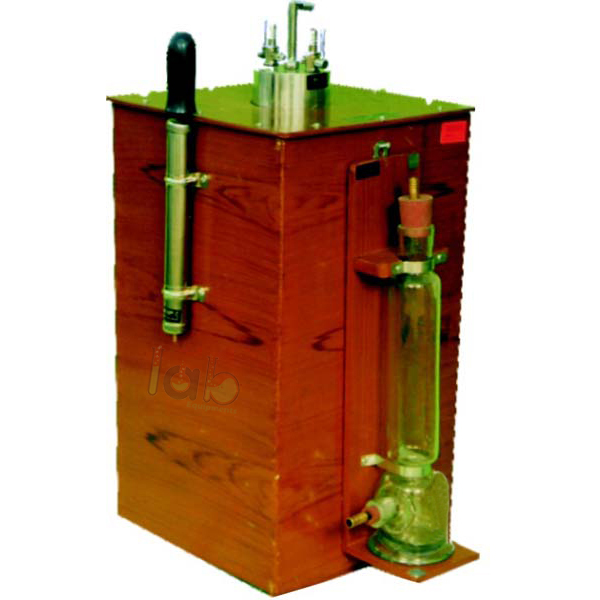
Wave Motion Apparatus – Waves & Sound Kits
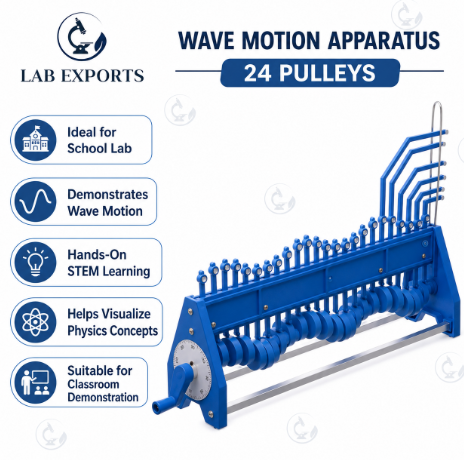
Product Code : SCL-H-11135
This wave kit lends itself to lessons on phase. With the kit running, students pick out elements that move exactly in step and elements that move in opposite directions, then link what they see to wavelength, amplitude and frequency. The same ideas lead on to interference and beats in sound.
Specifications of the wave motion kit
| Component | Specification |
|---|---|
| Pack format | Single educational wave demonstration kit |
| Primary application | Demonstration of mechanical wave motion and propagation |
| Learning concepts | Transverse and longitudinal waves, amplitude, wavelength, frequency, phase and particle displacement |
| Longitudinal motion | Can be discussed where the supplied configuration permits |
| Excitation mechanism and accessories | Depend on the supplied configuration; the kit list is available from [email protected] |
| House code | SCL-H-11135 |
| Manufacturer | Lab Exports, Delhi |
Phase and wavelength work with the wave kit
Two elements one wavelength apart are in phase: they move the same way at every moment. Elements half a wavelength apart are in antiphase and always move in opposite directions.
- Finding points in phase. Run a continuous wave slowly. Ask students to point to pairs of elements that move together and pairs that move against each other. On a sketch of the pattern, mark one wavelength between an in-phase pair and the amplitude of one element.
- Timing one element. Where the kit runs a steady continuous wave, follow a single element and count its complete oscillations over a measured time with an Analog Stop Clock. The count divided by the time gives the frequency f, and 1/f gives the period.
- Hearing phase with a tuning fork. Strike a fork from a tuning fork set and turn it slowly beside the ear. At some angles the sound fades, because waves from the two prongs meet out of phase there. This is the in-phase and antiphase idea again, now heard as interference.
Frequently Asked Questions
What should be checked before buying a wave motion apparatus?
Check which ideas the class needs and how clearly the apparatus shows them. Useful points are the number of moving elements, a base that stands up to frequent handling, and whether both transverse and longitudinal motion can be shown. The kit list and drive for this kit are available from [email protected].
Does a wave motion apparatus need electricity to run?
Not always. Many wave machines are turned by hand with a crank and need no power supply, while others are driven by a motor. On this kit the excitation mechanism depends on the supplied configuration, so ask for the kit list when you enquire.
How is a phase difference written in radians?
One whole wavelength corresponds to a phase difference of 2π radians. So elements half a wavelength apart differ in phase by π radians and move in opposite directions, and elements a quarter of a wavelength apart differ by π/2 radians.
Which wave property stays the same when a wave passes into a new medium?
The frequency stays the same, because it is set by the source. The speed and wavelength change together so that v = f × λ still holds. Here v is the wave speed, f the frequency and λ the wavelength.
Which type of wave can travel through solids, liquids and gases?
Longitudinal waves, such as sound, can travel through all three, because solids, liquids and gases all resist being compressed. Transverse mechanical waves need a medium that resists sideways shearing, so they cannot pass through the body of a liquid or a gas.
More apparatus for oscillation and wave practicals
More apparatus is in the Heat section of the Physics Lab range.
To enquire, email [email protected] with the house code SCL-H-11135 and the quantity, or use the Add To Cart button on this page. Tender buyers can also see the Tenders and OEM page.
Last updated: 24 November 2026