Turbojet Engine Model
Product Code : SCL-H-11186
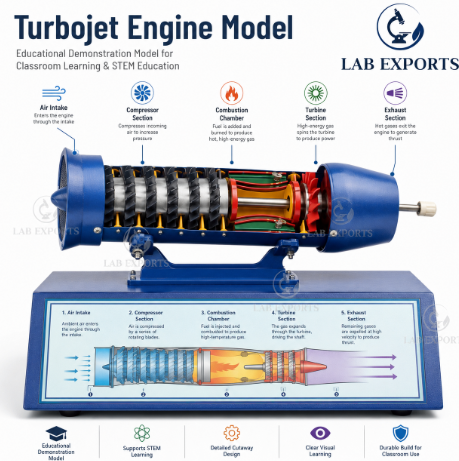
This turbojet engine model is a cutaway that opens up the inside of a jet engine. Turning the hand crank spins the compressor and turbine together on one central shaft, while colour-coded zones mark the low-pressure intake and the hot combustion area. Rotor blades, stator vanes and fuel injection nozzles are all in view.
Specifications of the turbojet engine model
| Component | Specification |
|---|---|
| Model type | Functional cross-sectional cutaway model |
| Materials | Cast aluminium alloy and engineering-grade polymers |
| Operation | Manual hand crank with a detachable handle, mechanical simulation |
| Base | Non-slip metal support stand |
| Visible parts | Rotor blades, stator vanes, fuel injection nozzles, central shaft |
| Flow path | Colour-coded zones from intake to exhaust |
| Supplied with | Educational manual with labelled parts diagrams and experiment outlines |
| House code | SCL-H-11186 |
| Manufacturer | Lab Exports, Delhi |
Lessons with the turbojet cutaway
A turbojet works on the Brayton cycle: the air is compressed, fuel burns at nearly constant pressure, and the hot gas expands through the turbine and out of the nozzle. The model is turned slowly by hand, so each stage can be stopped and examined.
- One flow path, zone by zone. Follow the colour-coded zones with the class from intake to exhaust. At each zone, ask what happens to the pressure and temperature of the air. Use the labelled parts diagrams in the manual to name the parts in each zone.
- Rotors and stators. Turn the crank and watch the rotor blades turn while the stator vanes stay still. Each rotor row pushes the air on, and each stator row turns it into the next row, so the pressure rises step by step.
- Turbine and jet. The turbine takes energy from the hot gas, much as the wheel of a Water Turbine Model takes energy from moving water. The gas leaving the nozzle gives thrust by reaction. Engineering students can measure the force of a jet on a surface with the Impact Of Jet On Vanes Apparatus.
Documentation and supply
An educational manual with labelled parts diagrams is supplied with the model. Most Lab Exports products carry a one-year manufacturer warranty.
Lab Exports manufactures the Turbojet Engine Model at its works in Laxmi Nagar, Delhi, and supplies it to schools, colleges and technical institutes in India and 60+ countries, handling the export documents for each shipment. More about the company is on the About Lab Exports page.
Frequently Asked Questions
Should a teaching lab choose a hand-cranked or a motorised turbojet cutaway?
Either can work, so match the model to the lesson. A motorised unit keeps the stages turning on its own, while a hand-cranked cutaway is simpler to look after and lets the teacher stop at any stage. This model is turned by a detachable hand crank.
Can a turbojet cutaway model be used to measure thrust?
No. This model is a mechanical simulation turned by hand, with no combustion and no pressurised parts, so it makes no real thrust. It is a visual teaching aid that shows where thrust comes from. Thrust is measured on a running engine fitted to a test rig.
Do the compressor and turbine rotate at the same speed?
Yes, in a single-shaft turbojet they do, because one rigid shaft joins them. On this model the hand crank turns the central shaft, so the compressor and turbine stages always turn together. Larger engines may use two or three shafts running at different speeds.
What are the five stages of a turbojet engine?
They are intake, compression, combustion, turbine and exhaust. Air enters and the compressor raises its pressure. Fuel burns in the combustion chamber, the turbine takes out enough energy to drive the compressor, and the remaining hot gas leaves the nozzle at high speed.
How does a compressor work in a jet engine?
An axial compressor has rows of rotating blades with fixed stator vanes between them. Each rotor row speeds the air up, and the stator row behind it slows the air and turns it, which raises its pressure. Many such stages together give a large rise in pressure.
Other engine models for heat-engine lessons
More apparatus is in the Heat section of the Physics Lab range.
To enquire, email [email protected] with the house code SCL-H-11186 and the quantity, or use the Add To Cart button on this page.
Last updated: 24 November 2026