Steam Engine Model
Product Code : SCL-H-11271
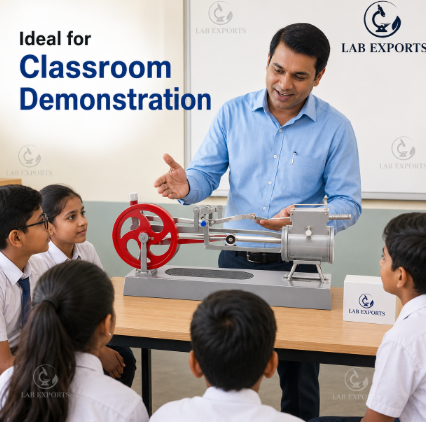
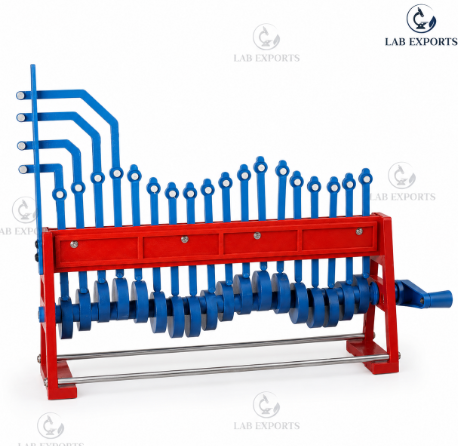
The model represents the principal moving mechanism associated with a reciprocating steam engine. Its piston mechanism, connecting linkage and flywheel arrangement allow learners to observe how linear movement can produce continuous rotary motion.
The apparatus is intended for supervised physics and mechanical-science demonstrations. The operating method, cylinder arrangement, construction materials, dimensions and compatibility with compressed air or steam have not been supplied and must be confirmed before the model is operated with any external pressure source.
Key Features
Visible motion transfer: Demonstrates the conversion of reciprocating piston movement into flywheel rotation.
Heat-engine learning aid: Supports introductory lessons on steam engines, thermal energy and mechanical work.
Classroom demonstration format: Allows groups of students to observe coordinated mechanical movement.
Hands-on instruction: The mechanism may be examined manually when the apparatus is disconnected from any operating source.
Reusable teaching model: Suitable for repeated lessons when handled within the confirmed operating limits.
Cross-disciplinary value: Connects concepts from physics, mechanics, energy conversion and engineering.
Specification-controlled supply: The required operating configuration can be confirmed before procurement.
Technical Specifications
|
Specification |
Detail |
|
Product Name |
Steam Engine Model |
|
Brand |
Lab Exports |
|
Product Category |
Physics Laboratory Equipment – Heat and Thermal Energy |
|
Unit Capacity |
One classroom demonstration model |
|
Demonstrated Motion |
Reciprocating motion converted into rotary motion |
What's Included in the Kit
1 × Steam Engine Model
A boiler, burner, pressure source, tubing, tools and instruction manual are not confirmed as included. Verify the complete supply scope before ordering.
Applications / Uses
Demonstrating the basic working principle of a reciprocating steam engine.
Observing piston, connecting-rod, crank and flywheel movement.
Explaining the conversion of thermal energy into mechanical work.
Comparing linear and rotary mechanical motion.
Introducing heat engines during physics lessons.
Supporting STEM exhibitions and engineering demonstrations.
Discussing historical developments in power-generation machinery.
How to Use the Steam Engine Model
Place the model on a stable, level laboratory bench.
Identify the piston mechanism, connecting linkage, crank and flywheel.
Check that all moving components are secure and unobstructed.
Rotate the flywheel slowly by hand to observe the mechanical sequence.
Ask students to track the piston movement as the flywheel completes one revolution.
Explain how pressure acting on a piston can create reciprocating movement.
Connect an operating source only when its type and permitted pressure have been verified.
Disconnect the operating source before touching or adjusting the mechanism.
Safety note: Do not apply live steam, compressed air, heat or flame unless the model is specifically rated for that operating method. Keep hands, clothing and loose objects away from moving parts.
Care & Maintenance
Remove dust with a soft, dry cloth after each demonstration.
Store the model in a dry cabinet away from moisture and corrosive chemicals.
Inspect joints, fasteners and moving components before operation.
Apply lubricant only where recommended in the supplied instructions.
Why Choose Lab Exports?
Lab Exports manufactures, supplies and exports scientific laboratory instruments and educational apparatus for institutional use. Its range includes physics equipment, experiment setups, science kits, mathematics kits, didactic models and STEM resources. Buyers can confirm the required operating method, construction and accessories before ordering to ensure that the supplied model matches the intended demonstration. As a trusted science model kit school project supplier, Lab Exports serves schools, colleges and laboratories worldwide — including institutions in Chad (Central Africa), Maldives (South Asia) and Chile (South America).
Frequently Asked Questions
What is a Steam Engine Model used for?
A Steam Engine Model is used to demonstrate piston movement, crank action, flywheel rotation and the basic principle of converting pressure-driven motion into mechanical work.
Does this model produce real steam?
Steam generation is not confirmed from the supplied information. Do not connect a boiler or apply heat unless the approved specification states that the model is designed for live-steam operation.
Can the flywheel be rotated manually?
The mechanism may be observed by slowly rotating the flywheel by hand when the model is disconnected from any pressure or heat source.
Is the Steam Engine Model suitable for schools?
Yes. It is intended for supervised demonstrations in schools, colleges, technical institutes and STEM laboratories.
What concepts can students learn from the model?
Students can study reciprocating motion, rotary motion, mechanical linkages, flywheel action, heat engines and energy conversion.
Are a boiler and accessories included?
Only one Steam Engine Model is confirmed. A boiler, burner, tubing, pressure source and operating accessories must be confirmed separately.
Contact Lab Exports to verify the operating configuration, or browse the Heat Laboratory Equipment category within the complete Physics Laboratory Equipment range.

.jpg)