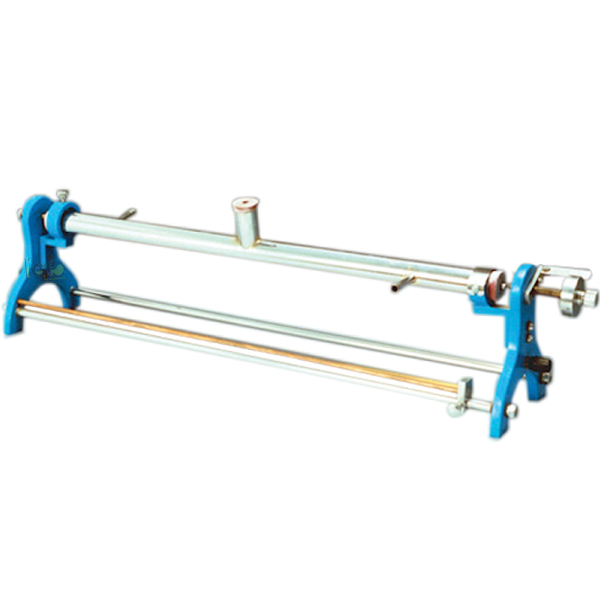
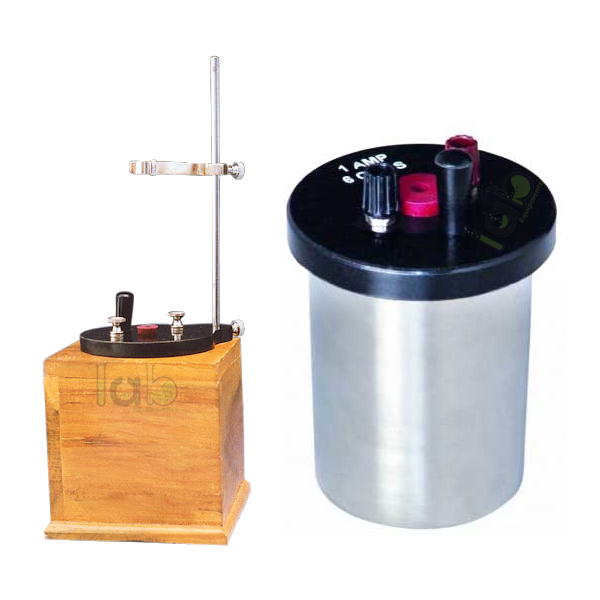
Clement and Desormes Apparatus
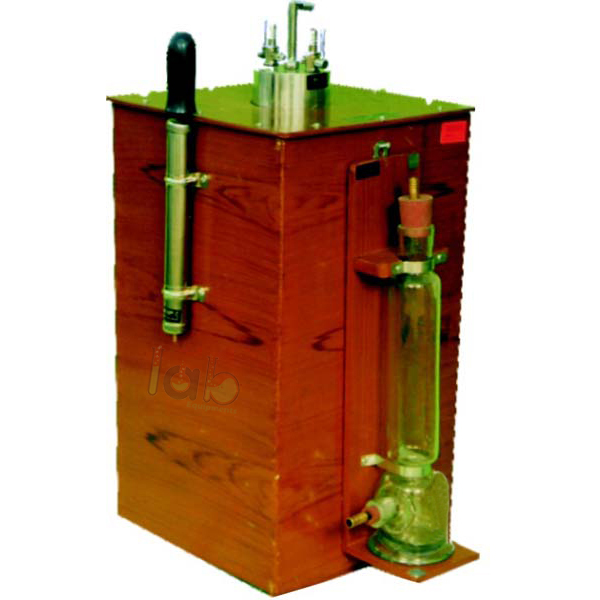
Product Code : EL-H-10405
The Clement and Desormes apparatus finds γ = Cp/Cv for a gas, usually air, where Cp and Cv are its specific heats at constant pressure and at constant volume. A 10 litre glass reagent bottle is closed by a leak-proof brass cap with a bent tube and two stopcocks. A football-type hand pump and a manometer on stand with scale are included.
Specifications of the Clement and Desormes apparatus
| Component | Specification |
|---|---|
| Vessel | Glass reagent bottle, 10 litre capacity |
| Cap | Brass, leak-proof, with bent tube |
| Stopcocks | Two: one for the pump connection, one for opening to air |
| Manometer | On stand, with scale (included) |
| Pump | Football-type hand pump (included) |
| Mercury | Not included |
| Supplied with | Installation instructions and a manual |
| House code | EL-H-10405 |
| Manufacturer | Lab Exports, Delhi |
Finding gamma for air by adiabatic expansion
The method compares two manometer readings. h1 is the excess pressure head after pumping, once the air is back at room temperature. h2 is the smaller excess head after a brief adiabatic expansion and slow warming at constant volume. For small pressure changes, γ = h1/(h1 - h2).
- Check that the brass cap is tight. Join the pump to the first stopcock and the manometer to the bent tube with Rubber Tubing.
- Pump air in and close the pump stopcock. Wait until the manometer reading is steady, then record h1. Timing equal waits on an Analog Stop Clock keeps the runs alike.
- Open the second stopcock to the air and close it again as soon as the manometer levels become equal.
- Wait for the air to regain room temperature and record the new steady reading h2.
- Repeat several times and average the values of γ.
For dry air the expected value is close to 1.40, as for any diatomic gas. Mercury is not supplied; if it is used in the manometer, fill and handle it under the laboratory's mercury safety rules.
Frequently Asked Questions
Why is a large 10 litre bottle used?
A large volume of air has little wall area for its size, so heat from the walls disturbs the quick expansion less. Readings are steadier and small pressure changes are easier to read. This apparatus uses a 10 litre glass reagent bottle with a leak-proof brass cap.
Which liquid should be used in the manometer?
A light liquid such as water gives a larger height difference for a small pressure change, so readings are easier to take. Mercury is not included. If it is used, follow the laboratory's mercury safety rules.
Why is the stopcock opened and closed quickly?
The expansion must be adiabatic, with no time for heat to flow in from the room. Close the stopcock as soon as the manometer levels become equal. Closing it late lets heat in and gives a value of γ that is too low.
Why is h2 smaller than h1?
When the stopcock opens, the pressure falls to atmospheric and the gas cools. After it closes, the gas warms at constant volume and its pressure rises, but only part of the way back, because some air has left the bottle.
Why do we wait before reading h1 and h2?
Pumping warms the air, so wait until it cools to room temperature before reading h1. After the expansion the air is cooler than the room, so wait again until it warms back and the reading is steady before recording h2.
Other apparatus for pressure measurement
More apparatus is in the Heat section of the Physics Lab range.
To enquire, email [email protected] with the house code EL-H-10405 and the quantity, or use the Add To Cart button on this page.
Last updated: 24 November 2026