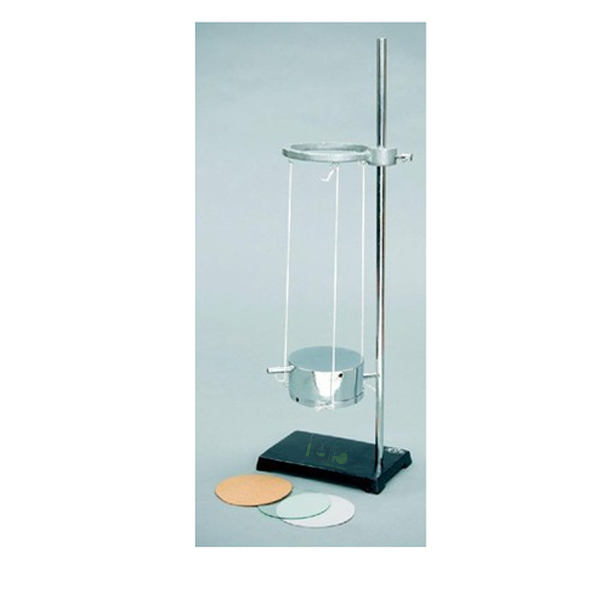
Searle's Thermal Conductivity Apparatus
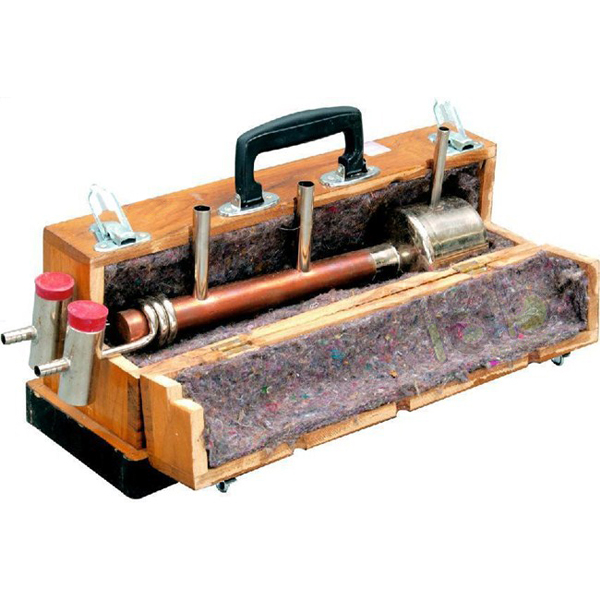
Product Code : EL-H-10399
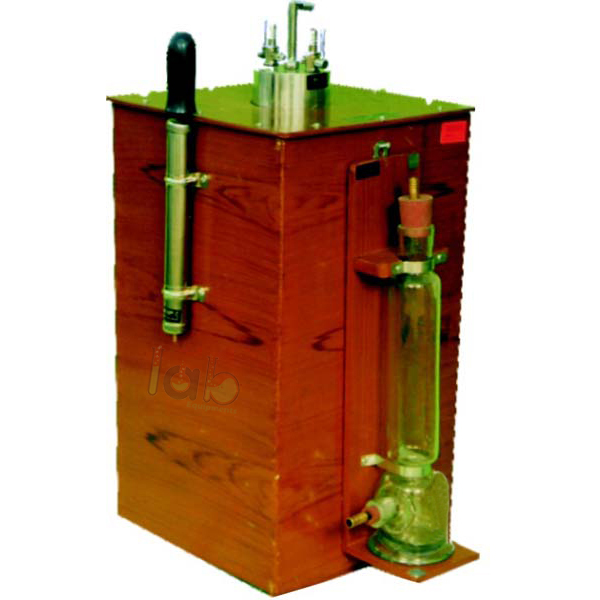
This apparatus finds the thermal conductivity of copper, a good conductor, by Searle's method, also called Searle's bar method. A 30 cm copper rod is heated by a steam jacket at one end and cooled by water in a spiral tube at the other. The rod sits in a felt-lined wooden case with a removable front.
Specifications of the Searle's conductivity apparatus
| Component | Specification |
|---|---|
| Rod | Copper, cylindrical, 30 cm (300 mm) long |
| Rod diameter | 3.7 cm, 2.5 cm or 1.8 cm (37 mm, 25 mm or 18 mm), to choose |
| Hot end | Steam jacket |
| Cold end | Water flowing through a spiral tube |
| Case | Wooden, lined with felt, with a removable front |
| Supplied without | Thermometers and steam boiler |
| Supplied with | Installation instructions and a manual |
| House code | EL-H-10399 |
| Manufacturer | Lab Exports, Delhi |
Measuring K of copper by the steady-state method
Heat flows along the copper rod from the steam end to the water end. Once no temperature changes, the heat conducted each second equals the heat carried off by the water. Then K = m c (T3 - T4) d / (A (T1 - T2) t).
Here T1 and T2 are the rod temperatures at two points a distance d apart, and T3 and T4 are the outlet and inlet water temperatures. The mass m of water flows out in time t, c is the specific heat of water, and A = πr2, where r is half the rod diameter.
- Fit thermometers at the two points on the rod and in the water inlet and outlet of the spiral tube.
- Join the steam jacket to a steam boiler, and feed cold water from a Constant Level Tank through Rubber Tubing so that the flow stays steady.
- Wait until all four thermometer readings stop changing, then record them.
- Collect the outflowing water for a time t measured on an Analog Stop Clock, and weigh it on a Physical Balance to find m.
- Measure the rod diameter with a Vernier Caliper IME Type, find A and calculate K.
As a check, change the water flow and wait for a new steady state. The water temperature rise changes, but the value of K should agree with the first run.
Frequently Asked Questions
Which copper rod diameter should be chosen?
The rod comes in 3.7 cm, 2.5 cm or 1.8 cm diameter, all 30 cm long. A thicker rod carries more heat, so the cooling water warms more and the readings are easier to take. A thinner rod carries less heat, so the rise in water temperature is smaller.
Why is the rod enclosed in a felt-lined case?
The felt cuts heat loss from the sides of the rod. Searle's method assumes that heat flows straight along the rod from the steam end to the water end, so side losses would give a low value of K.
What equipment is used with this apparatus to measure thermal conductivity?
Four thermometers and a steam boiler are needed, as neither is supplied. Add a steady cold water supply, a vessel to collect the outflow, a balance, a stop clock and a vernier caliper for the rod diameter.
How does Searle's method determine thermal conductivity?
It balances heat in and heat out at steady state. The heat carried off by the water each second, found from its flow and temperature rise, equals K times A times the temperature gradient along the rod. Dividing gives K.
Why is Searle's method not used for bad conductors?
Very little heat would flow along a poor conductor, so the cooling water would warm too little to measure and steady state would take very long. Side losses would also be large beside the heat conducted. Poor conductors are tested as thin discs instead.
Other thermal conductivity apparatus
More apparatus is in the Heat section of the Physics Lab range.
To enquire, email [email protected] with the house code EL-H-10399 and the quantity, or use the Add To Cart button on this page.
Last updated: 24 November 2026