Solar Water Heater Model
Product Code : SCL-H-11133
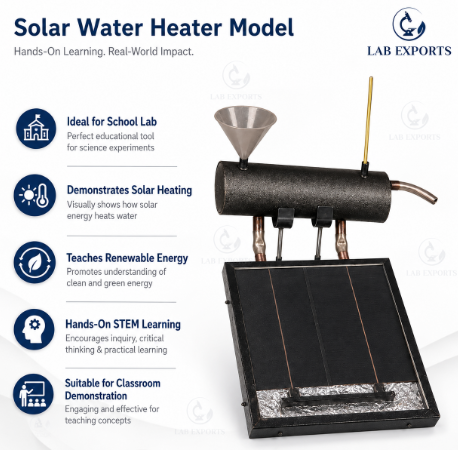
This single demonstration model shows how a solar collector turns radiation into heat and passes it to water. Students follow the heat from absorption at the collector, through conduction into the water, to the convection that moves the warmed water. It supports lessons on solar thermal energy and heat transfer.
Specifications of the solar water heater model
| Component | Specification |
|---|---|
| Pack format | Single educational demonstration model |
| Principle | Conversion of solar radiation into thermal energy for water heating |
| Learning concepts | Solar thermal energy, heat absorption, water heating, convection and heat transfer |
| Users | Schools, colleges, physics and STEM labs, environmental science programmes |
| Collector, container, tubing and dimensions | Confirmed on enquiry |
| House code | SCL-H-11133 |
| Manufacturer | Lab Exports, Delhi |
Following heat from collector to water
- Naming the three transfers. Point out where radiation is absorbed by the dark collector surface, where heat is conducted into the water in contact with it, and where the warmed water moves by convection.
- Warming of the water. Fill the model as its configuration directs and note the starting water temperature. Keep the collector exposed and read the temperature at regular intervals, keeping time with an Analog Stop Clock.
- Outdoor and indoor sources. Heat the water first in sunlight, then indoors under a suitable lamp. A Solar Irradiance Meter at the collector gives the light level in each case, to set beside the rate of warming.
Frequently Asked Questions
How does a solar water heater model work?
Sunlight is absorbed by a dark collector surface and conducted into the water touching it. The warmed water becomes less dense and rises towards the container, while cooler water sinks to replace it. This natural circulation is the thermosiphon effect.
Can the model be used indoors under a lamp?
Yes. It can be run in sunlight or under a suitable lamp, which helps on cloudy days and for indoor lessons. Record the starting water temperature, keep the collector exposed and compare how fast the water warms under each source.
Why is the storage tank placed higher than the collector?
Warm water is lighter and rises, so it flows up from the collector into a higher tank on its own. Cooler water from the bottom of the tank sinks back into the collector to be heated. No pump is needed for this circulation.
What happens to the circulation when the sun goes in?
Once the collector stops warming, the water in it is no longer lighter than the water in the tank, so the natural flow slows and stops. A tank placed above the collector also stops warm water draining back into a cool collector.
Other solar models and an irradiance meter
More apparatus is in the Heat section of the Physics Lab range.
To enquire, email [email protected] with the house code SCL-H-11133 and the quantity, or use the Add To Cart button on this page.
Last updated: 24 November 2026