Diesel Engine Model Four Stroke
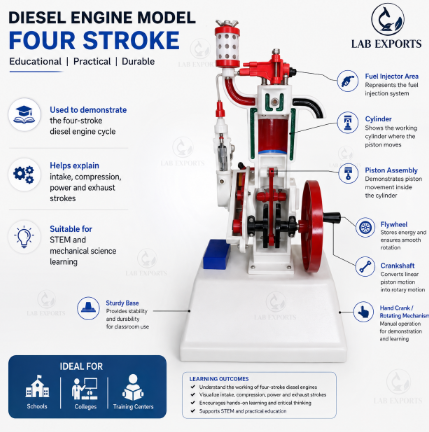
Product Code : SCL-H-11273
This four-stroke diesel engine model is a sectioned, hand-cranked teaching model of a compression-ignition engine. Turning the crank carries the piston, connecting rod, crankshaft, flywheel and inlet and exhaust valves through intake, compression, power and exhaust. It does not run on fuel, so the class can stop at any point and see what each part is doing.
Specifications of the four-stroke diesel engine model
| Component | Specification |
|---|---|
| Engine principle | Four-stroke compression-ignition (diesel) cycle |
| Construction | Sectioned (cut section) model on a mounted base |
| Operation | Manual, by hand crank |
| Cycle stages shown | Intake, compression, power and exhaust |
| Visible parts | Cylinder, piston, connecting rod, crankshaft, flywheel, inlet and exhaust valve mechanism |
| Fuel | None; a mechanical teaching model, not intended to run on fuel |
| Materials, dimensions and scale | For the current model, available from [email protected] |
| House code | SCL-H-11273 |
| Manufacturer | Lab Exports, Delhi |
Compression ignition shown on the sectioned model
A diesel engine gets the heat for ignition from compression, not from a spark. Only air enters on the intake stroke. Fuel is injected near the top of the compression stroke, into air that compression has made very hot, and it lights on its own.
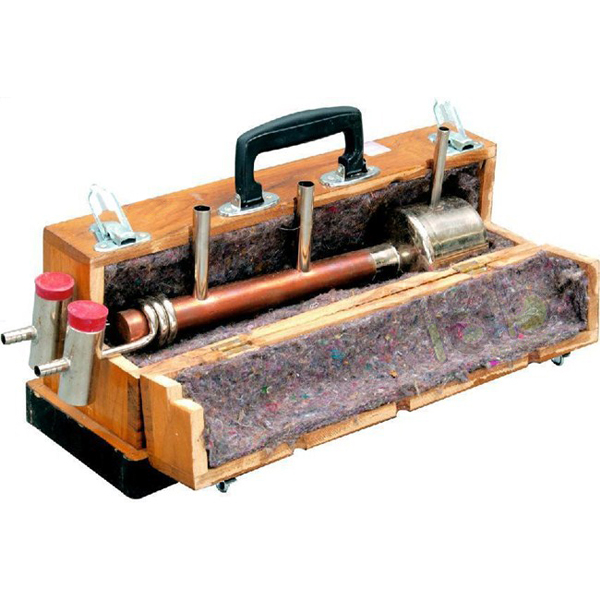
- Heating air by compression. Turn the crank slowly from the start of intake. Students note that the inlet valve is open while the piston moves down, and that both valves are shut while it rises again. In a running engine, that air is now trapped and squeezed. Work done on a gas raises its temperature, the same link between work and heat studied with the Joule's Mechanical Heat Experiment Apparatus.
- Sketching the valve timing. Stop the crank each time a valve begins to open and each time it closes. Mark the crank position on a circle drawn in the notebook. After two full turns, the marks form a simple valve timing diagram worked out from the model itself.
- Work on the compression stroke. Stop the crank halfway up the compression stroke. In a running engine with one cylinder, nothing else pushes the piston up here: the turning flywheel drives it against the trapped air. A diesel squeezes its air much harder than a petrol engine squeezes its mixture, so this stroke takes a lot of work. The flywheel gets that energy back on the power stroke. A flywheel with a larger moment of inertia loses less speed while doing this work. Moment of inertia is measured in practicals on the Fly Wheel.
Frequently Asked Questions
Which parts should be visible on a four-stroke diesel cut section model?
The piston, connecting rod, crankshaft, flywheel and both valves should be in view, with the cylinder opened up so the piston can be followed. On this model the sectioned design exposes the cylinder, piston assembly, valve mechanism and combustion region, and the hand crank moves them all together.
Can a valve timing diagram be taught with a hand-cranked diesel model?
Yes. Because the crank is turned by hand, the model can be stopped at the moment each valve opens or closes. Students note those crank positions over two turns and draw the diagram from what they saw. The movement is purely mechanical, since the model does not run on fuel.
What are the two main types of diesel engines?
By working cycle, diesel engines are two-stroke or four-stroke. A four-stroke engine, like this model, has one power stroke in every two turns of the crankshaft and separate intake and exhaust strokes. A two-stroke diesel fires on every turn and takes in air through ports in the cylinder wall.
Where are four-stroke diesel engines used?
They power trucks, buses, tractors, generator sets, pumps, earth-moving machines, and many ships and locomotives. Their high compression gives good fuel economy and strong pulling power at low speed, which suits heavy and steady work.
What are the advantages of a four-stroke engine over a two-stroke engine?
A four-stroke engine has separate strokes for taking in air and pushing out exhaust, so the cylinder is emptied and refilled more completely. It usually uses less fuel, runs cooler and wears more slowly. The trade-off is a heavier valve train and only one power stroke in two turns.
Other engine models to compare with this one
- Two Stroke Diesel Engine
- Petrol Engine Model Four Stroke
- Two Stroke Petrol Engine
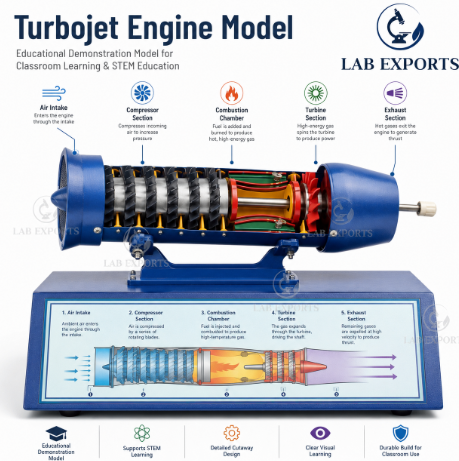
- Turbojet Engine Model
More apparatus is in the Heat section of the Physics Lab range.
To enquire, email [email protected] with the house code SCL-H-11273 and the quantity, or use the Add To Cart button on this page. Tender buyers can also see the Tenders and OEM page.
Last updated: 24 November 2026