Lee's And Charlton's Apparatus
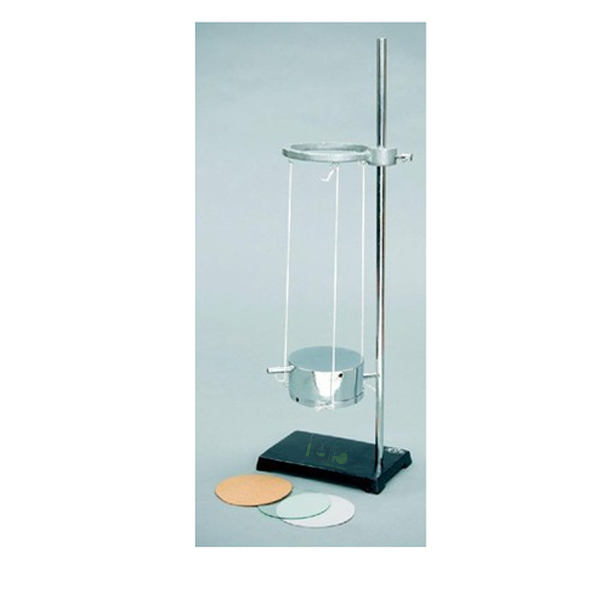
Product Code : EL-H-10400
This apparatus measures the thermal conductivity of thin layers of poor conductors such as card, glass or ebonite. The specimen sits between a brass steam chest and an 11 cm brass slab hung by three strings. Steady temperatures and the cooling rate of the slab give the conductivity K.
Specifications of the Lee's and Charlton's apparatus
| Component | Specification |
|---|---|
| Brass slab | Cylindrical, 11 cm (110 mm) diameter, 10.5 mm thick, with a radial thermometer hole |
| Suspension | Three strings from a stout annular ring |
| Steam chest | Brass hollow cylinder, 4.5 cm deep, same diameter as the slab, with inlet and outlet tubes |
| Stand | Heavy retort stand |
| Alternative slab | Iron cylindrical slab of the same size |
| Thermometers | Not included |
| House code | EL-H-10400 |
| Manufacturer | Lab Exports, Delhi |
Conductivity of a poor conductor by the disc method
The test has two stages. First the specimen disc lies between the steam chest and the slab until the chest temperature T1 and the slab temperature T2 are steady. Heat then passes through the specimen as fast as the slab loses it to the air.
Second, the slab alone is warmed a little above T2 and its cooling rate dT/dt at T2 is found. Neglecting edge losses, K = m c (dT/dt) x / (A (T1 - T2)). Here m is the mass of the slab, c the specific heat of brass, x the specimen thickness and A its face area.
- Measure the specimen thickness x with a Screw Gauge / Micrometer and its diameter with a Vernier Caliper IME Type. Weigh the slab on a Physical Balance.
- Hang the slab by its three strings from the annular ring on the retort stand and lay the specimen on it. Place the steam chest on top.
- Insert thermometers in the chest and the slab, and pass steam through the chest with Rubber Tubing. Record T1 and T2 once both are steady.
- Remove the specimen and warm the slab against the chest to about 10 °C above T2. Let it cool alone, reading its temperature every 30 seconds on an Analog Stop Clock.
- Plot the cooling curve, draw the tangent at T2 to find dT/dt, and calculate K.
Repeating the test with discs of card, glass and ebonite lets students compare how well each poor conductor passes heat.
Documentation and supply
Installation instructions and a manual are supplied with the apparatus. Most Lab Exports products carry a one-year manufacturer warranty.
Lab Exports manufactures the Lee's and Charlton's apparatus at its works in Laxmi Nagar, Delhi, and supplies it to colleges and universities in India and 60+ countries, handling the export documents for each shipment. More about the company is on the About Lab Exports page.
Frequently Asked Questions
What is a Lee's disc?
A Lee's disc is the metal slab on which the specimen rests and whose temperature is read. Here it is a brass slab 11 cm across and 10.5 mm thick, hung by three strings, with a radial hole for a thermometer. An iron slab of the same size is an option.
What comes with the apparatus and what must be added?
The set has the brass slab with its strings and annular ring, the brass steam chest with inlet and outlet tubes, and a heavy retort stand. Thermometers are not included. A steam supply, a stop clock, a balance and a screw gauge are also needed.
Why is the material taken in the form of a thin disc?
A thin disc with a large face lets enough heat cross a poor conductor to give a steady, measurable temperature difference, and steady state comes sooner. Its narrow rim also keeps heat loss from the edge of the specimen small.
Why is Lee's method not used for good conductors?
With a good conductor, the two faces of a thin disc would be at almost the same temperature. The difference T1 - T2 would be too small to read well, so K would carry a large error. The disc method is kept for bad conductors, and good conductors are tested as long rods.
More apparatus for thermal conductivity practicals
More apparatus is in the Heat section of the Physics Lab range.
To enquire, email [email protected] with the house code EL-H-10400 and the quantity, or use the Add To Cart button on this page.
Last updated: 24 November 2026