Two Stroke Petrol Engine
Product Code : SCL-H-11211
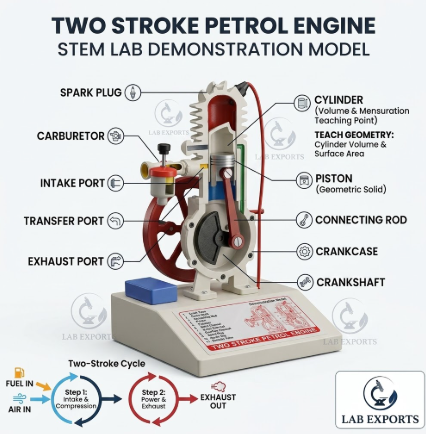
This two-stroke petrol engine model is a cutaway of a spark-ignition engine that fires once in every turn of the crankshaft. Turning the hand wheel moves the piston, connecting rod and crankshaft, so students can follow the charge from the carburettor into the crankcase and up through the transfer ports. A printed legend on the base names each part.
Specifications of the two-stroke petrol engine model
| Component | Specification |
|---|---|
| Model type | Cutaway (cross-sectional) teaching model |
| Materials | Cast metal alloy and durable industrial plastics |
| Operation | Mounted manual hand crank wheel |
| Visible parts | Piston, cylinder walls, transfer ports, spark plug, carburettor, crankcase, crankshaft |
| Labelling | Printed legend on the base naming each key component |
| Mounting | Stable base |
| Supplied with | User manual and experiment guide |
| House code | SCL-H-11211 |
| Manufacturer | Lab Exports, Delhi |
Classroom work with the petrol two-stroke cutaway
In this engine the crankcase is part of the gas path. Each stroke of the piston does two jobs at once, one above the piston and one below it.
- Tracing the charge. Name the parts from the legend, then turn the hand wheel slowly. Follow the fresh charge from the carburettor into the crankcase, up the transfer port into the cylinder, and out of the exhaust port as burnt gas.
- Above and below the piston. On the upstroke, the charge above the piston is compressed while a new charge is drawn into the crankcase. On the downstroke, the burning charge drives the piston down while the crankcase charge is squeezed ready for transfer. Students record both jobs for each stroke in a two-row table.
- Spark or hot air. Compare the spark plug here with the Two Stroke Diesel Engine model, where hot compressed air sets the fuel alight. Then look at the Petrol Engine Model Four Stroke: in a four-stroke engine the fresh charge enters through a valve and does not pass through the crankcase.
Frequently Asked Questions
Is a hand-cranked model or a running two-stroke engine better for a school lab?
A hand-cranked cutaway suits a school lab better. A running engine burns petrol, which brings a fire risk indoors, and its parts move far too fast to follow. With this model the hand wheel sets the pace, so students can stop at any point of the cycle.
Why do clear port markings matter on a two-stroke engine model?
A two-stroke engine controls its gas flow with ports in the cylinder wall, not valves. The cycle only makes sense if students can see which port the piston is covering. On this model the transfer ports are visible in the cutaway, and a printed legend on the base names each component.
How does a two-stroke petrol engine work?
It completes intake, compression, power and exhaust in one crankshaft revolution. The upstroke compresses the charge above the piston and draws a fresh charge into the crankcase. A spark ignites the charge near the top, and on the downstroke the exhaust port opens first, then the transfer port lets the new charge in.
Why is oil mixed with the fuel in a two-stroke petrol engine?
Because the fresh charge passes through the crankcase, the crankcase cannot hold a bath of oil as in a four-stroke engine. Oil is mixed into the petrol instead and lubricates the bearings and cylinder as the charge flows through. Some of this oil burns, which adds to the oil these engines use.
Where are two-stroke petrol engines used?
Mainly where a light, simple engine is wanted, such as small motorcycles, chainsaws and portable generators. A power stroke in every revolution gives a lot of power for the weight. Against this, they use more fuel and oil than four-stroke engines.
Engine models for side-by-side lessons
More apparatus is in the Heat section of the Physics Lab range.
To enquire, email [email protected] with the house code SCL-H-11211 and the quantity, or use the Add To Cart button on this page.
Last updated: 24 November 2026