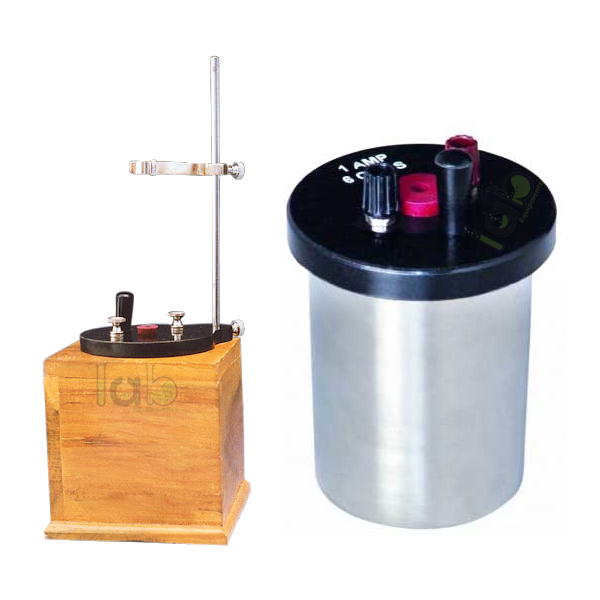
Joule's Calorimeter
Product Code : EL-H-10401
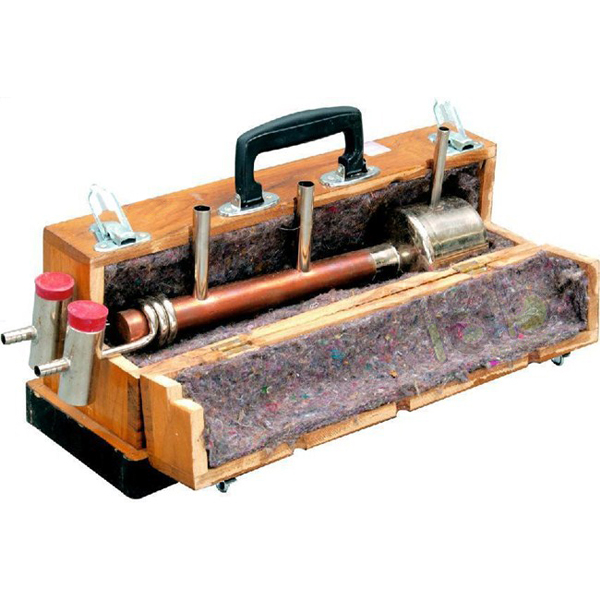
This calorimeter is used to study the heating effect of an electric current and to verify Joule's law of heating. A coil of wire joined to two terminals sits inside a 5 × 7.5 cm copper calorimeter. The calorimeter stands in a well-polished wooden outer vessel with a bakelite top.
Specifications of the Joule's calorimeter
| Component | Specification |
|---|---|
| Calorimeter | Copper, 5 × 7.5 cm |
| Heating circuit | Coil of wire connected to two terminals |
| Outer vessel | Well-polished wood |
| Top | Bakelite, with holes for a thermometer and a stirrer |
| Options | Customised calorimeter size; version without the wooden outer vessel |
| Supplied with | Installation instructions and a manual |
| House code | EL-H-10401 |
| Manufacturer | Lab Exports, Delhi |
Experiments on the heating effect of current
A current I through a resistance R for a time t produces heat H = I2Rt, which equals VIt, where V is the potential difference across the coil. The coil warms a weighed mass of water in the copper calorimeter, and the temperature rise shows how much heat was produced.
Wire the circuit before each experiment. Join the terminals to an IC Regulated Power Supply or a Battery Eliminator. Put an Ammeter in series, with a Rheostat Nichrome Wire Groove Type and a One Way Plug Key. Connect a Voltmeter across the coil. Weigh the calorimeter empty and with water on a Physical Balance.
- Heat and current. Pass different steady currents for the same time, timed on an Analog Stop Clock, starting each run with the same mass of fresh water. For small temperature rises, the rise divided by I2 should stay nearly the same.
- Heat and time. Keep the current fixed and note the temperature at equal time intervals while stirring. While the rise is small, it grows roughly in step with the time the current flows.
- Electrical equivalent of heat. Let m1 and c1 be the mass and specific heat of the water, and m2 and c2 those of the copper calorimeter. The starting and final temperatures are T1 and T2. The heat taken in is then (m1c1 + m2c2)(T2 - T1). Dividing VIt in joules by this heat in calories gives a value close to 4.2 J per calorie.
Frequently Asked Questions
What else is needed to use the Joule's calorimeter?
The circuit needs a steady DC supply, an ammeter in series, a voltmeter across the coil, a rheostat and a plug key. A thermometer and a stirrer pass through the holes in the bakelite top, and a balance and a stop clock are used for the readings.
Which calorimeter sizes are available?
The standard copper calorimeter is 5 × 7.5 cm. A customised calorimeter size can be made, and a version without the wooden outer vessel is also offered. Give the size you need with the enquiry.
Why is the calorimeter placed in a wooden box?
The wooden outer vessel reduces heat exchange between the calorimeter and the room. Less heat escapes while the current flows, so the temperature rise gives a truer measure of the heat produced by the coil.
Why do we stir the water during heating?
Stirring spreads the heat from the coil through all the water, so the thermometer reads the true average temperature. Without it, warm water gathers near the coil and the reading depends on where the thermometer bulb sits.
Why is a rheostat used in the circuit?
The rheostat sets the current for each run and lets you hold it steady while the clock runs. The heat produced depends on the square of the current, so even a small drift in current spoils the comparison between runs.
Other apparatus for heat measurement practicals
- Copper Calorimeter
- Joule's Mechanical Heat Experiment Apparatus
- Callendar and Barne's Apparatus (Continuous Flow)
More apparatus is in the Heat section of the Physics Lab range.
To enquire, email [email protected] with the house code EL-H-10401 and the quantity, or use the Add To Cart button on this page. Tender buyers can also see the Tenders and OEM page.
Last updated: 24 November 2026