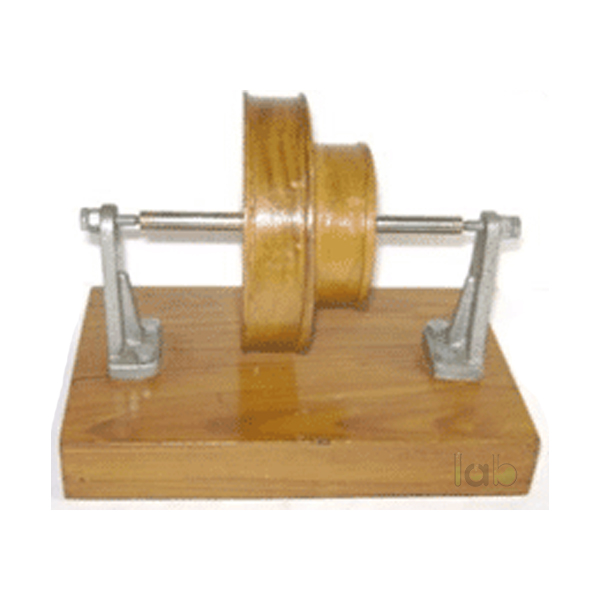
Wheel And Axle, On Stand
Product Code : EL-AM-10334
This wheel and axle on stand is a simple machine for finding mechanical advantage, velocity ratio and efficiency. Two grooved, polished wooden wheels of 7.5 cm and 12 cm diameter are fixed rigidly together. They turn on steel centres on a wooden base. Cord and hooks are supplied, but weights are not included.
Specifications of the wheel and axle
| Component | Specification |
|---|---|
| Wheels | Two polished wooden wheels with grooved rims, 7.5 cm and 12 cm diameter |
| Arrangement | Wheels fixed rigidly together, so both turn as one |
| Mounting | Steel centres on a wooden base |
| Supplied with | Cord and hooks |
| Weights | Not included |
| Ideal mechanical advantage | 1.6, the ratio of the wheel diameters (12/7.5) |
| House code | EL-AM-10334 |
| Manufacturer | Lab Exports, Delhi |
Experiments with the wheel and axle
The effort hangs from a cord wound on the 12 cm wheel. The load hangs from a second cord, wound the opposite way on the 7.5 cm wheel. Both wheels turn together, so when the effort falls the load rises. Taking moments about the axis at balance, effort × R = load × r, where R and r are the radii of the larger and smaller wheel. The ideal mechanical advantage is therefore R/r = 1.6.
- Mechanical advantage and efficiency. Hang the load on the small wheel with a slotted mass hanger. Add masses to the effort hook until the load rises slowly at a steady speed, or pull the effort cord with a spring balance and read the effort directly. Actual mechanical advantage = load/effort, and efficiency = (mechanical advantage/velocity ratio) × 100 percent.
- Velocity ratio. Mark both cords, turn the wheels through a few full turns, and measure how far the effort and the load each move. Their ratio is the velocity ratio. It equals the ratio of the circumferences, 2πR/2πr, so it also comes out at 1.6.
- Effort against load graph. Repeat with several loads and plot effort against load. The line does not pass through the origin. Its intercept is the effort lost in friction at the steel centres, and the efficiency rises as the load grows.
Documentation and supply
Installation instructions and a manual are supplied with the apparatus. Most Lab Exports products carry a one-year manufacturer warranty.
Lab Exports manufactures the wheel and axle at its works in Laxmi Nagar, Delhi, and supplies it to schools, colleges and universities in India and 60+ countries, handling the export documents for each shipment. More about the company is on the About Lab Exports page.
Frequently Asked Questions
Does a wheel and axle multiply force or speed?
It can do either. With the effort on the 12 cm wheel and the load on the 7.5 cm wheel, it multiplies force, so a small effort lifts a larger load. Used the other way round, it gives the load more speed and distance but needs a larger effort.
How is a wheel and axle different from a lever?
It is a lever that can keep turning. The common axis acts as the fulcrum, and the two radii are the effort arm and the load arm. A lever only moves through a short arc, but the wheel and axle can turn many times and lift a load a long way.
Why does the measured mechanical advantage fall short of 1.6?
Friction at the steel centres and the stiffness of the cord use up part of the effort. The velocity ratio stays at 1.6 because it depends only on the wheel sizes. So the actual mechanical advantage, and with it the efficiency, is always a little lower.
How can the mechanical advantage of a wheel and axle be increased?
Use a larger wheel or a smaller axle, since the ideal value is the ratio of their radii. On this apparatus the wheels are fixed at 12 cm and 7.5 cm. Keeping the steel centres clean and the cords seated in the grooves brings the measured value closer to 1.6.
Are weights supplied with the wheel and axle?
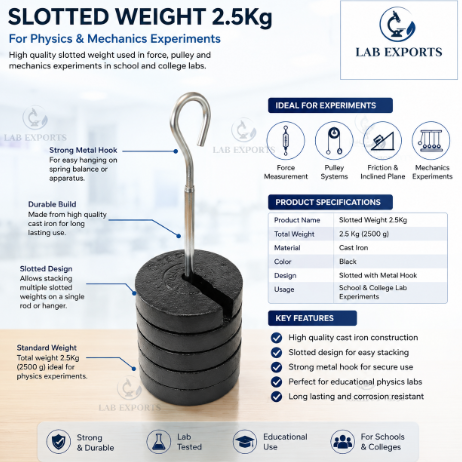
No. Cord and hooks come with it, but weights are not included. For the experiment you also need slotted masses on a hanger for the load and the effort, or a spring balance to measure the effort.
Other apparatus for moments and simple machine practicals
More apparatus is in the Applied Mechanics section of the Physics Lab range.
To enquire, email [email protected] with the house code EL-AM-10334 and the quantity, or use the Add To Cart button on this page. Tender buyers can also see the Tenders and OEM page.
Last updated: 19 November 2026