LED Characteristics Apparatus
Product Code : SCL-EAE-11171
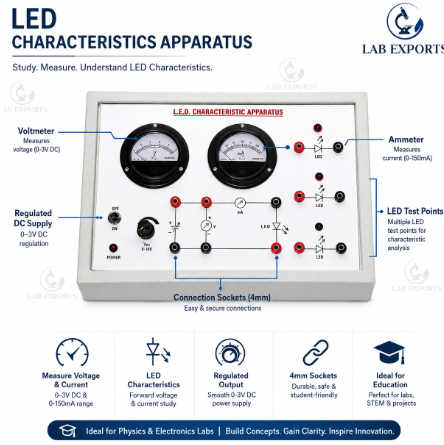
This apparatus is used to study how the current through a light-emitting diode changes as the forward voltage rises. It has five selectable LEDs, red, amber, green, blue and white, with a built-in regulated 0 to 5 V DC supply and built-in meters. Students plot the V-I curve and find the knee voltage at which each LED starts to conduct and glow.
Specifications of the LED characteristics apparatus
| Component | Specification |
|---|---|
| Principle | Voltage-current characteristics of a light-emitting diode |
| Bias studied | Forward bias |
| Measured quantities | Voltage and current |
| Concepts covered | LED behaviour, forward bias, semiconductor characteristics, V-I curve |
| LEDs | Five, selectable: red, amber, green, blue and white |
| DC supply | Built in, regulated, 0 to 5 V |
| Meters | Built in: 0 to 20 mA ammeter, and 0 to 5 V voltmeter across the selected LED |
| Series resistor | 330 Ω in each LED path, keeping the current below about 15.2 mA even with a shorted LED |
| House code | SCL-EAE-11171 |
| Manufacturer | Lab Exports, Delhi |
Taking the forward V-I curve of an LED
An LED is a PN junction diode that gives out light when electrons and holes recombine at the junction. In forward bias it passes almost no current until the voltage reaches its knee value. Above that, the current rises steeply and the LED glows.
- Select one LED in forward bias and turn the built-in supply down to zero. Its own 330 Ω series resistor limits the current.
- The voltmeter reads across the selected LED and the 0 to 20 mA ammeter reads the current through it. A Digital Multimeter across the LED gives a check on the voltmeter.
- Raise the voltage from zero step by step, recording the voltage and current each time. Note the reading at which the LED first glows.
- The supply goes no higher than 5 V, and the series resistor keeps the current within the range of the ammeter.
- Plot current against voltage and read off the knee voltage where the curve turns sharply upward. Quote the forward voltage at a stated forward current, so that the LEDs can be compared fairly.
- Repeat with each of the other four LEDs.
Repeating the readings with a PN Junction Diode Unit lets students compare the knee of an ordinary diode with that of the LED.
From the knee voltage to Planck's constant
The knee voltage links electronics to modern physics. The energy of each emitted photon is roughly eV, where e is the charge on an electron and V the knee voltage. Set eV equal to hc/λ, where c is the speed of light and λ the wavelength of the light. When the wavelength of the LED is known, this gives an estimate of Planck's constant h.
Frequently Asked Questions
What does an LED characteristics apparatus measure?
It measures the forward voltage across the LED and the current through it at each step. From these readings students plot the V-I curve and find the knee voltage, where the LED starts to conduct and give out light.
What else is needed to run the LED characteristics experiment?
Very little, because the main parts are built in. The unit has a regulated 0 to 5 V DC supply and a 330 Ω series resistor for each LED. It also has a 0 to 20 mA ammeter and a 0 to 5 V voltmeter. A digital multimeter is useful to cross-check readings, and graph paper is needed for the V-I curves.
How does an LED differ from an ordinary PN junction diode?
Both conduct in forward bias, but an LED gives out light when electrons and holes recombine at its junction. It is made from compound semiconductors such as gallium arsenide or gallium phosphide rather than silicon. Its knee voltage is usually higher than that of a silicon diode.
Why do LEDs of different colours have different forward voltages?
Because the colour depends on the band gap of the semiconductor. A wider band gap gives photons of higher energy and shorter wavelength, and it needs a higher forward voltage before current flows. So a blue LED switches on at a higher voltage than a red one. The red, amber, green and blue LEDs on this unit show the trend.
What happens if the polarity across an LED is reversed?
The LED is then in reverse bias. Almost no current flows and it stays dark. An LED can stand only a small reverse voltage, so a larger one may damage it. Keep the LED in forward bias for this experiment.
How can the anode and cathode of an LED be identified?
On a standard LED the longer lead is the anode and the shorter lead is the cathode. The cathode side often has a flat edge on the rim of the plastic case. If the leads have been cut, a multimeter on its diode test range shows which way the LED conducts.
Other semiconductor characteristics apparatus
- PN Junction Diode Characteristics Apparatus
- Zener Diode Apparatus
- Solar Cell Characteristics Apparatus
- Energy Band Gap Apparatus
More apparatus is in the Electrical and Electronics section of the Physics Lab range.
To enquire, email [email protected] with the house code SCL-EAE-11171 and the quantity, or use the Add To Cart button on this page. Tender buyers can also see the Tenders and OEM page.
Last updated: 23 November 2026