Solar Wind Dynamo Model
Product Code : SCL-EAE-11130
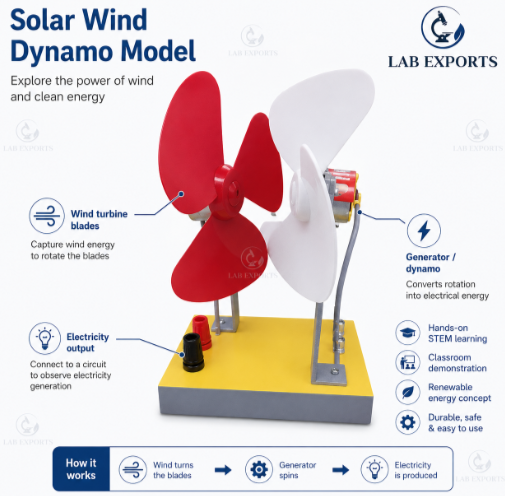
The Solar Wind Dynamo Model is a solar motor-generator demonstrator, a chain of energy conversions in one assembly. Light on its 3 V, 1 W photovoltaic panel produces electricity that runs a DC motor. The motor turns a dynamo through a mechanical coupling, and the output of the dynamo lights an LED. It supports lessons on renewable energy, motors, generators and conservation of energy.
Specifications of the solar wind dynamo model
| Component | Specification |
|---|---|
| Stage 1: light to electrical energy | Photovoltaic solar panel, nominal 3 V, 1 W, about 0.33 A at its maximum-power point |
| Stage 2: electrical to mechanical energy | DC electric motor |
| Coupling | Mechanical coupling from the motor to the dynamo; there is no fan or wind-turbine stage |
| Stage 3: mechanical to electrical energy | Dynamo (generator) stage |
| Stage 4: electrical energy to light | LED output |
| Construction | Single integrated model on a 250 × 150 mm base, overall height about 150 mm |
| House code | SCL-EAE-11130 |
| Manufacturer | Lab Exports, Delhi |
Classroom activities with the energy-chain model
Energy changes form four times along the model. Radiant energy becomes electrical in the solar cell and kinetic in the motor. The dynamo turns it back into electrical energy, and the LED gives it out as light. A motor turns because a current-carrying coil in a magnetic field feels a force. A dynamo works the other way round, since a coil turned in a magnetic field has an emf induced in it.
- Following the chain. Set the model on a clean, dry, stable surface and check the panel, motor, dynamo, LED and connections. Put the panel in bright sunlight or under a strong lamp. Whether the motor starts and the LED lights depends on the light level, the starting torque of the motor, losses in the coupling and the load on the dynamo. Students watch the motor start, the dynamo turn and the LED light, and name each energy transformation as it happens.
- Light on the panel. Shade part of the panel and note how the motor speed and LED brightness change. Read the light level at the panel with a solar irradiance meter each time, so that changes in output can be linked to changes in light. For a closer study of the cell itself, use the solar cell characteristics apparatus.
- Motor and dynamo on their own. Show the force on a current-carrying coil with an electric motor model, and induction in a turning coil with the Dynamo Model AC DC. Then point out the same two machines working together on this model.
Frequently Asked Questions
What energy transformation takes place in a solar cell?
Light energy is changed directly into electrical energy by the photovoltaic effect. Light falling on the junction in the cell frees electrons, and the junction drives them round the circuit as a current. On this model that current runs the DC motor.
Will a DC motor generate electricity?
Yes. Turn the shaft of a small DC motor by an outside force and its coil turns in a magnetic field. An emf is induced, so the motor gives out a current. A DC motor and a DC dynamo are built from the same kinds of parts: a coil, magnets and a commutator.
How efficiently does a solar panel turn sunlight into electricity?
Only part of the light that falls on a panel becomes electrical energy. The rest is reflected or warms the panel. On this model more energy is lost as heat, sound and friction in the motor and dynamo. So the LED gets only a small share of the light energy that reached the panel.
Other models of energy conversion
More apparatus is in the Electrical and Electronics section of the Physics Lab range.
To enquire, email [email protected] with the house code SCL-EAE-11130 and the quantity, or use the Add To Cart button on this page.
Last updated: 23 November 2026