Resistance Box 500 Ohms
Product Code : SCL-EAE-11175
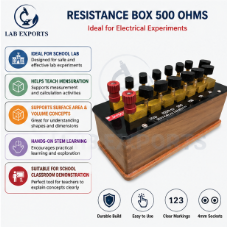
With known values up to 500 Ω, this resistance box covers many of the resistances met in school and college electricity practicals. Seven toggle-switched sections give 0 to 500 Ω in 10 Ω steps. Students switch in a chosen value to see its effect on current, voltage or bridge balance, and use it as the standard against which an unknown resistance is compared.
Specifications of the 500 ohm resistance box
| Component | Specification |
|---|---|
| Maximum resistance | 500 Ω |
| Selection | Seven labelled toggles, each bypassing one section |
| Sections | 10, 20, 20, 50, 100, 100 and 200 Ω |
| Range and step | 0 to 500 Ω in 10 Ω steps |
| Terminals | Two insulated 4 mm terminals |
| Function | Introducing known resistance values into electrical circuits |
| Used with | Ammeters, voltmeters, rheostats and bridge equipment |
| House code | SCL-EAE-11175 |
| Manufacturer | Lab Exports, Delhi |
Where the 500 ohm range is used
- Several resistors from one box. In an Ohm's law practical the box stands in for a fixed resistor. Connect it in series with an ammeter, with a voltmeter across it. For each setting, plot a V-I graph and compare its gradient with the value selected on the box.
- Known arm of a Wheatstone bridge. In a bridge built from resistance boxes, this box forms the known arm R, with a galvanometer across the bridge. P and Q are the ratio arms and S the unknown. At balance P/Q = R/S, so S follows from the three known values.
- Shunt in the half deflection method. To find the resistance G of a galvanometer, a high-value resistance box gives a high resistance R in series with the cell. This box is then joined across the galvanometer as the shunt S and set, in its 10 Ω steps, to bring the deflection to half. Then G = RS/(R - S).
Frequently Asked Questions
Which resistance range suits school circuit work?
Choose a box whose top value is above the highest resistance the practical needs. A range up to 500 Ω covers many of the resistances in school Ohm's law and bridge circuits. Higher ranges are kept for tasks such as the series resistance in galvanometer work. This box moves in 10 Ω steps, so work that needs 1 Ω steps calls for finer sections.
Can a 500 ohm box replace fixed resistors in an Ohm's law practical?
Yes. One box gives many known values, so a class can test several resistances without changing the meters or rewiring the circuit. Each value set on the box can then be compared with the gradient of its own V-I graph.
What does the slope of a V-I graph give?
The resistance, when V is plotted on the y-axis and I on the x-axis, since R = V/I. A straight line through the origin shows that the resistance stays constant, which is Ohm's law. If I is plotted against V instead, the slope is 1/R.
Why is it called the half deflection method?
Because the galvanometer resistance is found by halving its deflection. A shunt S is joined across the galvanometer and adjusted until the deflection drops to half its first value. The galvanometer resistance is then G = RS/(R - S), where R is the high resistance in series with the cell.
Rheostats and other adjustable resistances
More apparatus is in the Electrical and Electronics section of the Physics Lab range.
To enquire, email [email protected] with the house code SCL-EAE-11175 and the quantity, or use the Add To Cart button on this page. Tender buyers can also see the Tenders and OEM page.
Last updated: 23 November 2026