Rheostat 8” (100 ohm 1.6A)
Product Code : SCL-EAE-11189
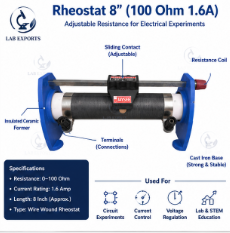
This 8 inch sliding rheostat has a maximum resistance of 100 Ω and carries up to 1.6 A. Oxidised nichrome wire is closely wound on a porcelain tube of 203.2 mm nominal length, and a spring-loaded phosphor bronze slider runs on a guide rod. Three insulated 4 mm binding posts let it work as a variable resistor or as a potential divider.
Specifications of the 8 inch rheostat
| Component | Specification |
|---|---|
| Maximum resistance | 100 Ω |
| Maximum current | 1.6 A |
| Tube length | 8 inches (203.2 mm nominal) |
| Former | Vitreous enamelled or porcelain ceramic tube |
| Winding | Oxidised nichrome wire, closely wound |
| Sliding contact | Spring-loaded phosphor bronze slider on a guide rod |
| Terminals | 3 insulated 4 mm binding posts |
| End supports | Moulded insulated end brackets |
| House code | SCL-EAE-11189 |
| Manufacturer | Lab Exports, Delhi |
Practicals that need a 100 ohm rheostat
- Ohm's law and resistance per centimetre. Join a length of constantan wire, an ammeter and the rheostat in series with a battery eliminator, with a voltmeter across the wire. Move the slider to take several pairs of V and I. The slope of the V against I graph gives the resistance, and dividing by the length gives the resistance per centimetre.
- Setting the current in a potentiometer wire. In the driver circuit of a potentiometer, the rheostat in series with the cell sets a steady current along the wire. Adjust it so the balance point falls well along the wire, then leave the slider untouched for the rest of the run.
- Variable voltage from a fixed supply. Used as a potential divider, the rheostat gives a smoothly varied voltage from zero up to the supply voltage. In a demonstration this can vary lamp brightness or the speed of a small DC motor.
Connections and the 1.6 A limit
- Switch off the supply before wiring the rheostat into the circuit.
- For current control, use one lower end terminal and the top slider-rod terminal, in series with the load.
- For a variable voltage, connect the supply across both lower end terminals and take the output between one end terminal and the slider terminal.
- Keep the current at or below 1.6 A, watching the ammeter, so that the winding does not overheat.
- Full current through the whole coil would mean 256 W in the winding. The listed rating does not say the winding can take that continuously, so switch off between readings when working near both limits.
Frequently Asked Questions
Why do rheostats of the same resistance have different current ratings?
The current rating depends on how much heat the winding can shed. That is set by the wire thickness and by the length and surface of the tube. A thicker wire carries more current but needs a longer winding for the same resistance. This one is rated 100 Ω and 1.6 A on an 8 inch tube.
What is the tube of this rheostat made of, and why?
It is a vitreous enamelled or porcelain ceramic tube. Ceramic does not conduct, so no current leaks from turn to turn through the former. It also stands the heat of the winding and carries that heat away.
Why are the turns of wire in a rheostat insulated from each other?
Current must travel the full length of the wire, turn after turn. If bare turns touched, current would jump across them and part of the coil would be skipped. Here the nichrome wire is oxidised, and the thin oxide layer keeps adjacent turns apart while the slider presses on the winding to make contact.
What happens if the circuit is joined to both lower end terminals only?
The whole coil is then in the circuit and moving the slider changes nothing, so it acts as a fixed 100 Ω resistor. Both end terminals are used together only in the potential divider connection, where the output is taken from the slider terminal.
Why should the slider be at maximum resistance before switching on?
At maximum resistance the first current is as small as possible, which protects the meters, the load and the winding. Then move the slider slowly while watching the ammeter, and stay at or below 1.6 A.
Other sliding rheostats
More apparatus is in the Electrical and Electronics section of the Physics Lab range.
To enquire, email [email protected] with the house code SCL-EAE-11189 and the quantity, or use the Add To Cart button on this page. Tender buyers can also see the Tenders and OEM page.
Last updated: 23 November 2026