Resistance Box Plug Type

Product Code : EL-EAE-10282
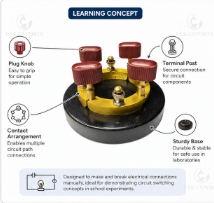
This plug type resistance box supplies known resistances for bridge and circuit practicals, typically from 0 to 100 Ω. Pulling out a brass plug brings its coil into the circuit. The non-inductive coils are double-covered constantan (Eureka) or manganin wire on Bakelite spools, under a brass block in a wood box. Accuracy is ±0.05% to ±0.1% with constantan and ±0.02% to ±0.05% with manganin.
Specifications of the plug type resistance box
| Component | Specification |
|---|---|
| Typical range | 0 to 100 Ω, any whole number of ohms |
| Typical coils | Eight, of 1, 2, 2, 5, 10, 20, 20 and 40 Ω, in series |
| Coil wire | Double-covered constantan (Eureka), ±0.05% to ±0.1%, or manganin, ±0.02% to ±0.05% |
| Winding | Non-inductive (bifilar), on Bakelite spools |
| Plug block | Rectangular brass, 10 mm or 12 mm thick, carrying the plug contacts |
| Housing | Wood box |
| House code | EL-EAE-10282 |
| Manufacturer | Lab Exports, Delhi |
Circuits that use the resistance box
Each coil joins two neighbouring sections of the brass block. With a plug in the gap, current flows through the brass and the coil is shorted out. With the plug removed, the current must pass through the coil. The resistance between the terminals is the sum of the coils whose plugs are out. With every plug in, only the small contact resistance of the plugs remains.
- Known resistance in a bridge. In a meter bridge, the box goes in one gap as the known resistance R and the wire under test in the other. Choose R so the balance point falls near the middle of the bridge wire.
- Ohm's law. Use the box as the resistor in series with an ammeter, a battery eliminator and a rheostat, with a voltmeter across the box. Plot V against I. The slope should match the value set on the box.
- Shunt across a cell. On a potentiometer, balance the cell with no load and note the length l1. Set a value R on the box, join it across the cell as a shunt, and balance again at l2. Then r = R(l1 - l2)/l2, where r is the internal resistance of the cell.
Setting a value on the box
- Check that every plug is clean and pushed firmly home, so the box is at its zero setting.
- Connect the box into the circuit through its terminals.
- Remove the plugs whose values add up to the resistance you need.
- After the reading, put the plugs back with a slight twist to keep the contact resistance low.
Frequently Asked Questions
Why are constantan or manganin wires used for the coils in a resistance box?
Both alloys combine a high resistivity with a resistance that hardly changes with temperature. A short coil can then give a large resistance, and its value stays steady as the current warms it. Copper, aluminium or iron would need far more wire and would change value with temperature.
How accurate are constantan and manganin coils?
On this box, constantan coils are accurate to ±0.05% to ±0.1%, and manganin coils to ±0.02% to ±0.05%. Manganin suits the closer grade because its resistance is very stable and it gives only a tiny thermoelectric emf against copper.
Why are the coils in a resistance box doubly wound?
Doubly wound coils are non-inductive. The wire is folded back on itself before winding, so current flows in opposite directions in neighbouring turns and their magnetic fields cancel. No induced emf then upsets a bridge balance when the key is closed. The coils of this box are wound this way. Double-covered wire is different: it means two layers of insulation.
What is a standard resistance?
A standard resistance is a resistor whose value is known accurately and stays steady with time and temperature. The coils of a resistance box serve as such known resistances in bridge and potentiometer work. They are also used to calibrate ammeters and voltmeters.
How is the equivalent resistance of resistances in series found?
Add them: R = R1 + R2 + R3 and so on. In a plug type box, the coils whose plugs are removed are in series between the terminals. The resistance in circuit is therefore the sum of their marked values.
Other resistance boxes
More apparatus is in the Electrical and Electronics section of the Physics Lab range.
To enquire, email [email protected] with the house code EL-EAE-10282 and the quantity, or use the Add To Cart button on this page.
Last updated: 23 November 2026