Tapping Key Manufacturer,Supplier and Exporter in India
Product Code : SCL-EAE-11283
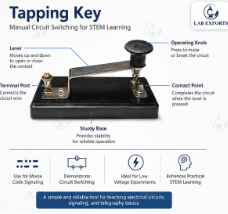
The Tapping Key functions as a normally open contact device. Pressing or tapping its operating control brings the conductive contacts together and completes the circuit. Releasing the control separates the contacts and interrupts current flow.
This momentary action is useful where an experiment requires only a brief observation, such as checking galvanometer deflection or confirming a bridge-circuit balance. The unit provides a clear physical demonstration of make-and-break switching. Its contact material, base construction, terminal type and electrical rating were not supplied.
Key Features
Momentary contact operation: Completes the circuit only while the operating control is pressed.
Quick circuit interruption: Stops current when released, reducing unnecessary energisation during observations.
Suitable for sensitive instruments: Supports brief galvanometer and detector readings in supervised experiments.
Simple operating principle: Helps students understand normally open switching and make-and-break circuit control.
Accessible connection points: Allows attachment to suitable laboratory leads and circuit components.
Compact laboratory format: Fits conveniently into school and college electrical experiment setups.
Reusable instructional apparatus: Supports repeated demonstrations when kept clean and operated within its confirmed rating.
Technical Specifications
|
Specification |
Detail |
|
Product name |
Tapping Key |
|
Brand |
Lab Exports |
|
Product category |
Physics Laboratory Equipment / Electrical and Electronics |
|
Device type |
Momentary electrical contact key |
|
Normal contact state |
Open when not pressed |
|
Operating action |
Manual press or tap |
|
Primary function |
Briefly making and breaking an electrical circuit |
What’s Included in the Kit
One Tapping Key
Integrated momentary-contact mechanism
Electrical connection terminals
Mounted supporting base
Applications and Uses
Making brief contact in galvanometer experiments
Checking detector deflection in bridge circuits
Controlling current during Wheatstone bridge observations
Supporting resistance-comparison experiments
Demonstrating normally open switch operation
Testing simple electrical circuits momentarily
Reducing prolonged current flow through sensitive components
How to Use the Tapping Key
Place the key on a stable, dry and non-conductive laboratory bench.
Keep the circuit power switched off while making connections.
Connect the key in series at the required position in the circuit.
Check that the contact is open when the operating control is released.
Switch on the approved low-voltage supply.
Press the key briefly to complete the circuit and take the observation.
Release the key immediately after recording the reading.
Switch off the supply before changing any circuit connection.
Safety note: Use the key only within its confirmed voltage and current ratings. Do not hold it closed unnecessarily, operate it with wet hands or use it with exposed mains-voltage circuits.
Care and Maintenance
Keep the contact surfaces, terminals and base clean and dry.
Press the operating control gently; do not strike or force it.
Inspect terminals and contacts if operation becomes intermittent.
Store the key in a dry, dust-free cabinet after use.
Why Choose Lab Exports?
Lab Exports manufactures and exports scientific laboratory instruments, experiment setups, science kits and STEM teaching equipment for institutional requirements. The Tapping Key is relevant to the company’s electrical and electronics laboratory equipment range.
Buyers can also explore the wider physics laboratory equipment collection and the broader laboratory equipment range . Contact materials, electrical ratings, accessories and export packing should be confirmed in the final quotation.
Frequently Asked Questions
What is a Tapping Key used for?
A Tapping Key is used to make brief electrical contact while taking a reading or checking circuit response. Current stops when the key is released.
Is a Tapping Key the same as a plug key?
No. A tapping key is normally used for momentary contact, while a plug key commonly remains closed until its plug is removed or repositioned.
Why is momentary contact useful in galvanometer experiments?
It limits the time for which current passes through the detector. This helps reduce unnecessary heating and prolonged needle deflection.
Can the key be used in a Wheatstone bridge circuit?
Yes. It can provide brief detector contact during bridge balancing, subject to the experiment circuit and the key’s confirmed rating.
What voltage and current can the Tapping Key handle?
The electrical ratings were not supplied. Confirm the maximum voltage and current before connecting the key to any circuit.
Is the Tapping Key suitable for school laboratories?
Yes. It is suitable for supervised school, college, polytechnic and vocational experiments involving low-voltage electrical circuits.
Request the confirmed contact material, electrical rating and accessory list through the Lab Exports contact page, or browse the related electrical and electronics laboratory equipment range.The Tapping Key functions as a normally open contact device. Pressing or tapping its operating control brings the conductive contacts together and completes the circuit. Releasing the control separates the contacts and interrupts current flow.
This momentary action is useful where an experiment requires only a brief observation, such as checking galvanometer deflection or confirming a bridge-circuit balance. The unit provides a clear physical demonstration of make-and-break switching. Its contact material, base construction, terminal type and electrical rating were not supplied.
Key Features
Momentary contact operation: Completes the circuit only while the operating control is pressed.
Quick circuit interruption: Stops current when released, reducing unnecessary energisation during observations.
Suitable for sensitive instruments: Supports brief galvanometer and detector readings in supervised experiments.
Simple operating principle: Helps students understand normally open switching and make-and-break circuit control.
Accessible connection points: Allows attachment to suitable laboratory leads and circuit components.
Compact laboratory format: Fits conveniently into school and college electrical experiment setups.
Reusable instructional apparatus: Supports repeated demonstrations when kept clean and operated within its confirmed rating.
Technical Specifications
|
Specification |
Detail |
|
Product name |
Tapping Key |
|
Brand |
Lab Exports |
|
Product category |
Physics Laboratory Equipment / Electrical and Electronics |
|
Device type |
Momentary electrical contact key |
|
Normal contact state |
Open when not pressed |
|
Operating action |
Manual press or tap |
|
Primary function |
Briefly making and breaking an electrical circuit |
What’s Included in the Kit
One Tapping Key
Integrated momentary-contact mechanism
Electrical connection terminals
Mounted supporting base
Applications and Uses
Making brief contact in galvanometer experiments
Checking detector deflection in bridge circuits
Controlling current during Wheatstone bridge observations
Supporting resistance-comparison experiments
Demonstrating normally open switch operation
Testing simple electrical circuits momentarily
Reducing prolonged current flow through sensitive components
How to Use the Tapping Key
Place the key on a stable, dry and non-conductive laboratory bench.
Keep the circuit power switched off while making connections.
Connect the key in series at the required position in the circuit.
Check that the contact is open when the operating control is released.
Switch on the approved low-voltage supply.
Press the key briefly to complete the circuit and take the observation.
Release the key immediately after recording the reading.
Switch off the supply before changing any circuit connection.
Safety note: Use the key only within its confirmed voltage and current ratings. Do not hold it closed unnecessarily, operate it with wet hands or use it with exposed mains-voltage circuits.
Care and Maintenance
Keep the contact surfaces, terminals and base clean and dry.
Press the operating control gently; do not strike or force it.
Inspect terminals and contacts if operation becomes intermittent.
Store the key in a dry, dust-free cabinet after use.
Why Choose Lab Exports?
Lab Exports manufactures and exports scientific laboratory instruments, experiment setups, science kits and STEM teaching equipment for institutional requirements. The Tapping Key is relevant to the company’s electrical and electronics laboratory equipment range.
Buyers can also explore the wider physics laboratory equipment collection and the broader laboratory equipment range . Contact materials, electrical ratings, accessories and export packing should be confirmed in the final quotation.
Frequently Asked Questions
What is a Tapping Key used for?
A Tapping Key is used to make brief electrical contact while taking a reading or checking circuit response. Current stops when the key is released.
Is a Tapping Key the same as a plug key?
No. A tapping key is normally used for momentary contact, while a plug key commonly remains closed until its plug is removed or repositioned.
Why is momentary contact useful in galvanometer experiments?
It limits the time for which current passes through the detector. This helps reduce unnecessary heating and prolonged needle deflection.
Can the key be used in a Wheatstone bridge circuit?
Yes. It can provide brief detector contact during bridge balancing, subject to the experiment circuit and the key’s confirmed rating.
What voltage and current can the Tapping Key handle?
The electrical ratings were not supplied. Confirm the maximum voltage and current before connecting the key to any circuit.
Is the Tapping Key suitable for school laboratories?
Yes. It is suitable for supervised school, college, polytechnic and vocational experiments involving low-voltage electrical circuits.
Request the confirmed contact material, electrical rating and accessory list through the Lab Exports contact page, or browse the related electrical and electronics laboratory equipment range.The Tapping Key functions as a normally open contact device. Pressing or tapping its operating control brings the conductive contacts together and completes the circuit. Releasing the control separates the contacts and interrupts current flow.
This momentary action is useful where an experiment requires only a brief observation, such as checking galvanometer deflection or confirming a bridge-circuit balance. The unit provides a clear physical demonstration of make-and-break switching. Its contact material, base construction, terminal type and electrical rating were not supplied.
Key Features
Momentary contact operation: Completes the circuit only while the operating control is pressed.
Quick circuit interruption: Stops current when released, reducing unnecessary energisation during observations.
Suitable for sensitive instruments: Supports brief galvanometer and detector readings in supervised experiments.
Simple operating principle: Helps students understand normally open switching and make-and-break circuit control.
Accessible connection points: Allows attachment to suitable laboratory leads and circuit components.
Compact laboratory format: Fits conveniently into school and college electrical experiment setups.
Reusable instructional apparatus: Supports repeated demonstrations when kept clean and operated within its confirmed rating.
Technical Specifications
|
Specification |
Detail |
|
Product name |
Tapping Key |
|
Brand |
Lab Exports |
|
Product category |
Physics Laboratory Equipment / Electrical and Electronics |
|
Device type |
Momentary electrical contact key |
|
Normal contact state |
Open when not pressed |
|
Operating action |
Manual press or tap |
|
Primary function |
Briefly making and breaking an electrical circuit |
What’s Included in the Kit
One Tapping Key
Integrated momentary-contact mechanism
Electrical connection terminals
Mounted supporting base
Applications and Uses
Making brief contact in galvanometer experiments
Checking detector deflection in bridge circuits
Controlling current during Wheatstone bridge observations
Supporting resistance-comparison experiments
Demonstrating normally open switch operation
Testing simple electrical circuits momentarily
Reducing prolonged current flow through sensitive components
How to Use the Tapping Key
Place the key on a stable, dry and non-conductive laboratory bench.
Keep the circuit power switched off while making connections.
Connect the key in series at the required position in the circuit.
Check that the contact is open when the operating control is released.
Switch on the approved low-voltage supply.
Press the key briefly to complete the circuit and take the observation.
Release the key immediately after recording the reading.
Switch off the supply before changing any circuit connection.
Safety note: Use the key only within its confirmed voltage and current ratings. Do not hold it closed unnecessarily, operate it with wet hands or use it with exposed mains-voltage circuits.
Care and Maintenance
Keep the contact surfaces, terminals and base clean and dry.
Press the operating control gently; do not strike or force it.
Inspect terminals and contacts if operation becomes intermittent.
Store the key in a dry, dust-free cabinet after use.
Why Choose Lab Exports?
Lab Exports manufactures and exports scientific laboratory instruments, experiment setups, science kits and STEM teaching equipment for institutional requirements. The Tapping Key is relevant to the company’s electrical and electronics laboratory equipment range.
Buyers can also explore the wider physics laboratory equipment collection and the broader laboratory equipment range . Contact materials, electrical ratings, accessories and export packing should be confirmed in the final quotation.
Frequently Asked Questions
What is a Tapping Key used for?
A Tapping Key is used to make brief electrical contact while taking a reading or checking circuit response. Current stops when the key is released.
Is a Tapping Key the same as a plug key?
No. A tapping key is normally used for momentary contact, while a plug key commonly remains closed until its plug is removed or repositioned.
Why is momentary contact useful in galvanometer experiments?
It limits the time for which current passes through the detector. This helps reduce unnecessary heating and prolonged needle deflection.
Can the key be used in a Wheatstone bridge circuit?
Yes. It can provide brief detector contact during bridge balancing, subject to the experiment circuit and the key’s confirmed rating.
What voltage and current can the Tapping Key handle?
The electrical ratings were not supplied. Confirm the maximum voltage and current before connecting the key to any circuit.
Is the Tapping Key suitable for school laboratories?
Yes. It is suitable for supervised school, college, polytechnic and vocational experiments involving low-voltage electrical circuits.
Request the confirmed contact material, electrical rating and accessory list through the Lab Exports contact page, or browse the related electrical and electronics laboratory equipment range.The Tapping Key functions as a normally open contact device. Pressing or tapping its operating control brings the conductive contacts together and completes the circuit. Releasing the control separates the contacts and interrupts current flow.
This momentary action is useful where an experiment requires only a brief observation, such as checking galvanometer deflection or confirming a bridge-circuit balance. The unit provides a clear physical demonstration of make-and-break switching. Its contact material, base construction, terminal type and electrical rating were not supplied.
Key Features
Momentary contact operation: Completes the circuit only while the operating control is pressed.
Quick circuit interruption: Stops current when released, reducing unnecessary energisation during observations.
Suitable for sensitive instruments: Supports brief galvanometer and detector readings in supervised experiments.
Simple operating principle: Helps students understand normally open switching and make-and-break circuit control.
Accessible connection points: Allows attachment to suitable laboratory leads and circuit components.
Compact laboratory format: Fits conveniently into school and college electrical experiment setups.
Reusable instructional apparatus: Supports repeated demonstrations when kept clean and operated within its confirmed rating.
Technical Specifications
|
Specification |
Detail |
|
Product name |
Tapping Key |
|
Brand |
Lab Exports |
|
Product category |
Physics Laboratory Equipment / Electrical and Electronics |
|
Device type |
Momentary electrical contact key |
|
Normal contact state |
Open when not pressed |
|
Operating action |
Manual press or tap |
|
Primary function |
Briefly making and breaking an electrical circuit |
What’s Included in the Kit
One Tapping Key
Integrated momentary-contact mechanism
Electrical connection terminals
Mounted supporting base
Applications and Uses
Making brief contact in galvanometer experiments
Checking detector deflection in bridge circuits
Controlling current during Wheatstone bridge observations
Supporting resistance-comparison experiments
Demonstrating normally open switch operation
Testing simple electrical circuits momentarily
Reducing prolonged current flow through sensitive components
How to Use the Tapping Key
Place the key on a stable, dry and non-conductive laboratory bench.
Keep the circuit power switched off while making connections.
Connect the key in series at the required position in the circuit.
Check that the contact is open when the operating control is released.
Switch on the approved low-voltage supply.
Press the key briefly to complete the circuit and take the observation.
Release the key immediately after recording the reading.
Switch off the supply before changing any circuit connection.
Safety note: Use the key only within its confirmed voltage and current ratings. Do not hold it closed unnecessarily, operate it with wet hands or use it with exposed mains-voltage circuits.
Care and Maintenance
Keep the contact surfaces, terminals and base clean and dry.
Press the operating control gently; do not strike or force it.
Inspect terminals and contacts if operation becomes intermittent.
Store the key in a dry, dust-free cabinet after use.
Why Choose Lab Exports?
Lab Exports manufactures and exports scientific laboratory instruments, experiment setups, science kits and STEM teaching equipment for institutional requirements. The Tapping Key is relevant to the company’s electrical and electronics laboratory equipment range.
Buyers can also explore the wider physics laboratory equipment collection and the broader laboratory equipment range . Contact materials, electrical ratings, accessories and export packing should be confirmed in the final quotation.
Frequently Asked Questions
What is a Tapping Key used for?
A Tapping Key is used to make brief electrical contact while taking a reading or checking circuit response. Current stops when the key is released.
Is a Tapping Key the same as a plug key?
No. A tapping key is normally used for momentary contact, while a plug key commonly remains closed until its plug is removed or repositioned.
Why is momentary contact useful in galvanometer experiments?
It limits the time for which current passes through the detector. This helps reduce unnecessary heating and prolonged needle deflection.
Can the key be used in a Wheatstone bridge circuit?
Yes. It can provide brief detector contact during bridge balancing, subject to the experiment circuit and the key’s confirmed rating.
What voltage and current can the Tapping Key handle?
The electrical ratings were not supplied. Confirm the maximum voltage and current before connecting the key to any circuit.
Is the Tapping Key suitable for school laboratories?
Yes. It is suitable for supervised school, college, polytechnic and vocational experiments involving low-voltage electrical circuits.
Request the confirmed contact material, electrical rating and accessory list through the Lab Exports contact page, or browse the related electrical and electronics laboratory equipment range.The Tapping Key functions as a normally open contact device. Pressing or tapping its operating control brings the conductive contacts together and completes the circuit. Releasing the control separates the contacts and interrupts current flow.
This momentary action is useful where an experiment requires only a brief observation, such as checking galvanometer deflection or confirming a bridge-circuit balance. The unit provides a clear physical demonstration of make-and-break switching. Its contact material, base construction, terminal type and electrical rating were not supplied.
Key Features
Momentary contact operation: Completes the circuit only while the operating control is pressed.
Quick circuit interruption: Stops current when released, reducing unnecessary energisation during observations.
Suitable for sensitive instruments: Supports brief galvanometer and detector readings in supervised experiments.
Simple operating principle: Helps students understand normally open switching and make-and-break circuit control.
Accessible connection points: Allows attachment to suitable laboratory leads and circuit components.
Compact laboratory format: Fits conveniently into school and college electrical experiment setups.
Reusable instructional apparatus: Supports repeated demonstrations when kept clean and operated within its confirmed rating.
Technical Specifications
|
Specification |
Detail |
|
Product name |
Tapping Key |
|
Brand |
Lab Exports |
|
Product category |
Physics Laboratory Equipment / Electrical and Electronics |
|
Device type |
Momentary electrical contact key |
|
Normal contact state |
Open when not pressed |
|
Operating action |
Manual press or tap |
|
Primary function |
Briefly making and breaking an electrical circuit |
What’s Included in the Kit
One Tapping Key
Integrated momentary-contact mechanism
Electrical connection terminals
Mounted supporting base
Applications and Uses
Making brief contact in galvanometer experiments
Checking detector deflection in bridge circuits
Controlling current during Wheatstone bridge observations
Supporting resistance-comparison experiments
Demonstrating normally open switch operation
Testing simple electrical circuits momentarily
Reducing prolonged current flow through sensitive components
How to Use the Tapping Key
Place the key on a stable, dry and non-conductive laboratory bench.
Keep the circuit power switched off while making connections.
Connect the key in series at the required position in the circuit.
Check that the contact is open when the operating control is released.
Switch on the approved low-voltage supply.
Press the key briefly to complete the circuit and take the observation.
Release the key immediately after recording the reading.
Switch off the supply before changing any circuit connection.
Safety note: Use the key only within its confirmed voltage and current ratings. Do not hold it closed unnecessarily, operate it with wet hands or use it with exposed mains-voltage circuits.
Care and Maintenance
Keep the contact surfaces, terminals and base clean and dry.
Press the operating control gently; do not strike or force it.
Inspect terminals and contacts if operation becomes intermittent.
Store the key in a dry, dust-free cabinet after use.
Why Choose Lab Exports?
Lab Exports manufactures and exports scientific laboratory instruments, experiment setups, science kits and STEM teaching equipment for institutional requirements. The Tapping Key is relevant to the company’s electrical and electronics laboratory equipment range.
Buyers can also explore the wider physics laboratory equipment collection and the broader laboratory equipment range . Contact materials, electrical ratings, accessories and export packing should be confirmed in the final quotation.
Frequently Asked Questions
What is a Tapping Key used for?
A Tapping Key is used to make brief electrical contact while taking a reading or checking circuit response. Current stops when the key is released.
Is a Tapping Key the same as a plug key?
No. A tapping key is normally used for momentary contact, while a plug key commonly remains closed until its plug is removed or repositioned.
Why is momentary contact useful in galvanometer experiments?
It limits the time for which current passes through the detector. This helps reduce unnecessary heating and prolonged needle deflection.
Can the key be used in a Wheatstone bridge circuit?
Yes. It can provide brief detector contact during bridge balancing, subject to the experiment circuit and the key’s confirmed rating.
What voltage and current can the Tapping Key handle?
The electrical ratings were not supplied. Confirm the maximum voltage and current before connecting the key to any circuit.
Is the Tapping Key suitable for school laboratories?
Yes. It is suitable for supervised school, college, polytechnic and vocational experiments involving low-voltage electrical circuits.
Request the confirmed contact material, electrical rating and accessory list through the Lab Exports contact page, or browse the related electrical and electronics laboratory equipment range.The Tapping Key functions as a normally open contact device. Pressing or tapping its operating control brings the conductive contacts together and completes the circuit. Releasing the control separates the contacts and interrupts current flow.
This momentary action is useful where an experiment requires only a brief observation, such as checking galvanometer deflection or confirming a bridge-circuit balance. The unit provides a clear physical demonstration of make-and-break switching. Its contact material, base construction, terminal type and electrical rating were not supplied.
Key Features
Momentary contact operation: Completes the circuit only while the operating control is pressed.
Quick circuit interruption: Stops current when released, reducing unnecessary energisation during observations.
Suitable for sensitive instruments: Supports brief galvanometer and detector readings in supervised experiments.
Simple operating principle: Helps students understand normally open switching and make-and-break circuit control.
Accessible connection points: Allows attachment to suitable laboratory leads and circuit components.
Compact laboratory format: Fits conveniently into school and college electrical experiment setups.
Reusable instructional apparatus: Supports repeated demonstrations when kept clean and operated within its confirmed rating.
Technical Specifications
|
Specification |
Detail |
|
Product name |
Tapping Key |
|
Brand |
Lab Exports |
|
Product category |
Physics Laboratory Equipment / Electrical and Electronics |
|
Device type |
Momentary electrical contact key |
|
Normal contact state |
Open when not pressed |
|
Operating action |
Manual press or tap |
|
Primary function |
Briefly making and breaking an electrical circuit |
What’s Included in the Kit
One Tapping Key
Integrated momentary-contact mechanism
Electrical connection terminals
Mounted supporting base
Applications and Uses
Making brief contact in galvanometer experiments
Checking detector deflection in bridge circuits
Controlling current during Wheatstone bridge observations
Supporting resistance-comparison experiments
Demonstrating normally open switch operation
Testing simple electrical circuits momentarily
Reducing prolonged current flow through sensitive components
How to Use the Tapping Key
Place the key on a stable, dry and non-conductive laboratory bench.
Keep the circuit power switched off while making connections.
Connect the key in series at the required position in the circuit.
Check that the contact is open when the operating control is released.
Switch on the approved low-voltage supply.
Press the key briefly to complete the circuit and take the observation.
Release the key immediately after recording the reading.
Switch off the supply before changing any circuit connection.
Safety note: Use the key only within its confirmed voltage and current ratings. Do not hold it closed unnecessarily, operate it with wet hands or use it with exposed mains-voltage circuits.
Care and Maintenance
Keep the contact surfaces, terminals and base clean and dry.
Press the operating control gently; do not strike or force it.
Inspect terminals and contacts if operation becomes intermittent.
Store the key in a dry, dust-free cabinet after use.
Why Choose Lab Exports?
Lab Exports manufactures and exports scientific laboratory instruments, experiment setups, science kits and STEM teaching equipment for institutional requirements. The Tapping Key is relevant to the company’s electrical and electronics laboratory equipment range.
Buyers can also explore the wider physics laboratory equipment collection and the broader laboratory equipment range . Contact materials, electrical ratings, accessories and export packing should be confirmed in the final quotation.
Frequently Asked Questions
What is a Tapping Key used for?
A Tapping Key is used to make brief electrical contact while taking a reading or checking circuit response. Current stops when the key is released.
Is a Tapping Key the same as a plug key?
No. A tapping key is normally used for momentary contact, while a plug key commonly remains closed until its plug is removed or repositioned.
Why is momentary contact useful in galvanometer experiments?
It limits the time for which current passes through the detector. This helps reduce unnecessary heating and prolonged needle deflection.
Can the key be used in a Wheatstone bridge circuit?
Yes. It can provide brief detector contact during bridge balancing, subject to the experiment circuit and the key’s confirmed rating.
What voltage and current can the Tapping Key handle?
The electrical ratings were not supplied. Confirm the maximum voltage and current before connecting the key to any circuit.
Is the Tapping Key suitable for school laboratories?
Yes. It is suitable for supervised school, college, polytechnic and vocational experiments involving low-voltage electrical circuits.
Request the confirmed contact material, electrical rating and accessory list through the Lab Exports contact page, or browse the related electrical and electronics laboratory equipment range.