Step Down Transformer
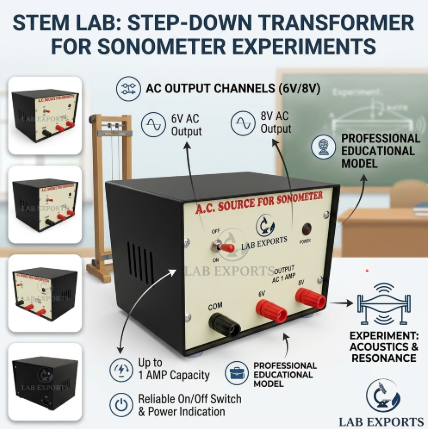
Product Code : SCL-EAE-11207
This bench transformer turns 220 to 240 V AC mains into a low-voltage AC supply for student circuits. A rotary dial selects 2, 4, 6, 8, 10 or 12 V AC at up to 2 A. The steel case has colour-coded banana sockets, a red LED power indicator and a removable earthed mains lead.
Specifications of the step down transformer
| Component | Specification |
|---|---|
| Input voltage | 220 to 240 V AC, 50 Hz |
| Output voltages | 2, 4, 6, 8, 10 and 12 V AC |
| Maximum current | 2 A on the selected output (24 VA on the 12 V tap) |
| Output selection | Rotary selector dial |
| Windings | Enamel-insulated copper |
| Output terminals | Colour-coded insulated banana sockets |
| Mains lead | Removable three-pin earthed cable |
| Indicator | Red LED power indicator |
| Enclosure | Powder-coated sheet steel |
| House code | SCL-EAE-11207 |
| Manufacturer | Lab Exports, Delhi |
Powering AC practicals from the transformer
The turns-ratio rule is Vs/Vp = Ns/Np. Here Vp and Vs are the primary and secondary voltages, and Np and Ns are the turns on the two coils.
- Lamps and heating coils. Run low-voltage lamps or a heating coil straight from the AC output. Start on 2 V and raise the dial one step at a time.
- Electromagnets and induction. Drive an electromagnet with AC to show an alternating magnetic field and the currents it induces in a nearby coil.
- Turns ratio. Feed a low AC voltage to the primary of the Demountable Transformer and read its secondary voltage on a digital multimeter. Compare the two voltages with the turns ratio.
- DC work. The output is AC, so for DC work add a rectifier circuit, or use a Battery Eliminator instead.
Setting up and switching on
- Stand the transformer on a dry, level bench, away from water.
- Turn the selector to the lowest output and connect the load to the output sockets.
- Plug in the mains lead and switch on. The LED shows that the unit is live.
- Raise the output as the experiment needs, keeping the load current at or below 2 A.
- Switch off at the mains before changing any connection.
Documentation and supply
An experiment and instruction manual is supplied with the transformer. Most Lab Exports products carry a one-year manufacturer warranty.
Lab Exports manufactures the step down transformer at its works in Laxmi Nagar, Delhi, and supplies it to schools, colleges and universities in India and 60+ countries, handling the export documents for each shipment. More about the company is on the About Lab Exports page.
Frequently Asked Questions
How is a lab step-down transformer different from a bare 12 V transformer?
A bare chassis transformer gives one fixed output on loose leads. This unit gives six outputs from 2 to 12 V AC on a rotary dial. It is housed in a powder-coated steel case with insulated banana sockets, an LED indicator and an earthed lead.
What does the 2 A rating mean?
It is the highest current the output should supply on any voltage step. On the 12 V tap, 2 A corresponds to 24 VA. Keep the total load current at or below 2 A. A heavier load overheats the windings, so check the current of lamps and coils before connecting them.
What is a step-down transformer used for in the physics lab?
It lowers mains AC to a low AC voltage for practicals. This unit powers lamps, heating coils, coils and circuit boards, drives electromagnet and induction demonstrations, and is used to show the turns-ratio rule.
In a step-down transformer, which coil has more turns?
The primary coil. In an ideal transformer the voltage ratio equals the turns ratio, Vs/Vp = Ns/Np. The secondary has fewer turns than the primary, so its output voltage is lower than the mains input.
Why is the secondary current larger than the primary current?
Power in and power out are nearly equal, so VpIp is close to VsIs. Here Ip and Is are the primary and secondary currents. When the voltage is stepped down, the current is stepped up in the same ratio.
Other apparatus for AC and induction lessons
More apparatus is in the Electrical and Electronics section of the Physics Lab range.
To enquire, email [email protected] with the house code SCL-EAE-11207 and the quantity, or use the Add To Cart button on this page. Tender buyers can also see the Tenders and OEM page.
Last updated: 23 November 2026