Resistance Coil Unit
Product Code : SCL-EAE-11262
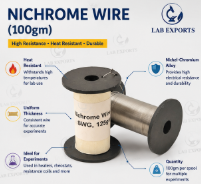
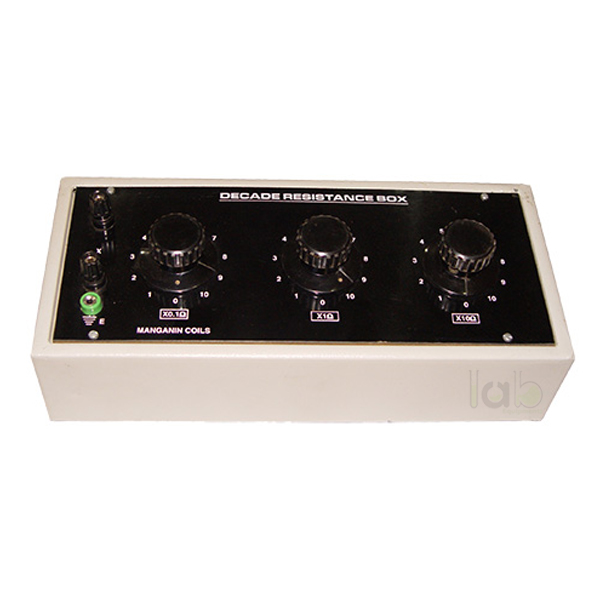
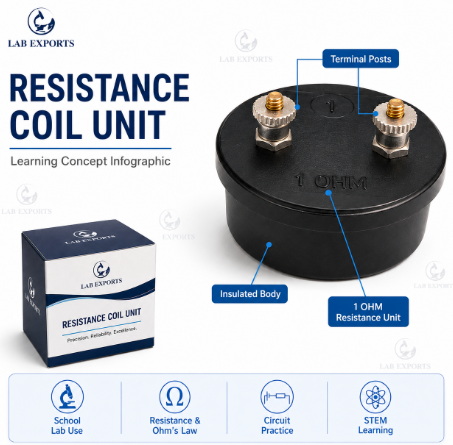
The resistance coil unit is the resistive element, or load, of a low-voltage teaching circuit. With a regulated supply, an ammeter and a voltmeter it shows how a resistance limits current and develops a measurable potential difference. Several units joined together give series and parallel combinations for equivalent-resistance practicals.
Specifications of the resistance coil unit
| Component | Specification |
|---|---|
| Function | Resistive element for an experimental circuit |
| Resistance rating | Selected to suit the experiment and agreed when ordering |
| Wire material, terminal layout, permissible load | Confirmed by email with the house code and the value required |
| Use | Reusable when operated within its rating |
| Not included | Leads, meters, switches and power sources |
| House code | SCL-EAE-11262 |
| Manufacturer | Lab Exports, Delhi |
Equivalent-resistance practicals with coil units
When a current I passes through a resistance R, a potential difference V = IR appears across it. For a fixed resistance at steady temperature, V/I stays constant.
- Current and potential difference. With the supply off, join an IC Regulated Power Supply, a One Way Plug Key, a rheostat, an ammeter and one unit in series. Connect a voltmeter across the unit terminals. Switch on and take several V and I readings by moving the rheostat.
- Units in series. Join two units end to end and measure V/I for the pair. Compare it with R1 + R2, where R1 and R2 are the values found for each unit alone.
- Units in parallel. Join the same two units side by side and measure again. Compare the result with the value from 1/R = 1/R1 + 1/R2.
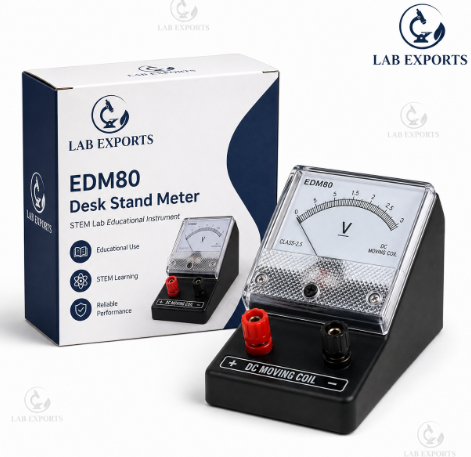
For the meters, a Digital LCD Ammeter and an Analog Voltmeter Panel Type suit bench circuits. Check the resistance, current and power ratings of each unit before use.
Documentation and supply
Most Lab Exports products carry a one-year manufacturer warranty.
Lab Exports manufactures the resistance coil unit at its works in Laxmi Nagar, Delhi, and supplies it to schools, colleges and universities in India and 60+ countries, handling the export documents for each shipment. More about the company is on the About Lab Exports page.
Frequently Asked Questions
How do you make sure the rating of the unit is comfortably above the load?
Work out the highest current the circuit will pass and compare it with the current and power ratings of the unit. Stay well inside both, and set the rheostat to its full value before switching on. The permissible load of this unit is confirmed by email.
How is the power dissipated in a resistance unit calculated?
Use P = VI or P = I2R, where V is the potential difference across the unit, I the current through it and R its resistance. That power turns into heat in the coil, so it must stay within the power rating.
Why is it advised to clean the ends of connecting wires before connecting them?
Oxide or insulation on the ends adds contact resistance at the terminals. That extra resistance sits in series with the unit, lowers the current and can give a wrong value of V/I. Scrape the ends bright and tighten every terminal.
Other apparatus for current and resistance practicals
- Resistance in Series and Parallel Apparatus
- Lamps in Series Kit
- Lamps in Parallel Kit
- Ohms Law Apparatus
More apparatus is in the Electrical and Electronics section of the Physics Lab range.
To enquire, email [email protected] with the house code SCL-EAE-11262 and the quantity, or use the Add To Cart button on this page.
Last updated: 23 November 2026