Newton’s Law of Cooling
Product Code : SCL-EAE-11213
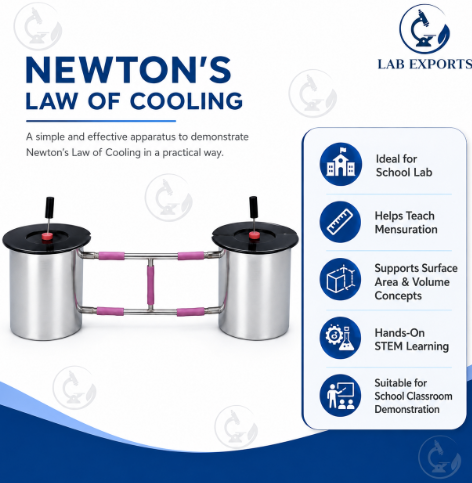
This apparatus is used to verify Newton's law of cooling and to plot cooling curves. A 200 mL copper calorimeter sits inside an outer copper draught shield, with an air gap between the two walls. An insulated lid holds two rubber stoppers for thermometers, and a brass loop stirrer keeps the water at one temperature.
Specifications of the Newton's law of cooling apparatus
| Component | Specification |
|---|---|
| Inner vessel | Copper calorimeter, 200 mL |
| Outer vessel | Copper draught shield enclosing the calorimeter, with an air gap between the walls (not water-filled, no filling point) |
| Lid | Insulated composite lid with rubber grommets |
| Thermometer holders | 2 perforated rubber stoppers |
| Stirrer | Brass wire loop with insulated handle |
| Thermometers | Not in the listed contents; add them to the enquiry if needed |
| House code | SCL-EAE-11213 |
| Manufacturer | Lab Exports, Delhi |
Cooling-curve practicals with this apparatus
Newton's law of cooling says that, for small temperature differences, the rate of cooling is proportional to the excess temperature: dT/dt = -k(T - Ts). Here T is the water temperature, Ts the temperature of the surroundings, t the time and k a constant for the vessel.
- Plotting a cooling curve. Heat water on a hotplate & magnetic stirrer and pour it into the inner vessel. Fit the lid, with one thermometer in the water and the second in the enclosure. Stir gently and read the water temperature every minute, timed with an analog stop clock. The curve of temperature against time falls steeply at first, then more slowly.
- Verifying the law. Draw tangents to the cooling curve at several temperatures to find the rate of cooling at each. Plot each rate against its excess over the enclosure temperature. A straight line through the origin verifies the law.
- Specific heat of a liquid by cooling. Cool equal volumes of water and a second liquid through the same temperature range in the same vessel, and time each. Comparing the two cooling times gives the specific heat of the liquid by the method of cooling.
Documentation and supply
A step-by-step practical guide is supplied with the apparatus. Most Lab Exports products carry a one-year manufacturer warranty.
Lab Exports manufactures the Newton's law of cooling apparatus at its works in Laxmi Nagar, Delhi, and supplies it to schools, colleges and universities in India and 60+ countries, handling the export documents for each shipment. More about the company is on the About Lab Exports page.
Frequently Asked Questions
What else is needed to carry out the experiment?
You need two thermometers, a stop clock and a way to heat the water. The thermometers are not in the listed contents, so add them to the enquiry if needed. One reads the water through a stopper and the other reads the enclosure.
What is the apparatus made of?
The 200 mL inner calorimeter and the outer draught shield are both copper, with an air gap between them. The lid is an insulated composite with rubber grommets, and the thermometers sit in two perforated rubber stoppers. The stirrer is a brass wire loop with an insulated handle.
Why is the calorimeter made of copper?
Copper conducts heat well, so the water and the vessel wall quickly share one temperature. Its specific heat capacity is also low, so the vessel itself stores little of the heat being measured.
Why is the calorimeter placed inside a double-walled enclosure?
To keep the surroundings steady. The outer copper wall shields the calorimeter from draughts and room convection, so its rate of cooling depends mainly on its excess temperature. The space between the walls is an air gap, not a water jacket. The second thermometer confirms that the enclosure temperature stays nearly constant during the run.
Does Newton's law of cooling hold for any temperature difference?
No. It holds well only when the excess over the surroundings is small. At large excesses, losses by radiation and convection grow faster than the excess itself, so the rate of cooling is no longer proportional to it.
How is the rate of cooling found from the cooling curve?
Draw a tangent to the temperature-time curve at the chosen temperature and find its slope. The size of that slope, in degrees per minute, is the rate of cooling at that temperature. Repeat at several temperatures for the second graph.
Other apparatus for heat practicals
- Copper Calorimeter
- Joule's Calorimeter
- Searle's Thermal Conductivity Apparatus
- Lee's And Charlton's Apparatus
More apparatus is in the Electrical and Electronics section of the Physics Lab range.
To enquire, email [email protected] with the house code SCL-EAE-11213 and the quantity, or use the Add To Cart button on this page.
Last updated: 23 November 2026