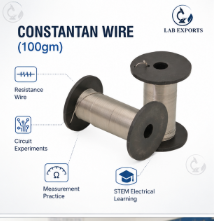
Constantan Wire (100gm)
Product Code : SCL-EAE-11251
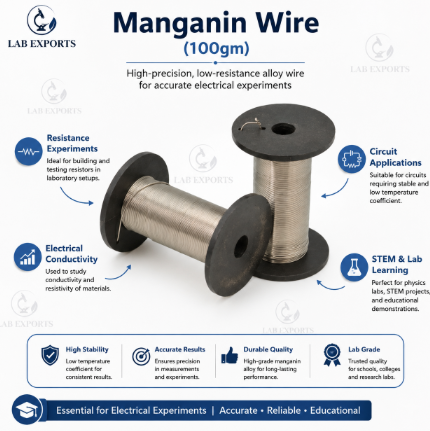
Constantan, also sold as Eureka wire, is a copper-nickel resistance alloy. Its resistivity is many times that of copper, and its resistance stays nearly constant as the wire warms. It is supplied bare, in 100 g net packs of 24, 26 or 28 SWG. Lengths cut from a pack serve as potentiometer and metre bridge wires, and go into resistivity work, Ohm's law circuits and experimental resistance coils.
Specifications of the constantan wire
| Component | Specification |
|---|---|
| Wire type | Constantan (Eureka) resistance wire, bare |
| Alloy | Copper-nickel |
| Pack weight | 100 g net; each pack holds a single gauge |
| Sizes | 24 SWG (0.559 mm), 26 SWG (0.457 mm) or 28 SWG (0.376 mm); diameters are of the bare metal |
| Nominal resistivity | 0.49 Ω mm2/m at 20 °C |
| Resistance per metre at 20 °C | 24 SWG about 2.00 Ω/m; 26 SWG about 2.99 Ω/m; 28 SWG about 4.41 Ω/m |
| Enamelled wire | A separate winding-wire option |
| Category | Electrical laboratory consumable |
| Length per pack | Given on request for the chosen gauge |
| House code | SCL-EAE-11251 |
| Manufacturer | Lab Exports, Delhi |
Where constantan wire does its work
Along a uniform constantan wire, every centimetre has the same resistance, and that value hardly changes as the wire warms. A potentiometer and a metre bridge both depend on this. At a given current, the resistance per metre of the chosen gauge sets the fall of potential along each metre of wire.
- Comparing the emfs of two cells. A steady current in the potentiometer with jockey pencil sets up a uniform fall of potential along its wire. Each cell is balanced against this fall in turn: a Leclanche cell at length l1 and a Daniel cell at length l2. Their emfs are in the ratio of these lengths, E1/E2 = l1/l2.
- Internal resistance. First find the balance length l1 with no current drawn from the cell. Next, shunt the cell with a resistance R set on a resistance box and find the new balance length l2. The cell then has an internal resistance r = R(l1 - l2)/l2.
- Metre bridge wire. In a meter bridge, the balance point divides the wire in the ratio of the two resistances in the gaps. That ratio holds only if every centimetre of wire keeps the same resistance throughout the experiment.
Frequently Asked Questions
Why is constantan used for potentiometer wires?
Because its resistance per centimetre stays nearly the same while current warms the wire. The fall of potential along the wire is then uniform and steady, so each balancing length means the same potential difference throughout the experiment. Its high resistivity also gives a usable potential gradient.
What is meant by the temperature coefficient of resistance?
It is the fractional change in resistance for each degree rise in temperature. Pure metals such as copper have a fairly large positive value. Constantan has a value close to zero, so its resistance barely changes over ordinary laboratory temperatures.
Is Eureka wire the same as constantan?
Yes. Eureka is another name for constantan, the copper-nickel resistance alloy. Suppliers often list the wire under both names, as this page does, so either name can be used in an enquiry.
Can constantan wire be soldered?
Yes. It takes ordinary soft solder once the surface is cleaned and a suitable flux is used. For most practicals, though, the bare wire is simply clamped under terminal screws, which makes it easy to change a length.
Is constantan used in thermocouples?
Yes. Constantan is one of the standard thermocouple metals. Joined to copper or iron, it gives a small emf that grows with the temperature difference between the two junctions. A pair of copper-constantan junctions and a sensitive galvanometer can show this thermoelectric effect in class.
Related apparatus for bridge and potentiometer work
More apparatus is in the Electrical and Electronics section of the Physics Lab range.
To enquire, email [email protected] with the house code SCL-EAE-11251 and the quantity, or use the Add To Cart button on this page.
Last updated: 23 November 2026