Loading Rheostat 3KW Bank

Product Code : SCL-EAE-11311
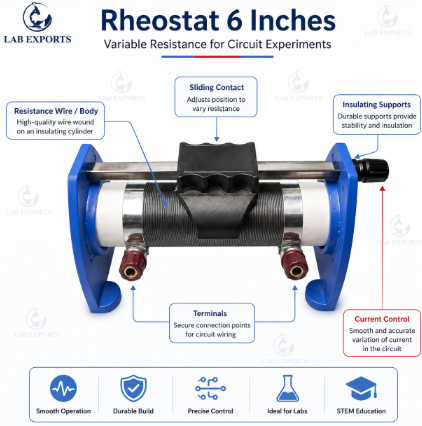
Regulation and efficiency tests need a real load, and this loading rheostat bank supplies one with a capacity of 3 kW. It turns the electrical energy a source gives out into heat, so a generator, alternator or other source can be run on load. Students follow the terminal voltage as the load rises from zero to full.
Specifications of the 3 kW loading rheostat bank
| Component | Specification |
|---|---|
| Load type | Resistive (loading rheostat bank) |
| Power capacity | 3 kW |
| Supplied | One Loading Rheostat 3KW Bank |
| Confirmed in the quotation | Operating voltage, current range, phase, resistance range, adjustment method and duty cycle |
| House code | SCL-EAE-11311 |
| Manufacturer | Lab Exports, Delhi |
Regulation and efficiency tests by direct loading
Every real source has some internal impedance, so its terminal voltage falls as it gives more current. One common form is regulation = (VNL - VFL)/VFL × 100 percent. Here VNL is the terminal voltage at no load and VFL the terminal voltage at full load. Direct loading on this bank gives both readings from one run.
- Direct load test on a single-phase transformer. Feed the primary at rated voltage and connect the bank to the secondary. Put a portable analog wattmeter on each side, with an analog ammeter panel and an analog voltmeter panel in the secondary. Raise the load in steps up to full-load secondary current. Efficiency at each step is output power divided by input power.
- Where the lost power goes. The output wattmeter reads the power the bank turns into heat. The gap between the two wattmeter readings is the loss inside the transformer, in its windings and core. Plot both against load current.
Heat, earthing and switching order
- Check that the source voltage, current, phase and frequency match the rating of the bank.
- With the source stopped or isolated, set the bank to minimum load and wire it through the meters.
- The bank turns up to 3 kW into heat. Keep free air space around it, earth it soundly, tighten every terminal and fit suitable circuit protection. Never cover it while it is in use.
- Reduce the load to zero before the source is switched off.
Frequently Asked Questions
When is a resistive load bank used?
It is used when a test needs a steady real-power load. In a direct load test, all the output of the transformer or generator goes into the bank, and the output wattmeter reads it. Tests at a lagging power factor also need an inductive load.
How does load current affect the efficiency and regulation of a transformer?
Efficiency rises with load and is highest where copper loss equals core loss, then falls slowly as the load rises further. The voltage drop, and so the regulation, grows with load current and also depends on the power factor of the load.
What is voltage regulation and how is it worked out?
It is how far the terminal voltage falls when the load goes from zero to full, given as a percentage. Subtract the full-load voltage from the no-load voltage, divide by the full-load voltage and multiply by 100. Many transformer texts divide by the no-load voltage instead.
Other loads for regulation and efficiency tests
- Loading Rheostat 6.5KW Bank
- Loading Rheostat 1.2KW Bank
- Lamp Load 2.5KW
- Loading Inductor 2.4KVAR, for regulation at lagging power factor
More apparatus is in the Electrical and Electronics section of the Physics Lab range.
To enquire, email [email protected] with the house code SCL-EAE-11311 and the quantity, or use the Add To Cart button on this page.
Last updated: 23 November 2026