Manganin Wire (100gm)
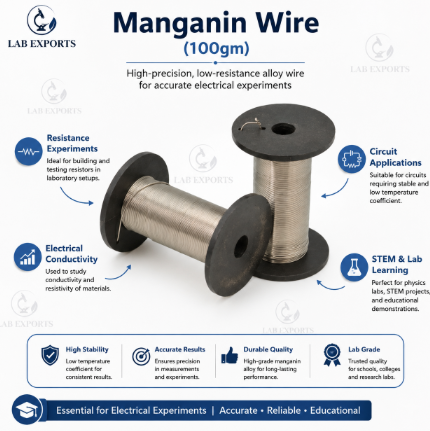
Product Code : SCL-EAE-11246
Manganin is a copper-manganese-nickel resistance alloy whose resistance hardly changes as it warms. This bare wire comes in 100 g net packs of one gauge each: 24, 26 or 28 SWG. It is cut to length for winding resistance coils and standards, and for resistivity and resistance-against-length practicals.
Specifications of the manganin wire
| Component | Specification |
|---|---|
| Wire type | Bare manganin resistance wire |
| Alloy | Copper-manganese-nickel, very small temperature coefficient of resistance |
| Pack weight | 100 g net, one gauge per pack |
| Gauges | 24, 26 or 28 SWG (0.559, 0.457 or 0.376 mm diameter of the metal) |
| Resistivity | 0.43 Ω mm2/m nominal, at 20 °C |
| Resistance per metre | About 1.75 Ω/m (24 SWG), 2.62 Ω/m (26 SWG) and 3.87 Ω/m (28 SWG), at 20 °C |
| Category | Electrical laboratory consumable |
| Length per pack | Stated in the quotation for the gauge chosen |
| House code | SCL-EAE-11246 |
| Manufacturer | Lab Exports, Delhi |
Experiments and coil work with manganin wire
A length of manganin keeps practically the same resistance while a small current warms it. That makes it the usual choice for standard resistors and for the coils inside resistance boxes and bridges.
- Resistance against length. Clamp a length between two terminals. Connect it in series with an ammeter, a one way plug key and a battery eliminator on a low voltage. Put a voltmeter across the wire. Record V and I for several lengths and plot R = V/I against the length L. A straight line through the origin shows that R is proportional to L.
- Resistivity of manganin. Take the mean of several screw gauge readings of the diameter, made at different points along the wire. Then ρ = RA/L, where A = πr2 is the cross-sectional area and r is half the mean diameter. Compare the result with the nominal 0.43 Ω mm2/m at 20 °C, converting the units first.
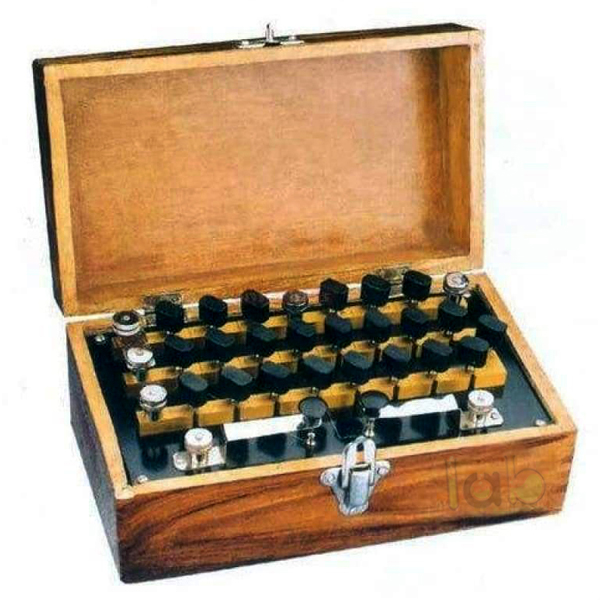
- Winding a coil of known value. The wire is bare, so wind a measured length on an insulating former and keep the turns from touching. Check its value on a meter bridge, with a plug-type resistance box as the known resistance.
Frequently Asked Questions
Why is manganin used for making standard resistance coils?
Because its resistance hardly changes with temperature. A coil wound from it keeps its value as the room warms or as the current heats the wire slightly. Its resistivity is also high, so a useful resistance fits into a short length of wire.
Are manganin and constantan both alloys?
Yes. Manganin is an alloy of copper, manganese and nickel, and constantan is an alloy of copper and nickel. Both have a far higher resistivity than pure copper and a very small temperature coefficient of resistance. That is why both are used for resistance coils.
On what factors does the resistivity of a wire depend?
It depends only on the material and its temperature, not on the size of the sample. Resistance does depend on size: R = ρL/A, where L is the length and A the cross-sectional area. So a longer or thinner manganin wire has more resistance, but the same resistivity.
Is manganin wire magnetic?
No. Manganin is practically non-magnetic, so the wire is not attracted by a magnet. Any magnetic field around a manganin coil comes only from the current flowing in it.
How is the resistance per metre of a given gauge worked out?
Divide the resistivity by the cross-sectional area of the wire: resistance per metre = ρ/A, with A = πd2/4 and d the diameter of the metal. A thinner gauge has a smaller area, so it has more ohms per metre. With ρ = 0.43 Ω mm2/m and d in mm, this gives about 1.75, 2.62 and 3.87 Ω/m for 24, 26 and 28 SWG.
More apparatus for resistance measurements
More apparatus is in the Electrical and Electronics section of the Physics Lab range.
To enquire, email [email protected] with the house code SCL-EAE-11246 and the quantity, or use the Add To Cart button on this page.
Last updated: 23 November 2026