Rheostat 10 Inches
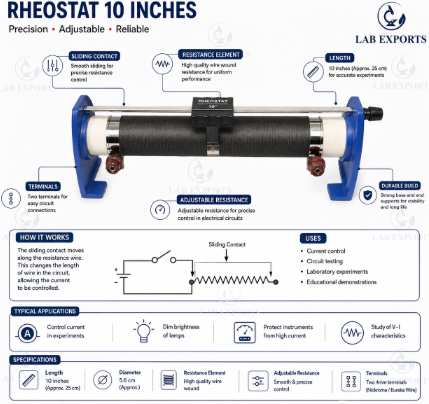
Product Code : SCL-EAE-11281
This rheostat of nominal 10 inch size has a sliding contact on an integrated resistance element with connection terminals. Wired in series, it controls the current through a load. Wired as a potential divider, it gives an output voltage that can be raised from nearly zero up to the supply voltage.
Specifications of the 10 inch rheostat
| Component | Specification |
|---|---|
| Apparatus type | Sliding variable resistor |
| Size | 10 inches (about 254 mm) |
| Adjustment method | Movable sliding contact |
| Resistance element | Integrated, with electrical connection terminals |
| Primary function | Variable resistance and circuit-current control |
| House code | SCL-EAE-11281 |
| Manufacturer | Lab Exports, Delhi |
Series and divider circuits with the 10 inch rheostat
In series, only one end terminal and the slider are used. Moving the slider adds or removes winding, and the current falls or rises. As a potential divider, the whole winding goes across the supply, and the output comes from the slider and one end.
- Diode curve from zero volts. Take the divider output through a series resistor to a PN junction diode unit. A voltmeter reads the diode voltage and a digital LCD ammeter the current. Start at zero, move the slider a little at a time and plot the forward curve.
- Reverse breakdown of a Zener diode. Put a Zener diode unit in reverse bias behind a series resistor. The divider then lets the voltage climb slowly, so the sharp rise in current is not missed.
- Current control. Change to the series connection to set a steady current through a coil or lamp.
- Set the rheostat down on a dry, non-conductive surface where it cannot tip or slide.
- Check the resistance element, slider and terminals for damage before wiring.
- Choose the series or divider connection and wire it with the supply switched off.
- Set the slider for maximum resistance, or for minimum output voltage, then switch on and adjust gradually.
Frequently Asked Questions
What are the types of rheostat?
Laboratory rheostats are mostly wire-wound. Common forms are sliding tube rheostats with one or two tubes, groove-type rheostats, and rotary or circular ones with a turning contact. This one is a sliding rheostat of nominal 10 inch size.
What is the formula of a rheostat?
R = ρL/A. Here L is the length of winding in use, A the cross-section of the wire and ρ the resistivity of the winding material. The slider sets L and so sets R. The current then follows from Ohm's law, I = V/R.
In what type of experiment is a rheostat most often used in a lab?
In any circuit where the current or voltage must be set by hand. Common school uses are Ohm's law readings, controlling the current in a potentiometer wire, and plotting diode or lamp characteristics with the rheostat as a potential divider.
Parts for characteristic and divider circuits
More apparatus is in the Electrical and Electronics section of the Physics Lab range.
To enquire, email [email protected] with the house code SCL-EAE-11281 and the quantity, or use the Add To Cart button on this page.
Last updated: 23 November 2026