PN Junction Diode Characteristics Apparatus – 2 Meter

Product Code : SCL-EAE-11362
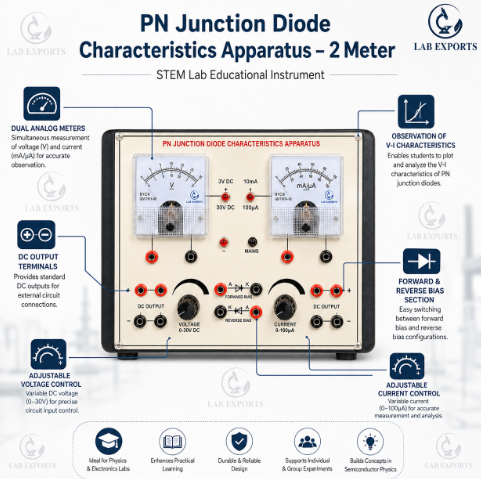
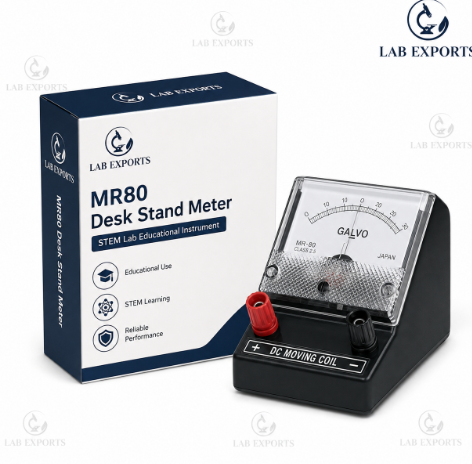
Two analog meters sit on this diode characteristics apparatus, one for the diode voltage and one for the diode current. Both pointers are read together at each bias setting. Students fill an observation table, plot the forward and reverse V-I curves and find the knee, while practising analog meter reading.
Specifications of the two-meter diode apparatus
| Component | Specification |
|---|---|
| Experiment | Forward- and reverse-bias V-I characteristics of a PN junction diode |
| Meter configuration | Two analog meters |
| Documentation | Circuit diagram for the diode connections |
| Users | Schools, colleges, polytechnics and technical institutes |
| Range and units of each meter | Confirmed by email with the house code |
| House code | SCL-EAE-11362 |
| Manufacturer | Lab Exports, Delhi |
Reading two pointer meters together
Set the apparatus on a stable bench and turn all adjustable controls to minimum. Then wire the diode for forward bias from the supplied circuit diagram.
- Paired readings. Raise the input gradually. At each step read the voltage meter and then the current meter before moving on, and enter both in the observation table. Look at each pointer square-on, not from the side.
- The reversed junction. Turn the input down to minimum and switch off, then reconnect for reverse bias. The current reading now stays near zero, which shows how little current the reversed junction passes.
- A warm-up circuit. Students can first practise reading two pointers together on an Ohms Law Apparatus (with meters). There both readings rise in step, so a misread pointer is easy to spot.
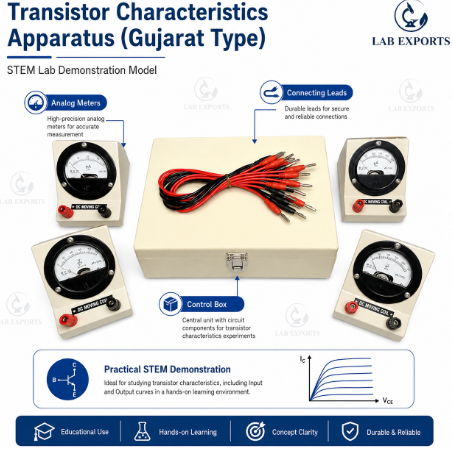
- Counting the quantities. A diode has two terminals, so each row of the table needs only one voltage and one current. On the Transistor Characteristics apparatus each setting needs input and output readings, so its table has more columns.
Documentation and supply
A circuit diagram for the diode connections is supplied with the apparatus. Most Lab Exports products carry a one-year manufacturer warranty.
Lab Exports manufactures the two-meter PN junction diode apparatus at its works in Laxmi Nagar, Delhi, and supplies it to schools, colleges and polytechnics in India and 60+ countries, handling the export documents for each shipment. More about the company is on the About Lab Exports page.
Frequently Asked Questions
How many meters should a diode characteristics apparatus have?
At least two: one for the voltage across the diode and one for the current through it. This apparatus has two analog meters, so each pair of readings is taken at the same moment. Some kits add more meters for separate forward and reverse ranges.
How are connections made on a diode characteristics apparatus?
Through the terminals on the panel, wired as the circuit diagram shows; a diagram for the diode connections is supplied with this apparatus. Make or change connections only with the controls at minimum and the supply switched off.
How do you identify forward and reverse bias in a diode circuit?
See which way the supply drives the junction. If the positive side goes to the anode, the p side, the diode is forward biased and conducts after the knee. If the positive side goes to the cathode, it is reverse biased and the current stays tiny.
What kind of graph do you get in forward and reverse bias?
In forward bias the current is almost zero at first, then rises steeply after the knee, so the curve bends sharply upward. In reverse bias the current stays very small and almost flat until breakdown. Both parts are drawn on one set of axes.
More characteristic-curve apparatus
- Transistor Characteristics Apparatus
- FET Characteristics Apparatus
- UJT Characteristics Apparatus
- Solar Cell Characteristics Apparatus
More apparatus is in the Electrical and Electronics section of the Physics Lab range.
To enquire, email [email protected] with the house code SCL-EAE-11362 and the quantity, or use the Add To Cart button on this page. Tender buyers can also see the Tenders and OEM page.
Last updated: 23 November 2026