Water Turbine Model
Product Code : SCL-EAE-11350
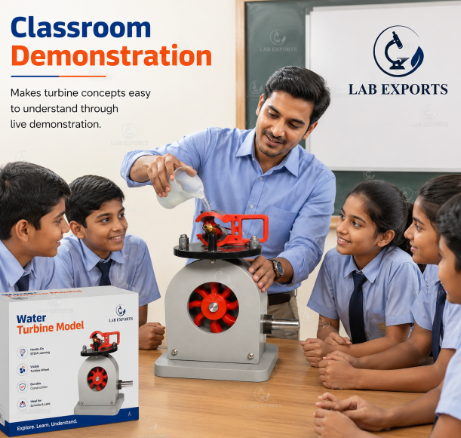
This water turbine model puts the turbine itself on the bench. A stream of water strikes its blades or buckets and gives up energy, so the rotor turns and gains mechanical energy. It is a bench-scale version of the machine at the heart of a hydropower station, used in physics and environmental science lessons.
Specifications of the water turbine model
| Component | Specification |
|---|---|
| Type | Renewable energy and hydropower demonstration model |
| Principle | Water directed at the turbine makes it rotate; the energy of moving water becomes mechanical energy of the rotor |
| Water path | Turbine with tubing and connections |
| Scale | Educational demonstration scale, for the bench |
| Water flow, generator and lamp | The water-flow requirement and any generator or lamp configuration are confirmed with the quotation |
| House code | SCL-EAE-11350 |
| Manufacturer | Lab Exports, Delhi |
Bench tasks with the water turbine model
Stand the model on a level, water-resistant bench, with a collection tray where required. Check the turbine, tubing and connections before each run. Drain and dry the model after the lesson.
- Where the water strikes. Aim a steady stream at the blades or buckets and watch the rotor start. Ask students how the water changes speed and direction as it leaves each blade. That change of momentum is the push that turns the rotor.
- From model to test rig. College students can set the model beside the Pelton Wheel Turbine Test Setup or the Francis Turbine Test Setup. There the same water-driven rotation is loaded and its performance is measured.
- Water against steam. The Steam Engine Model with Dynamo also turns a shaft with a moving fluid. Ask which of the two needs fuel to be burned, and which uses a renewable source.
Frequently Asked Questions
What does the water turbine model need to run?
It needs a steady flow of water aimed at the turbine, and a level, water-resistant bench with a collection tray where required. The exact water-flow requirement is confirmed with the quotation, as is any generator or lamp configuration.
Should a school choose a ready-made model or a DIY kit?
A ready-made model suits repeated class demonstrations, because the turbine is already set up and only needs water. A DIY kit suits project work, where students assemble the parts themselves. This water turbine model is a demonstration model at bench scale.
How does a water turbine work?
Water strikes the blades or buckets of the rotor and leaves with a different speed and direction. The change in its momentum pushes on the blades, so the rotor turns. In a power station the turbine shaft then drives a generator.
Is a turbine AC or DC?
Neither. A turbine only gives rotation. The type of electricity depends on the generator the shaft drives: an alternator gives AC, and a dynamo with a commutator gives DC. Any generator for this model is confirmed with the quotation.
What are the main types of water turbine?
There are two main types. In an impulse turbine, such as the Pelton wheel, a free jet strikes buckets on the rim. Francis and Kaplan turbines are reaction turbines: water under pressure fills the runner and pushes the blades as it flows through.
Hydro, wind, solar and biogas models
More apparatus is in the Electrical and Electronics section of the Physics Lab range.
To enquire, email [email protected] with the house code SCL-EAE-11350 and the quantity, or use the Add To Cart button on this page. Tender buyers can also see the Tenders and OEM page.
Last updated: 23 November 2026