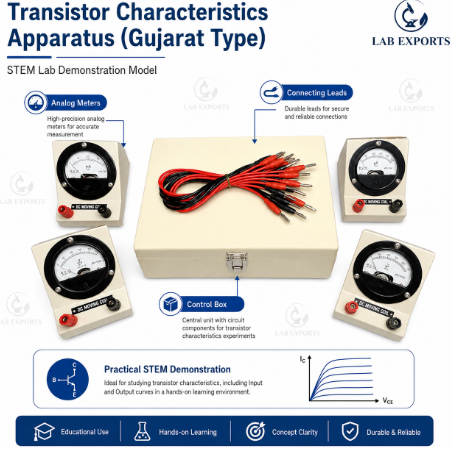
UJT Characteristics Apparatus

Product Code : SCL-EAE-11325
A unijunction transistor is a three-terminal semiconductor device with one emitter and two base terminals. The apparatus provides a structured circuit for observing how emitter current changes as emitter voltage is varied under a selected inter-base supply condition.
The measured readings can be used to plot the UJT emitter characteristic and identify its main operating regions. The apparatus also supports introductory discussion of triggering and relaxation-oscillator circuits. The fitted UJT type, meter ranges, supply outputs, panel material and circuit protection must be confirmed before ordering.
Key Features
UJT characteristic study: Supports practical observation of emitter voltage and emitter current.
Peak-point identification: Helps students locate the voltage at which significant emitter conduction begins.
Negative-resistance study: Demonstrates the region where increasing emitter current is associated with decreasing emitter voltage.
Valley-point observation: Supports identification of the transition from negative resistance to the conducting region.
Curve-plotting activity: Enables readings to be tabulated and converted into a characteristic graph.
Device-terminal learning: Reinforces correct identification of emitter, base one and base two.
Electronics training value: Connects semiconductor theory with UJT triggering and oscillator applications.
Technical Specifications
|
UJT Characteristics Apparatus technical information |
|
|
Specification |
Detail |
|
Product name |
UJT Characteristics Apparatus |
|
Brand |
Lab Exports |
|
Equipment category |
Semiconductor characteristics laboratory apparatus |
|
Device studied |
Unijunction transistor |
|
Device terminals |
Emitter, base one and base two |
|
Primary measurements |
Emitter voltage and emitter current |
|
Primary experiment |
Plotting the UJT emitter characteristic |
What's Included in the Kit
One UJT Characteristics Apparatus.
UJT device, meters, power arrangement and connecting leads only when specified in the accepted quotation.
Experiment manual or operating instructions, subject to the final supply scope.
Applications and Uses
Plotting the emitter characteristic of a unijunction transistor.
Determining the approximate peak voltage and peak current.
Identifying the negative-resistance region.
Determining the approximate valley voltage and valley current.
Studying the effect of the inter-base supply on UJT behaviour.
Introducing UJT triggering and relaxation-oscillator principles.
Supporting semiconductor-device and basic electronics practicals.
Extending circuit work with an Analog and Digital IC Trainer.
How to Use the UJT Characteristics Apparatus
Identify the emitter, base-one and base-two terminals.
Confirm the fitted UJT type and permitted electrical ratings.
Set all variable controls to their minimum positions.
Keep the power switched off while making connections.
Apply the specified inter-base voltage across the two base terminals.
Increase the emitter supply gradually through the approved limiting resistance.
Record emitter voltage and emitter current at selected points.
Continue through the peak, negative-resistance and valley regions without exceeding ratings.
Plot the characteristic curve from the recorded readings.
Return all controls to minimum and switch off the apparatus.
Safety note: Use suitable current limiting and never exceed the confirmed emitter-current, inter-base voltage or power-dissipation rating. Switch off the supply before changing connections.
Care and Maintenance
Keep the panel, meter windows, terminals and leads clean and dry.
Inspect sockets, cables and insulation before every experiment.
Operate voltage controls gradually and avoid meter overload.
Store the apparatus in a dry, dust-controlled laboratory cabinet.
Why Choose Lab Exports
Lab Exports manufactures and exports scientific instruments, experiment setups, science kits, mathematics kits, didactic models and STEM equipment. Its portfolio includes electrical, electronics and semiconductor apparatus for academic and vocational laboratories. As a test and measuring instrument India supplier, the company supplies institutional and international requirements, including institutions in Benin (West Africa), Indonesia (Southeast Asia) and Kiribati (Pacific). Buyers can confirm the UJT type, meter ranges, supply outputs and included accessories before production and dispatch.
Frequently Asked Questions
What is a UJT Characteristics Apparatus used for?
It is used to record and plot the emitter voltage-current characteristic of a unijunction transistor.
What are the terminals of a UJT?
A UJT has three terminals: emitter, base one and base two.
What is the negative-resistance region of a UJT?
It is the region between the peak and valley points where emitter voltage decreases while emitter current increases.
What is the UJT peak point?
The peak point marks the onset of significant emitter conduction under the selected inter-base operating condition.
Can the apparatus be used to explain a relaxation oscillator?
Yes. The observed triggering and negative-resistance behaviour can support introductory explanation of UJT relaxation oscillators.
Are meters and a power supply included?
The supplied configuration was not confirmed. Verify the meters, supply arrangement, UJT device, leads and manual before ordering.
Request confirmation of the fitted UJT, meter ranges and supplied accessories, or explore the complete Electrical and Electronics Laboratory Equipment range. Compatible


Wire.jpg)