IC Regulated Power Supply
Product Code : SCL-EAE-11292
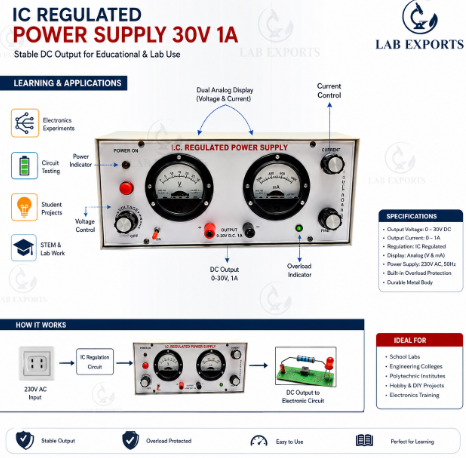
This bench DC source uses IC-based linear regulation. Its output is continuously variable from 0 to 30 V at 0 to 1 A, rated for continuous duty, with ripple and noise below 1 mV RMS. Voltage and current can be watched on its meter interface while a circuit runs.
Specifications of the IC regulated power supply
| Component | Specification |
|---|---|
| Output voltage | 0-30 V DC, continuously variable |
| Output current | 0-1 A, continuous duty |
| Regulation | IC-based linear regulation |
| Ripple and noise | Less than 1 mV RMS |
| Output monitoring | Voltage and current meter interface |
| Output terminals | Colour-coded 4 mm shrouded safety sockets |
| Protection | Short-circuit and overload protection |
| Chassis | Powder-coated cold-rolled steel |
| House code | SCL-EAE-11292 |
| Manufacturer | Lab Exports, Delhi |
Circuits powered from the regulated supply
The voltage can be set anywhere in its range, so one unit serves low-voltage semiconductor work as well as resistive circuits.
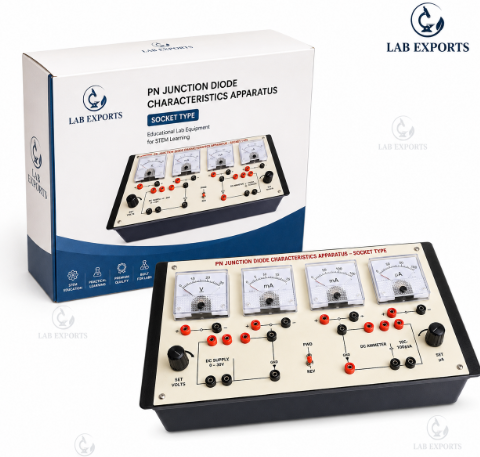
- Diode characteristics. Join a PN junction diode unit with a series resistor and raise the voltage from zero in small steps. Take the voltage across the diode on a digital multimeter and the current on a milliammeter in series. A Zener diode unit can be studied the same way in reverse bias.
- Transistor biasing. Use the supply to set the bias of an NPN transistor unit and watch how the collector current follows the base current.
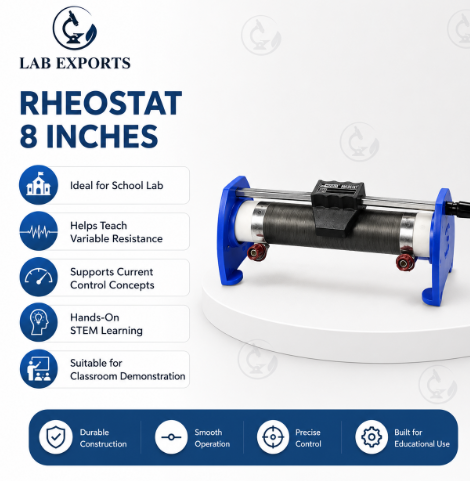
- Load regulation. Connect a rheostat and an ammeter as a variable load. Change the load current and note how little the output voltage moves on the meter.
Switching on and off
- Check that the circuit needs no more than 30 V DC and 1 A.
- Turn the voltage control to minimum before switching on.
- Connect the circuit to the colour-coded 4 mm sockets, observing polarity.
- Switch on and raise the voltage slowly while watching the voltage and current display.
- Reduce the output to zero before disconnecting the circuit.
Frequently Asked Questions
Is a linear or a switching power supply better for lab work?
For sensitive bench work a linear supply is usually preferred, because its output is quieter. A switching supply is smaller and more efficient but adds high-frequency ripple. This unit uses IC-based linear regulation, with ripple and noise below 1 mV RMS.
Why do linear DC power supplies produce lower ripple than switching supplies?
A linear regulator does not chop the current on and off. Its pass element conducts all the time while the control loop keeps correcting the output, so there is no switching frequency to leak through. A switching supply turns its transistor on and off very fast, which leaves ripple at the output.
What is the difference between an unregulated and a regulated power supply?
In an unregulated supply the output voltage changes when the mains voltage or the load current changes. A regulated supply compares its output with a reference and corrects it, so the set voltage stays steady. This unit is regulated by an IC.
What is load regulation?
Load regulation describes how much the output voltage changes when the load current changes from no load to full load. A smaller change means better regulation. It is usually stated as a percentage of the full-load voltage.
Bench apparatus for semiconductor experiments
- Zener Diode Apparatus
- Transistor Characteristics
- LED Characteristics Apparatus
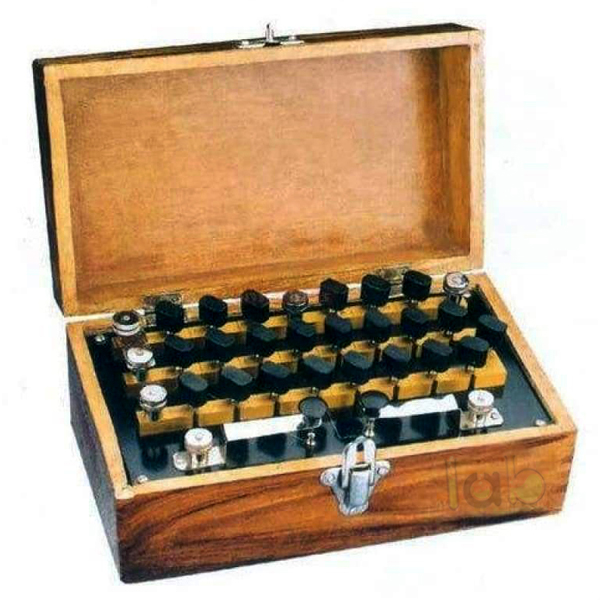
- 7 Decade Resistance Box
More apparatus is in the Electrical and Electronics section of the Physics Lab range.
To enquire, email [email protected] with the house code SCL-EAE-11292 and the quantity, or use the Add To Cart button on this page.
Last updated: 23 November 2026