Electronic Leclanche Cell

Product Code : SCL-EAE-11162
The Electronic Leclanche Cell is a solid-state stand-in for the wet Leclanche cell. It gives a regulated 1.5 V DC output at 4 mm red and black safety sockets, with no ammonium chloride, porous pot or zinc rod to look after. Overload and short-circuit protection are built in, inside an insulated, impact-resistant casing. It runs from the mains through an isolated low-voltage adapter.
Specifications of the electronic Leclanche cell
| Component | Specification |
|---|---|
| Output voltage | 1.5 V DC, regulated |
| Terminals | 4 mm colour-coded (red and black) safety sockets for standard patch cords |
| Protection | Overload and short-circuit protection |
| Construction | Solid-state circuit in an insulated, impact-resistant casing |
| Power input | Mains, through an isolated low-voltage adapter |
| Switch | ON/OFF switch on the low-voltage side of the unit |
| Replaces | Wet Leclanche cell, with no ammonium chloride, porous pot or zinc rod |
| Supplied with | User and instruction manual |
| House code | SCL-EAE-11162 |
| Manufacturer | Lab Exports, Delhi |
Experiments that use the electronic cell
The wet Leclanche cell has a zinc rod and a carbon electrode in ammonium chloride solution, with manganese dioxide in a porous pot as the depolariser. Its emf is close to 1.5 V, but the voltage falls when current is drawn for long, and the chemicals need regular care. The electronic unit keeps the nominal 1.5 V without them. It needs only a mains socket near the bench for its adapter.
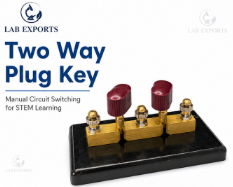
- Comparing emfs with a potentiometer. Use this cell with an Electronic Daniel Cell on a Potentiometer with Jockey Pencil. Join both cells through a two way plug key so that each can be balanced in turn against the wire, with a galvanometer showing the null point. A separate driver supply across the wire must have a higher emf than either cell. If l1 and l2 are the two balancing lengths, then E1/E2 = l1/l2.
- Bridge circuits. Use the cell as the steady source across the wire of a meter bridge, with a one way plug key in the cell circuit. Close the key only while a reading is taken.
- Constant low-voltage work. In basic Ohm's law work and other circuits that need a constant low voltage, the regulated output stands in for a wet cell that would run down during the period.
Frequently Asked Questions
Why can a wet Leclanche cell not give a steady current for long?
Because of polarisation. While current flows, hydrogen collects at the carbon electrode, and the manganese dioxide depolariser removes it only slowly, so the emf falls until the cell rests. The electronic cell has no electrodes to polarise and holds its regulated 1.5 V output.
What is the difference between a Leclanche cell and a Daniell cell?
A Leclanche cell uses a zinc rod and a carbon electrode in ammonium chloride, with manganese dioxide as the depolariser, and its emf is close to 1.5 V. A Daniell cell uses zinc in zinc sulphate and copper in copper sulphate. Its emf is lower but steadier, because it does not polarise in the same way.
Can a Leclanche cell be recharged?
No. The wet Leclanche cell is a primary cell. Its zinc is used up as it works, and it is renewed by replacing the zinc rod and the solution, not by charging. The Electronic Leclanche Cell has no zinc rod or solution, so there is nothing of that kind to renew. It draws its energy from the mains through its adapter instead.
What is the emf of a cell, and why is it found with a potentiometer?
The emf is the energy the cell gives to each coulomb of charge, equal to the voltage across it when no current flows. A voltmeter draws a small current and so reads slightly low. At the potentiometer balance point no current flows from the cell, so the balancing length measures the emf itself.
Other cells and supplies for electricity practicals
More apparatus is in the Electrical and Electronics section of the Physics Lab range.
To enquire, email [email protected] with the house code SCL-EAE-11162 and the quantity, or use the Add To Cart button on this page.
Last updated: 23 November 2026