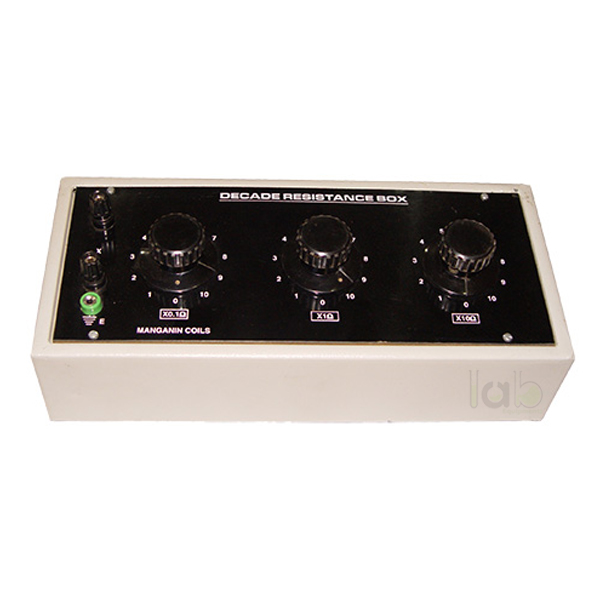
Decade Resistance Box, Dial Type
Product Code : EL-EAE-10284
A dial type decade resistance box sets a known resistance with rotary dials instead of plugs. The decades are joined in series, so the total is read straight from the dial positions. The single, two, three and four dial versions cover 0 to 9, 0 to 99, 0 to 999 and 0 to 9999 Ω in 1 Ω steps. The standard elements are high-stability ±1% metal film, for AC or DC.
Specifications of the dial type decade box
| Component | Specification |
|---|---|
| Versions and ranges | Single dial 0 to 9 Ω, two dials 0 to 99 Ω, three dials 0 to 999 Ω, four dials 0 to 9999 Ω |
| Dials | 0 to 9 on each; multipliers ×1, ×10, ×100 and ×1000 Ω; least step 1 Ω |
| Decade connection | Individual decades connected in series |
| Resistance elements | High-stability metal film, ±1%, for AC or DC use |
| Higher accuracy version | Constantan or manganin wound coils, bifilar, for DC and low-frequency AC |
| House code | EL-EAE-10284 |
| Manufacturer | Lab Exports, Delhi |
Experiments that need a quickly changed resistance
Each dial is one decade, and its steps are ten times larger than those of the dial below it. Turning a dial changes the value at once, with no plugs to pull or replace. This saves time when a resistance must be adjusted many times in one practical. At the lowest settings, contact and lead resistance add a small extra error.
- Half-deflection test on a galvanometer. Join a galvanometer, the decade box as a high resistance R and a cell in series, with a one-way plug key. Set R for a convenient deflection. Then put a plug type resistance box across the galvanometer as a shunt S and adjust S until the deflection halves. The galvanometer resistance is G = RS/(R - S).
- Converting a galvanometer into a voltmeter. Put the decade box in series with the galvanometer and set the value R = V/Ig - G. Here V is the range wanted, Ig is the current for full-scale deflection and G is the galvanometer resistance. Check the new scale against a voltmeter.
- Checking an ohmmeter. Set known values on the dials and compare them with the readings of an ohm meter across its scale.
Reading the dials
- Turn every dial to zero, then connect the box through its terminals.
- Use the highest dial first to come close to the value you need.
- Bring in the lower dials one by one for the final setting.
- Add the dial settings together, because the decades are in series, and record the total.
Frequently Asked Questions
What is a decade resistance box used for?
It supplies a known resistance that can be changed quickly by turning dials. In the lab it sets the series resistance in circuit practicals, balances bridges and gives the resistance needed to convert a galvanometer. It can also be used to check meters against known values.
Is the wound-coil version better than the film version?
For the highest accuracy, yes. The standard box uses high-stability ±1% metal film elements, which suit general AC and DC work. Film elements also have very little inductance. The constantan or manganin wound-coil version is made where higher accuracy is needed. Its bifilar coils serve on DC and low-frequency AC.
How does temperature affect a decade resistance box?
Warming changes the resistance of most materials a little, so the box should not be overloaded or kept near heat. Constantan and manganin change very little with temperature. That is why they are used for the coils of the higher-accuracy version.
What does decade mean in a decade resistance box?
A decade is a range of ten. Each dial has ten positions, 0 to 9, and covers one decade, so the dials act like the digits of a number. On the four dial version the dials are ×1, ×10, ×100 and ×1000 Ω. Reading the dials in order, from the highest decade down, gives the total resistance.
Other boxes that supply a known resistance
More apparatus is in the Electrical and Electronics section of the Physics Lab range.
To enquire, email [email protected] with the house code EL-EAE-10284 and the quantity, or use the Add To Cart button on this page.
Last updated: 23 November 2026