Dynamo Model AC DC
Product Code : SCL-EAE-11120
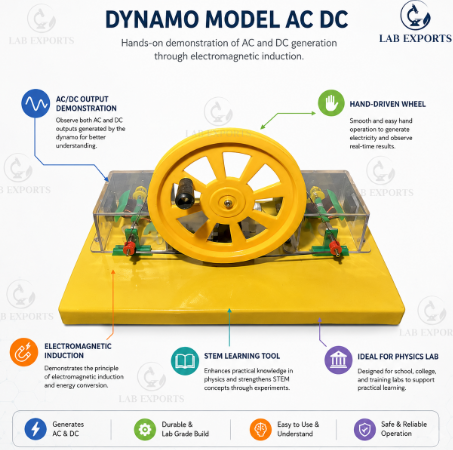
The Dynamo Model AC DC is a demonstration dynamo: a classroom model of a generator, turned by a hand crank. It shows mechanical work being turned into electrical energy by electromagnetic induction. Slip rings give alternating current (AC) and a split-ring commutator gives pulsating direct current (DC). A miniature lamp shows the output.
Specifications of the dynamo model
| Component | Specification |
|---|---|
| Type | Demonstration model |
| Drive | Hand crank, through a belt drive or a gear drive |
| Output take-off | Brushes on slip rings for AC, and on a split-ring commutator for pulsating DC |
| Output sockets | Two |
| Output indicator | Matched miniature lamp |
| Output | About 2 V with a permanent-magnet field; the loaded output depends on shaft speed and load |
| Principle | Electromagnetic induction |
| Energy conversion | Mechanical energy to electrical energy |
| House code | SCL-EAE-11120 |
| Manufacturer | Lab Exports, Delhi |
Generator lessons with the dynamo model
When a coil turns in a magnetic field, the magnetic flux through it keeps changing and an EMF is induced. This is Faraday's law of electromagnetic induction. The induced EMF reverses every half turn, so the natural output of a turning coil is alternating.
- Work into electricity. Find the two output sockets and the AC and DC take-offs on the model. Turn the hand crank gently at a steady speed and watch the miniature lamp. Then turn faster: the flux changes faster, so the EMF is larger and the lamp glows brighter.
- AC and DC compared. Change between the AC and DC outputs while turning at the same steady speed, and compare the lamp each time. Students then sketch how each output varies during one turn of the coil.
- Direction of the induced current. Apply Fleming’s Right Hand Rule to find which way the induced current flows in the moving side of the coil. Follow on with the Electric Motor Model, where a coil in a magnetic field turns electrical energy back into motion.
The output is about 2 V and changes with the speed of turning and the load. If a meter is used, read the AC output as an RMS value and the pulsating DC as an average value. Use the model under teacher supervision, and keep fingers, loose clothing and leads away from moving parts.
Frequently Asked Questions
How exactly does a dynamo work?
Mechanical work turns a coil in a magnetic field, so the flux through the coil keeps changing and an EMF is induced. When the circuit is closed, a current flows. The magnetic force on this current opposes the motion, so work must be done to keep the coil turning, and that work becomes electrical energy.
Which current does a dynamo produce, AC or DC?
It can give either, depending on how the coil is joined to the outside circuit. The EMF in the turning coil always alternates. Slip rings pass it out as AC, while a split-ring commutator reverses the connections every half turn, so the outside current keeps one direction (DC). This model has both take-offs.
What do AC and DC generators have in common?
Both work on electromagnetic induction and turn mechanical energy into electrical energy. In both, a coil and a magnetic field move relative to each other, and the EMF induced in the coil alternates. The main difference lies in how the output is taken from the coil.
Other apparatus for electromagnetic induction lessons
More apparatus is in the Electrical and Electronics section of the Physics Lab range.
To enquire, email [email protected] with the house code SCL-EAE-11120 and the quantity, or use the Add To Cart button on this page.
Last updated: 23 November 2026