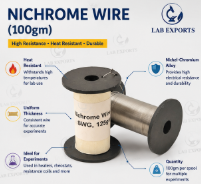
Nichrome Wire (100gm)
Product Code : SCL-EAE-11252
Nichrome is a nickel-chromium resistance wire with a high resistivity and a surface that resists oxidation, even when red hot. It comes as a nominal 100 g pack. Lengths cut from it are used to show the heating effect of current and to study resistance against length. They can also be wound into resistance coils and small heating elements.
Specifications of the nichrome wire
| Component | Specification |
|---|---|
| Wire type | Nichrome (nickel-chromium) resistance wire |
| Pack weight | 100 g (nominal), cut to length for each practical |
| Properties | High resistivity; surface resists oxidation when red hot |
| Item type | Electrical laboratory consumable |
| Gauge, diameter, resistance per metre | Confirmed in the quotation |
| Maximum operating temperature | Confirmed in the quotation |
| House code | SCL-EAE-11252 |
| Manufacturer | Lab Exports, Delhi |
Heating and resistance work with nichrome wire
The heat produced in a wire is H = I2Rt. Here I is the current, R is the resistance of the wire and t is the time for which the current flows. A short length of nichrome has a useful resistance and stays whole when it glows.
- Heating effect of current. Fix a short length between heat-resistant terminals. Feed it from a low-voltage Battery Eliminator, with a rheostat and an ammeter in series. Raise the current a little at a time and watch the wire warm up.
- Resistance against length. Cut several lengths of the same wire. For each one, read the current on the ammeter and the potential difference on a voltmeter across it. R = V/I grows in step with the length, while the diameter, checked with a screw gauge, stays the same.
- Comparing materials. Repeat the measurement with constantan wire of the same length and gauge. The two readings show how the material sets the resistance.
- Coils and small heaters. Wind a measured length round a heat-resistant former to make a resistance coil or a small heating element, then link the heating seen in class to electric heaters, irons and toasters.
Handling the wire during a practical
- Confirm the gauge and the safe current for the practical before cutting.
- Cut the length you need and clamp both ends firmly in heat-resistant terminals.
- Use a current-limited low-voltage supply with the ammeter in series, and start at the lowest setting.
- Switch off and let the wire cool before touching it, because it can become very hot.
Frequently Asked Questions
What are the characteristics of nichrome wire?
Nichrome is a nickel-chromium alloy with a much higher resistivity than copper. Its surface resists oxidation even when red hot, so a short length gives a useful resistance and survives heating. The gauge and resistance per metre of this pack are stated in the quotation.
What is the maximum temperature range of nichrome wire?
There is no single figure, because it depends on the alloy grade and the gauge. For this pack, the maximum operating temperature is confirmed in the quotation together with the gauge. In class, raise the current slowly and use only what the practical needs.
Can nichrome wire be used as a heating element?
Yes. It is the usual wire for the elements of heaters, irons and toasters. Its high resistivity gives enough resistance in a short length, and its oxide skin protects it at high temperature. Lengths from this pack can be wound into small heating elements.
Why does a nichrome wire get hot when current passes?
The moving electrons collide with the atoms of the alloy and hand energy to them, which shows up as heat. The heat produced is H = I2Rt, so with equal current, nichrome gives far more heat than copper wire of equal length and thickness.
Why is nichrome wire used in an Ohm's law experiment?
Because even a short length has a resistance that an ammeter and voltmeter can measure easily. Its resistance rises slightly as it warms, so a heated wire makes the V and I readings drift. Pass only a small current, and break the circuit as soon as each pair of readings is noted.
Other wire packs for electrical practicals
More apparatus is in the Electrical and Electronics section of the Physics Lab range.
To enquire, email [email protected] with the house code SCL-EAE-11252 and the quantity, or use the Add To Cart button on this page.
Last updated: 23 November 2026