Galvanometer
Product Code : SCL-EAE-11202
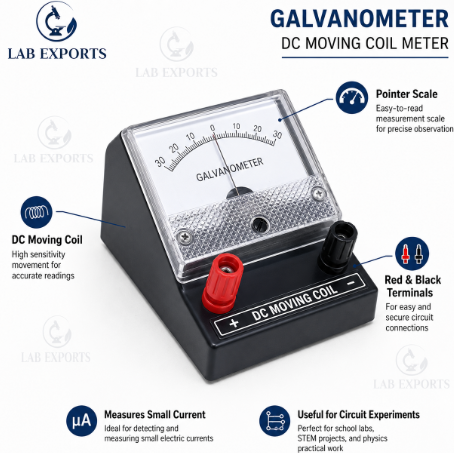
This galvanometer is a sensitive current detector for physics practicals. Its pointer moves when a small current flows, and the side it moves to shows which way that current flows. Its main job is the null detector in Wheatstone bridge, metre bridge and potentiometer circuits. It also makes induced current visible in coil and magnet work.
Specifications of the null-detector galvanometer
| Component | Specification |
|---|---|
| Function | Detects small currents and shows their direction |
| Main use | Null detector in bridge and potentiometer experiments |
| Other use | Showing induced current with a coil and magnet |
| Terminals | For quick insertion into an experimental circuit |
| Range, sensitivity, scale and case | Given on request for the current model |
| House code | SCL-EAE-11202 |
| Manufacturer | Lab Exports, Delhi |
Practicals done with this galvanometer
In the potentiometer practicals the galvanometer is not read for a value. It only has to show whether any current flows through its branch, and in which direction. For half deflection and induction, the size of the deflection matters too.
- Comparing the emf of two cells. On a potentiometer with jockey pencil, find the balancing length l1 for a Leclanche cell and l2 for a Daniel cell. A two-way plug key switches between them. Then E1/E2 = l1/l2.
- Internal resistance of a cell. On the same potentiometer, find the balancing length l1 with the cell on open circuit. Then put a known resistance R across the cell and find l2. The internal resistance is r = R(l1 - l2)/l2.
- Galvanometer resistance by half deflection. Join a cell, a high resistance R from a 10000 ohm resistance box and the galvanometer in series, and note the deflection. Put a shunt S from a 500 ohm resistance box across the galvanometer and adjust it until the deflection halves. Then G = RS/(R - S).
- Induced current. Join a coil of many turns to the galvanometer and push a bar magnet into it. The pointer kicks one way, then the other way when the magnet is pulled out. A faster movement gives a bigger kick.
How to find a null point
- Connect the galvanometer in the branch where the null is to be found, with a tapping key in series.
- At first, keep a high resistance in series with it, or a shunt across it, to limit the current.
- Tap the key briefly and note the side of the deflection.
- Adjust the circuit until a tap gives no deflection. Remove the protection and adjust again for a sharp null.
Frequently Asked Questions
Why is a galvanometer used to find the null point, and not an ammeter?
At balance the current in that branch is zero, so the detector only has to tell zero from not zero. A galvanometer moves for currents far too small to shift an ammeter pointer. It therefore locates balance much more closely, and its scale calibration does not matter.
Does it matter which way round the galvanometer is connected?
Not for finding a null. Current in either direction is shown, with the pointer swinging to one side or the other, so the leads can go either way round. The side of the swing then tells you which way the current is flowing.
Why does the galvanometer deflect to the same side at every jockey position?
There is no balance point on the wire. In a potentiometer, the usual cause is a driver cell with a lower emf than the cell under test. Another is that the positive terminals are not joined to the same end of the wire. A loose plug or a broken lead in the main circuit gives the same result.
Why is a high resistance or a shunt used at the start?
Far from balance, a large current can flow through the coil. It can bang the pointer against its stop or overheat the coil. A high series resistance or a low shunt keeps the current small while you search. Remove it near balance so that the null point is sharp.
What does the deflection tell you when the bridge is not balanced?
The side of the swing shows which way current crosses the galvanometer branch. That tells you which way to move the jockey or change the resistance. When the swing changes side between two settings, the balance point lies between them.
Other apparatus for null-point practicals
- Meter Bridge or Wheatstone Bridge With Pencil Jockey
- Post Office Box Plug Type
- Potentiometer Apparatus
- Portable Wheatstone Bridge
More apparatus is in the Electrical and Electronics section of the Physics Lab range.
To enquire, email [email protected] with the house code SCL-EAE-11202 and the quantity, or use the Add To Cart button on this page.
Last updated: 19 November 2026