Solar Educational Kit
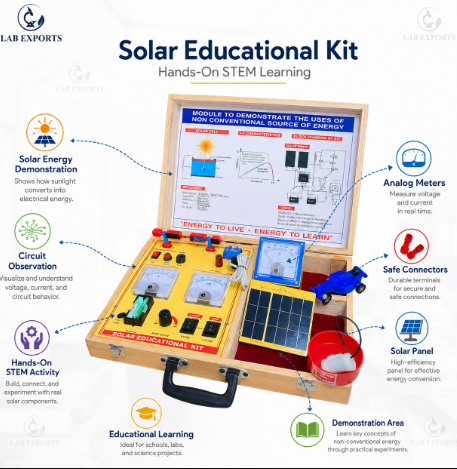
Product Code : SCL-EAE-11343
This kit is made for investigations rather than a single show. Students change one condition at a time, the light level, the angle of the panel or the load, and record how the electrical output of the solar module responds. It turns the photovoltaic effect into a fair test with clear variables.
Specifications of the solar educational kit
| Component | Specification |
|---|---|
| Kit type | Photovoltaic and renewable-energy teaching kit |
| Principle | Conversion of light energy into electrical energy |
| Variables studied | Light level, panel angle and load |
| Measurements | Output voltage and current, where meters are part of the set-up |
| Panel rating, loads and meters | Listed in the quotation for each order |
| House code | SCL-EAE-11343 |
| Manufacturer | Lab Exports, Delhi |
Fair-test investigations with the solar educational kit
In each test, keep every condition fixed except the one being studied. Take each reading twice and record both values in a table before changing anything.
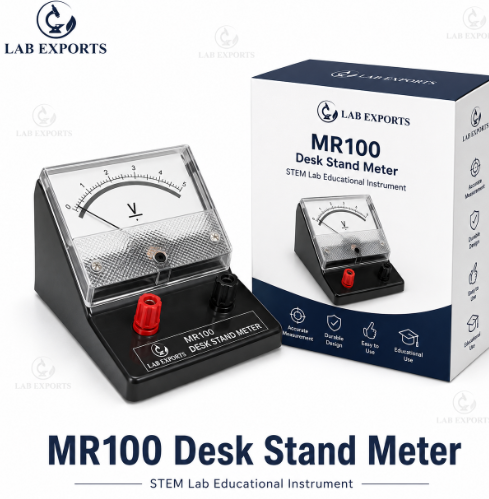
- Voltage or current as the measure. Tilt the module in equal steps away from the light. At each step read the voltage across it with a Digital LCD Voltmeter while the load is disconnected. Then reconnect the load and read its current with a Digital LED Ammeter, after checking that both meters read DC in suitable ranges. Students then decide which quantity follows the light more closely.
- Sun, cloud and shade. Take the kit outdoors and record the output in direct sun, under cloud and in open shade. A Solar Irradiance Meter held beside the module gives the light level for each reading, so output can be plotted against irradiance.
- Heavier and lighter loads. Use a rheostat as a variable load in place of a fixed one. As the load draws more current, the voltage across the module falls. This shows why a load must suit the module.
Frequently Asked Questions
What should be checked before buying a solar kit for a school lab?
Check that the panel output suits the loads you want to run, and whether meters come with the kit. For this kit, the panel rating, the supplied loads and the meters are listed in the quotation for each order, so ask for that list with the house code.
Do solar panels work on cloudy days?
Yes, but with less output. Cloud scatters and absorbs part of the sunlight, so less light reaches the module and the current falls. Comparing a cloudy reading with a sunny one is a good task for this kit.
Why does the voltage stay almost the same when a solar panel is tilted?
Because the open-circuit voltage of a cell depends only weakly on light, while its short-circuit current is nearly proportional to it. Tilting cuts the light caught by the panel, so the current falls clearly and the voltage drops only a little. Current is the better measure of the light received.
Which factors affect the output of a solar panel?
Light intensity, the angle between the panel and the light, shading, dust on the surface, temperature and the connected load all change the output. With this kit, students test light level, angle and load one at a time.
Meters and apparatus for solar investigations
- Digital LCD Voltmeter
- Digital LED Ammeter
- Solar Irradiance Meter
- Solar Cell Characteristics Apparatus
More apparatus is in the Electrical and Electronics section of the Physics Lab range.
To enquire, email [email protected] with the house code SCL-EAE-11343 and the quantity, or use the Add To Cart button on this page.
Last updated: 23 November 2026