Post Office Box Plug Type
Product Code : EL-EAE-10285
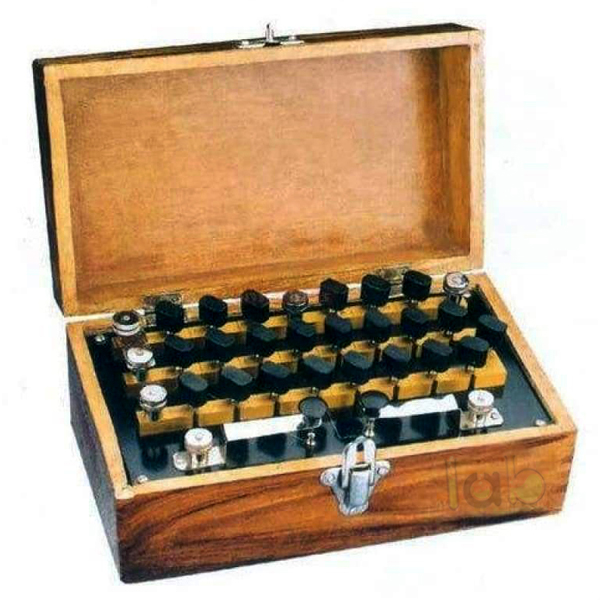
The plug type Post Office Box (P.O. Box) is a Wheatstone bridge built into one wood box. Two ratio arms and a third arm of plug coils are inside, and the unknown resistance forms the fourth arm. With a DC battery and a galvanometer it measures resistances from 0.1 to 1,111,000 Ω. It is made in 3-ratio and 4-ratio versions, with two external tapping keys or with the two keys built into the lid.
Specifications of the Post Office Box
| Component | Specification |
|---|---|
| Measuring range | 0.1 to 1,111,000 Ω, with a DC battery and galvanometer |
| 4-ratio version | 16 coils, bifilar wound (non-inductive); each of the two ratio arms has 1, 10, 100 and 1000 Ω coils; infinity gap |
| 3-ratio version | 16 non-inductive coils; each of the two ratio arms has 10, 100 and 1000 Ω coils |
| Manganin coils | Accuracy ±0.05% |
| Constantan coils | Accuracy ±0.1% |
| Brass block | 12 mm or 14 mm thick, on either version |
| Keys | Two external tapping keys (battery and galvanometer) with leads, or both keys built into the lid |
| Housing | Wood box |
| House code | EL-EAE-10285 |
| Manufacturer | Lab Exports, Delhi |
Finding an unknown resistance with the Post Office Box
P and Q are the values taken out in the two ratio arms, R is the value in the third arm and X is the unknown. When the galvanometer shows no deflection, P/Q = R/X, so X = (Q/P)R. Making P larger than Q forces R to be larger than X, which gives X to extra decimal places.
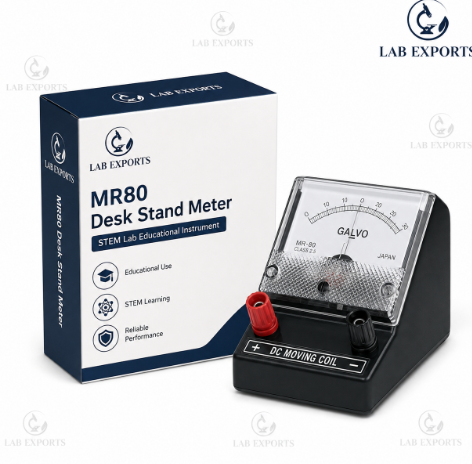
- Resistance of a coil. Connect a resistance coil as X. Join a Leclanche cell and the battery key across one diagonal, and a galvanometer with the galvanometer key across the other. Start with equal ratio arms, then move to 100:10 and 1000:10 to narrow the result.
- Cross-check with a slide-wire bridge. Measure the same coil on a meter bridge and compare the two values. They should agree within the reading errors of the two methods.
Order of the readings
- Take out the 10 Ω plugs in both ratio arms.
- Change R in the third arm and find two values between which the galvanometer deflection reverses.
- Set the ratio to 100:10, then to 1000:10, and narrow the pair of R values each time.
- For every trial, press the battery key first and the galvanometer key after it. This avoids the induced kick in the galvanometer when the current is switched on.
- Work out X = (Q/P)R from the final balance.
Frequently Asked Questions
On what principle does the Post Office Box work?
It works on the Wheatstone bridge principle. Four resistances form a loop, with a cell across one diagonal and a galvanometer across the other. When the galvanometer shows no deflection, P/Q = R/X, so the unknown X follows from the three known arms.
Why is the battery key pressed before the galvanometer key?
To keep an induced kick out of the galvanometer. When the cell circuit is closed, the current takes a moment to settle, and self-induction can send a brief surge. Closing the galvanometer key once the current is steady gives a true reading. Release the keys in the reverse order.
Why are the ratio arms set equal at the start?
Equal arms, such as 10 Ω in both P and Q, make R equal to X at balance. This gives a rough value of X quickly. The ratio is then changed to 100:10 and 1000:10 to find X to more decimal places.
Why does a Post Office Box use plugs instead of switches?
A plug pushed firmly into its socket makes a very low and steady contact resistance, so it adds almost nothing to the arm values. Loose or dirty plugs spoil this and make the balance point wander. Twist each plug in firmly and keep the plugs clean.
Other apparatus for bridge measurements
- Portable Wheatstone Bridge
- Meter Bridge or Wheatstone Bridge With Pencil Jockey
- Tapping Key, as a spare
- Resistance Coil
More apparatus is in the Electrical and Electronics section of the Physics Lab range.
To enquire, email [email protected] with the house code EL-EAE-10285 and the quantity, or use the Add To Cart button on this page. Tender buyers can also see the Tenders and OEM page.
Last updated: 23 November 2026