MR87 Desk Stand Meter

Product Code : SCL-EAE-11355
The MR87 desk stand meter is an analogue bench meter with a pointer that moves over a graduated scale. Students can watch a circuit quantity rise or fall as it happens, at bench level. Its function and range are set in the purchase order.
Specifications of the MR87 desk stand meter
| Component | Specification |
|---|---|
| Format | Analogue desk-stand laboratory meter |
| Indication | Pointer on a graduated scale |
| Function and range | Specified in the purchase order |
| House code | SCL-EAE-11355 |
| Manufacturer | Lab Exports, Delhi |
Watching a circuit change on the MR87
Confirm the function, range, polarity and terminal markings first. Join the meter in series as an ammeter or in parallel as a voltmeter, with the circuit switched off.
- A slow change. Slide the contact of a rheostat in the circuit slowly from one end to the other. The pointer creeps steadily, and students see the trend before they read any value.
- A sudden change. Press a tapping key and watch the pointer flick across and settle. Release it and the pointer falls back.
- A change of direction. On a meter ordered with a centre-zero scale, operate a reversing key and the pointer crosses to the opposite side of zero as the current reverses.
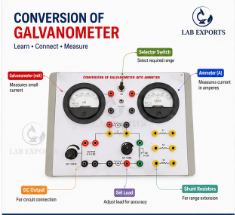
- One movement, several meters. The same moving-coil movement becomes an ammeter with a low-value shunt in parallel, or a voltmeter with a high resistance in series. The Conversion of Galvanometer practical builds both.
Frequently Asked Questions
When should an analogue meter be used instead of a digital one?
Use one when the trend matters more than the last digit. A pointer shows at a glance whether a quantity is rising, falling or reversing, as when a rheostat is moved or a switch closes. It also trains students to read a graduated scale.
What does full scale deflection mean?
It is the value that swings the pointer to the last mark on the scale. A larger current or voltage drives the pointer hard against its stop. On the MR87 the full-scale value follows from the range specified in the purchase order.
What is the basic principle behind moving-coil ammeters and voltmeters?
A coil carrying current in the field of a permanent magnet feels a turning force, balanced by control springs. A low-value shunt in parallel turns the movement into an ammeter. A high resistance in series turns it into a voltmeter.
Why does accuracy depend on where the needle sits?
The error of an analogue meter is usually stated as a fraction of its full-scale value. That same error is a bigger share of a small reading than of a large one. So pick a range that puts the pointer well up the scale.
Other meters for circuit demonstrations
More apparatus is in the Electrical and Electronics section of the Physics Lab range.
To enquire, email [email protected] with the house code SCL-EAE-11355 and the quantity, or use the Add To Cart button on this page. Tender buyers can also see the Tenders and OEM page.
Last updated: 23 November 2026