Energy Band Gap Apparatus
Product Code : SCL-EAE-11181
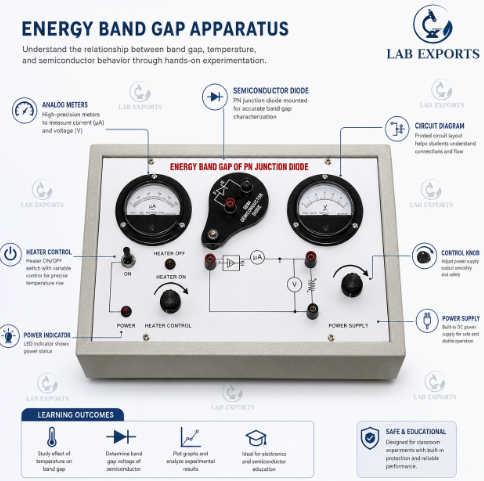
This apparatus finds the energy band gap of a semiconductor from the reverse saturation current of a germanium PN junction diode at different temperatures. The diode probe is heated in a miniature electric oven with a 0 to 110 °C glass thermometer. The console holds a regulated DC supply for a fixed reverse bias, a 0 to 10 V DC digital voltmeter and a digital micro-ammeter with 20 and 200 µA ranges.
Specifications of the energy band gap apparatus
| Component | Specification |
|---|---|
| Console | Powder-coated steel enclosure |
| Voltmeter | Built-in digital voltmeter, 0 to 10 V DC |
| Micro-ammeter | Built-in digital micro-ammeter, switchable 0 to 20 µA and 0 to 200 µA |
| Power supply | Regulated DC supply for a fixed reverse bias |
| Heating | Miniature electric oven with a thermometer slot |
| Sample | Encapsulated germanium junction diode probe |
| Thermometer | Glass, 0 to 110 °C |
| Terminals and circuit | Insulated terminals, fused circuit |
| Supplied with | Main console, oven assembly, diode probe, glass thermometer, a set of insulated patch cords and an experiment manual with calculation formulae |
| House code | SCL-EAE-11181 |
| Manufacturer | Lab Exports, Delhi |
Finding the band gap of a diode
In reverse bias only a tiny saturation current Is flows. Minority carriers carry it, and they appear when heat lifts electrons across the forbidden energy gap. So Is rises very steeply with temperature, roughly as exp(-Eg/kT). Here Eg is the band gap, k is the Boltzmann constant and T is the absolute temperature in kelvin.
- Band gap from a cooling run. Heat the diode probe in the oven, then read Is on the micro-ammeter every few degrees as it cools. Use the 200 µA range while the probe is hot and switch to 20 µA as the current falls. Plot log10 Is against 103/T and draw the straight line. With common logarithms, Eg = 0.198 × the size of the slope, in electronvolts.
- Diode characteristics first. Many courses trace the forward and reverse curves of a diode on the PN Junction Diode Characteristics Apparatus before this practical. That work shows how small the reverse current is at room temperature, and here students watch it grow as the junction warms.
- A second estimate from light. On the LED Characteristics Apparatus, the voltage at which an LED starts to glow also relates to the band gap of its material. Because a blue LED has a wider band gap than a red one, it needs more voltage before it glows.
Taking readings on the cooling run
- Place the diode probe and the thermometer in the oven, and connect the diode in reverse bias to the console with the patch cords.
- Switch on the supply and note the reverse current at room temperature.
- Switch on the oven and let the temperature rise to the upper end of the working range, then switch the heater off.
- As the diode cools, record the reverse current every few degrees, converting each temperature to kelvin for the graph.
The probe is a germanium diode, so a result of about 0.66 to 0.7 eV is expected. A silicon diode would give about 1.1 to 1.12 eV.
Frequently Asked Questions
How is the temperature of the diode controlled and measured?
The diode probe is heated in a miniature electric oven, and a glass thermometer reading 0 to 110 °C sits in the oven slot beside it. Heat to the top of the working range, switch the heater off, and take readings while the diode cools slowly.
What protection does the apparatus have for student use?
The console has insulated terminals and a fused circuit. The diode is encapsulated in a probe, so it can be handled at raised temperatures, and connections are made with insulated patch cords.
Why is the PN junction diode reverse biased in this experiment?
The reverse saturation current comes only from thermally generated minority carriers, so it depends directly on the band gap and the temperature. In forward bias a much larger current flows that depends mainly on the applied voltage, which would hide this effect.
What are the band gap values of germanium and silicon?
At room temperature germanium has a band gap of about 0.66 to 0.7 eV and silicon about 1.1 to 1.12 eV. The probe in this apparatus is germanium. Insulators have a much wider gap, while in conductors the valence and conduction bands overlap, so there is no gap at all.
How is the energy band gap related to temperature?
The band gap itself narrows only slightly as a semiconductor warms. What changes strongly is the number of electrons with enough thermal energy to cross it. That is why the reverse current climbs so fast with temperature, and why the experiment can treat the gap as constant.
Other apparatus for semiconductor practicals
- PN Junction Diode Characteristics Apparatus
- Zener Diode Apparatus
- LED Characteristics Apparatus
- Solar Cell Characteristics Apparatus
- Transistor Characteristics Apparatus
More apparatus is in the Electrical and Electronics section of the Physics Lab range.
To enquire, email [email protected] with the house code SCL-EAE-11181 and the quantity, or use the Add To Cart button on this page. Tender buyers can also see the Tenders and OEM page.
Last updated: 23 November 2026