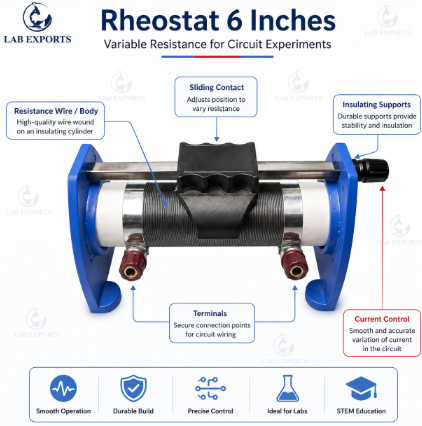
Rheostat 6 Inches
Product Code : SCL-EAE-11284
With a nominal size of 6 inches, this sliding rheostat keeps student set-ups compact. Moving its contact changes how much resistance wire lies between the chosen terminals. In a series circuit this sets the current, so beginners can watch a meter reading fall and rise as they move the slider.
Specifications of the 6 inch rheostat
| Component | Specification |
|---|---|
| Apparatus type | Sliding variable resistor |
| Nominal size | 6 inches (about 152 mm) |
| Adjustment | Sliding contact along the resistance element |
| Primary function | Variable resistance and current control |
| Resistance, maximum current and terminals | Confirmed with the quotation; check them against the circuit before use |
| House code | SCL-EAE-11284 |
| Manufacturer | Lab Exports, Delhi |
First current-control tasks with the 6 inch rheostat
In series with a load, the circuit resistance is the load resistance plus the part of the winding in use. For a fixed supply voltage V, the current is I = V / (Rload + Rrheostat). Using more of the winding lowers the current.
- Finding the working terminals. With no supply connected, set a digital multimeter to its resistance range and join it across the two terminals the experiment diagram uses. Slide the contact along in short moves and see how the reading alters. This shows students which pair of terminals gives a variable resistance before the rheostat goes into a live circuit.
- Current against slider position. Join a Leclanche cell, a one way plug key, an ammeter, a small lamp and the rheostat in series. Start with the slider at a high-resistance position, insert the plug and move the slider in steps. A table of ammeter readings shows the current falling as more winding is used, a first step before a full V-I graph.
Frequently Asked Questions
What should be checked before buying a small sliding rheostat?
Check that its resistance value and maximum current suit the planned circuit, because the current must stay within the rating. Also check that the slider moves smoothly and that the terminals hold leads firmly. For this model the resistance, current rating and terminal arrangement are confirmed with the quotation.
What should you be careful about when installing a rheostat?
Wire it with the supply off, using the terminals shown in the experiment diagram. Set the slider to a high-resistance position before switching on. Stay inside the current rating, as the winding warms up when current flows, and do not touch it during a long run.
How does a rheostat change resistance?
It changes the length of resistance wire that carries the current. The sliding contact touches the winding at one point, and only the wire between that point and the chosen end terminal is in the circuit. A longer working length gives a higher resistance.
Does changing the rheostat setting change the resistance of the wire under test?
No. The resistance of the test wire depends on its material, length, thickness and temperature. Moving the slider only changes the current through the test wire and the voltage across it. While its temperature is steady, the ratio V/I for that wire stays the same.
Other parts for a beginner current circuit
More apparatus is in the Electrical and Electronics section of the Physics Lab range.
To enquire, email [email protected] with the house code SCL-EAE-11284 and the quantity, or use the Add To Cart button on this page. Tender buyers can also see the Tenders and OEM page.
Last updated: 23 November 2026