Good and Bad Conductor of Electricity
Product Code : SCL-EAE-11200
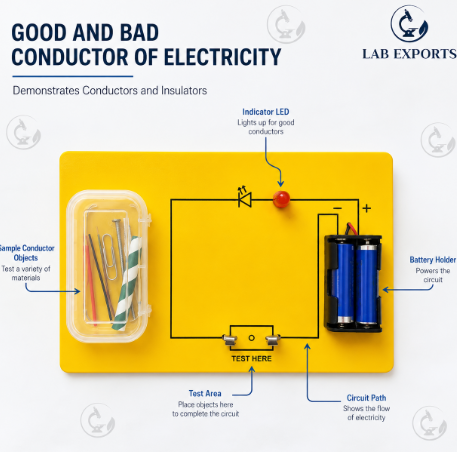
This low-voltage test circuit sorts materials into conductors and insulators. Two AA cells give 3 V, and an LED with a series resistor is the indicator. A sample is held between two clip leads. If it conducts, the circuit closes and the LED lights; if it insulates, the LED stays dark. The same set-up shows an open and a closed circuit.
Specifications of the conductor tester
| Component | Specification |
|---|---|
| Principle | The test material completes a low-voltage circuit, and an indicator shows whether current flows |
| Purpose | Classifying materials as good conductors or insulators |
| Supply | 3 V from two AA cells |
| Indicator | LED with a series current-limiting resistor |
| Switch | On/off switch in the circuit |
| Base | Insulated ABS base |
| Test leads | Two clip leads; the sample is connected between them |
| Test samples | Copper, aluminium, steel, graphite, plastic and dry wood |
| Circuit check | Touching the two clips together makes the LED light |
| Suggested use | Teacher demonstration and small-group practical work, reused across classes |
| House code | SCL-EAE-11200 |
| Manufacturer | Lab Exports, Delhi |
Testing materials on the conductor and insulator tester
Switch on and touch the two clips together. The LED should light, which shows that the circuit is complete and working.
- Metals. Test the copper, aluminium and steel samples, then a length of brass wire, a coin or a key. Each one lights the LED, because metals have many free charge carriers.
- A non-metal that conducts. Clip the graphite sample, or an electrode carbon rod, between the leads. Graphite conducts although it is not a metal.
- Insulators. Test the plastic and dry wood samples, then rubber, glass and paper. The LED stays dark, since these materials have very few free charge carriers.
- Record and sort. For each sample, note whether the LED lights fully, dimly or not at all. Draw up a table of conductors and insulators from the results.
Frequently Asked Questions
Which classes is the apparatus suitable for?
It suits school science lessons where pupils first sort materials into conductors and insulators. The circuit works on 3 V from two AA cells for supervised classroom use, as a teacher demonstration or a small-group practical, and it can be reused year after year.
Which test samples come with it?
The samples supplied include copper, aluminium, steel, graphite, plastic and dry wood. Any dry solid that fits between the two clip leads can also be tested, such as a coin, a key or a plastic ruler.
Are a paper clip, a nail and a plastic ruler conductors or insulators?
A steel paper clip and an iron nail are conductors, so the LED lights when either is clipped between the leads. A plastic ruler is an insulator and gives no response. A dry wooden ruler behaves the same way.
Is pure water a conductor of electricity?
Pure distilled water is a very poor conductor. Tap water and salt water conduct because dissolved salts supply ions that carry charge. Keep samples and clips dry on this tester, since a damp sample can give a weak response.
How can a weak current be detected in a conductivity tester?
Watch for a dim glow of the LED. A poor conductor or a loose contact lets only a small current through, and an LED lights at a much smaller current than a filament bulb. A dim or dark LED can also come from high contact resistance at the clips, so the result is a qualitative sign, not a conductivity value.
Other apparatus for first electricity lessons
More apparatus is in the Electrical and Electronics section of the Physics Lab range.
To enquire, email [email protected] with the house code SCL-EAE-11200 and the quantity, or use the Add To Cart button on this page.
Last updated: 23 November 2026