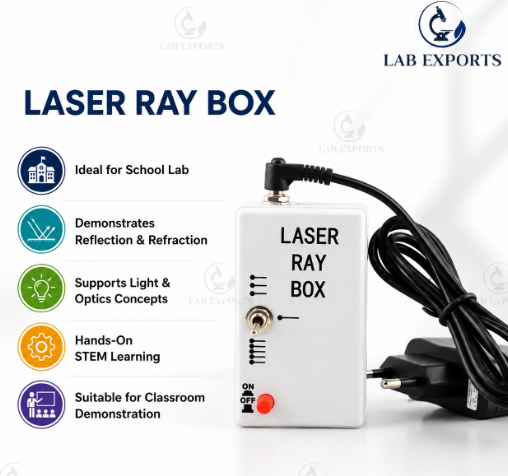
Laser Ray Box
Product Code : SCL-EAE-11128
The laser ray box projects five parallel red rays, at about 650 nm, so that students can see light paths and trace them on paper. A mask selects the rays in use, and a 9 V adapter powers the box. It is used with mirrors, lenses, prisms and transparent blocks to verify the laws of reflection, study refraction and show how lenses converge or diverge rays.
Specifications of the laser ray box
| Component | Specification |
|---|---|
| Function | Projection of visible rays for ray tracing |
| Rays | Five parallel red laser rays, wavelength about 650 nm |
| Ray selection | Mask to select the rays in use |
| Power | 9 V adapter matched to the box, supplied |
| Used with | Mirrors, lenses, prisms, transparent optical blocks and a magnetic board, all separate |
| Topics | Rectilinear propagation, reflection, refraction, lens ray paths |
| House code | SCL-EAE-11128 |
| Manufacturer | Lab Exports, Delhi |
Ray-tracing practicals with the laser ray box
A laser ray stays narrow and sharp across a whole sheet of paper, so points on the incident and emergent rays can be marked and joined afterwards. At a plane mirror, the angle of incidence equals the angle of reflection. At a boundary between two media, n1 sin i = n2 sin r. Here i is the angle of incidence, r the angle of refraction, and n1 and n2 the refractive indices of the two media.
- Laws of reflection. Stand a plastic mirror upright on a line ruled on the paper. Aim the ray at one point on the mirror from several directions, and measure each pair of angles from the normal with a protractor.
- Refraction through a glass block. Trace the ray through a rectangular glass slab. The emergent ray is parallel to the incident ray but shifted sideways. The refractive index of the glass is sin i / sin r at the first face.
- Critical angle. Aim the ray at the centre of the flat face of a semi circular glass slab, entering through the curved side. Increase the angle until the refracted ray just grazes the flat face. That angle is the critical angle, and beyond it the light is totally internally reflected.
- Prisms and lenses. Follow the ray through a glass prism to see it bend towards the base. With a convex lens, the five parallel rays meet at the principal focus. With a concave lens, they spread out as if they came from a focus behind the lens.
Tracing a ray step by step
- Place the ray box on a stable table with a sheet of paper as the ray-tracing surface.
- Connect the supplied 9 V adapter and set the mask for the rays the task needs.
- Set the mirror, lens, prism or block on the paper in the path of the ray and switch on.
- Mark points along the incident and emergent rays, then switch off and draw the ray paths with a ruler.
- Measure the angles with a protractor and compare them with the laws of reflection or refraction.
Frequently Asked Questions
What is a ray box?
A ray box is a light source that sends out narrow beams of light for ray-tracing work. An ordinary ray box uses a lamp with slits to form the beams. A laser ray box uses laser light instead, so its rays stay thinner and sharper along a whole sheet of paper. This box gives five parallel red rays.
What is a ray in physics?
A ray is a straight line with an arrow that shows the direction in which light travels. Real beams always have some width, but a narrow laser beam comes close to an ideal ray. That is why laser rays are easy to mark and measure.
What is a ray box used for in physics practicals?
It is used to show and measure light paths. The usual practicals are rectilinear propagation of light, the laws of reflection at a plane mirror and refraction through a glass block. Ray paths through a prism and through convex and concave lenses are traced too.
How should a laser ray box be used safely in class?
Use it under supervision, and never look into the laser aperture or point the beam at anyone. Keep mirrors and other reflecting surfaces angled down towards the bench, so that reflected rays stay on the table and away from eyes.
Other apparatus for ray optics practicals
More apparatus is in the Electrical and Electronics section of the Physics Lab range.
To enquire, email [email protected] with the house code SCL-EAE-11128 and the quantity, or use the Add To Cart button on this page. Tender buyers can also see the Tenders and OEM page.
Last updated: 23 November 2026