Step Down Transformer
Product Code : SCL-EAE-11259
This step down transformer is a teaching model that lowers an AC input to a smaller AC output by mutual induction. Its secondary winding has fewer turns than its primary. In class, students measure both voltages, check them against the winding ratio, and then load the output to look at losses and efficiency.
Specifications of the step down transformer
| Component | Specification |
|---|---|
| Primary function | Reduction of alternating voltage for educational demonstration |
| Operating principle | Mutual electromagnetic induction |
| Windings | Primary and secondary, with fewer turns on the secondary |
| Connections | Laboratory terminals for meters and experimental circuits |
| Input rating, output range, current capacity, enclosure | Confirmed by email for the current model |
| House code | SCL-EAE-11259 |
| Manufacturer | Lab Exports, Delhi |
Measurements on the step down transformer
The voltages follow the turns ratio, Vs/Vp = Ns/Np. Vp is the voltage across the primary and Vs the voltage across the secondary, while Np and Ns count the turns in those windings.
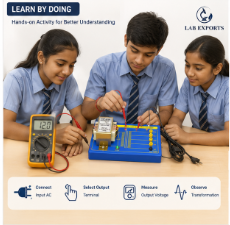
- Voltage ratio. Set one Digital Multimeter to its AC volts range across the primary and another across the secondary. Switch on and read both. Check how closely Vs/Vp matches the winding ratio.
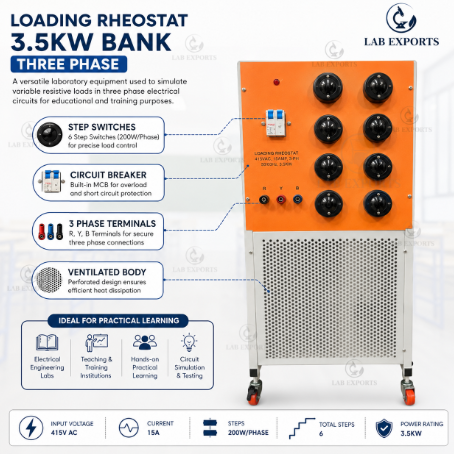
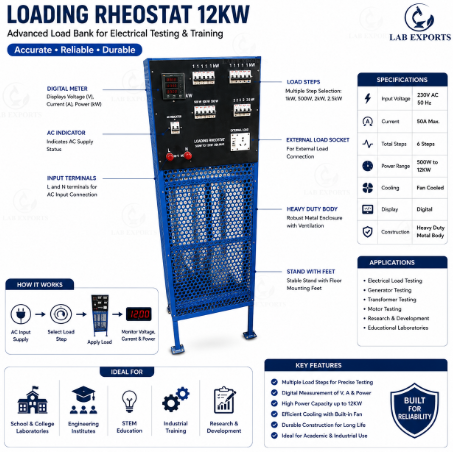
- Output on load. Connect a load, such as a rheostat kept within both ratings, to the secondary. Read the secondary voltage again and note how far it falls below the no-load value.
- Efficiency and losses. Add a meter on an AC current range in each circuit to read Ip and Is. Estimate the efficiency as (VsIs)/(VpIp) × 100 per cent. The shortfall comes from heating in the windings (copper loss) and in the core (iron loss).
Before switching on
- Place the transformer on a stable, dry, non-conductive surface.
- Read the nameplate and make sure the AC supply matches the input rating.
- Keep the supply switched off while making every connection.
- Connect the meters first and let the teacher check the primary wiring. Then switch on and take the readings.
Frequently Asked Questions
How do you choose the right step-down transformer?
Match the input rating to your supply first. Then check that the output voltage and current suit the loads you will run. For this teaching model, the input rating, output range and current capacity are confirmed by email with the house code.
What is the difference between step-up, step-down and isolation transformers?
A step-up transformer has more turns on its secondary and raises the voltage. A step-down transformer has fewer secondary turns and lowers it. An isolation transformer has about equal turns, so the voltage stays nearly the same, but the output is not joined directly to the input.
How are the energy losses reduced in a transformer?
Thick, low-resistance windings cut copper loss. A laminated core cuts eddy-current loss, and a soft-iron core cuts hysteresis loss. Winding the primary and secondary close together, often one over the other, reduces flux leakage.
Other apparatus for induction practicals
More apparatus is in the Electrical and Electronics section of the Physics Lab range.
To enquire, email [email protected] with the house code SCL-EAE-11259 and the quantity, or use the Add To Cart button on this page.
Last updated: 23 November 2026