Sliding Rheostat Dual Tube
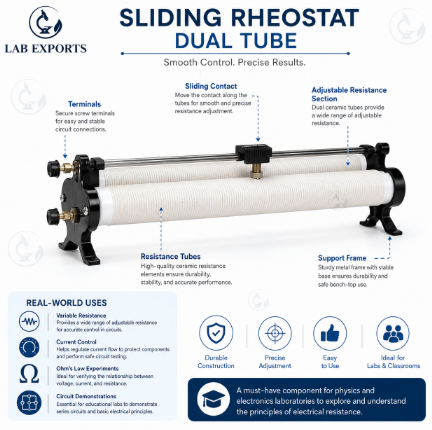
Product Code : SCL-EAE-11279
This sliding rheostat carries its resistance winding on two tubes mounted on one base. A movable sliding contact picks off part of the winding, so the resistance in the circuit, and the current, can be set by hand. It works as a series current controller or, where the circuit needs it, as a potential divider.
Specifications of the dual tube rheostat
| Component | Specification |
|---|---|
| Apparatus type | Sliding variable resistor (rheostat) |
| Tube configuration | Dual tube: two resistance-tube sections on one base |
| Adjustment | Movable sliding contact |
| Connections | Electrical connection terminals |
| Primary function | Variable resistance and circuit-current control |
| Supplied as | One apparatus with integrated sliding-contact mechanism |
| House code | SCL-EAE-11279 |
| Manufacturer | Lab Exports, Delhi |
Bench demonstrations with the dual tube rheostat
In a uniform wire R = ρL/A, with ρ the resistivity of the wire, L the length in use and A its cross-sectional area. Moving the slider changes L. The two tubes keep the whole winding in view, so a class can see how much wire is in the circuit.
- Lamp brightness and current. Using the slider and one end terminal, put the rheostat in one series loop with a lamp, a one way plug key and an ammeter. Start at maximum resistance, then move the slider and watch the lamp brighten as the reading rises.
- Potential divider on the bench. Join a low-voltage supply to the rheostat in the potential divider connection, and a voltmeter between the slider and one end terminal. As the slider travels, the reading climbs from nearly zero towards the full supply voltage.
Between readings, open the key so that the winding stays cool.
Frequently Asked Questions
What is the difference between a single tube and a double tube rheostat?
A single tube rheostat has its winding on one tube. A double tube rheostat shares the winding between two tubes on one base, which gives more wire and more surface to lose heat than one tube of the same length. The resistance and current rating of this model come with the quotation.
Can a rheostat be used in both AC and DC circuits?
Yes. A wire-wound rheostat limits current on low-voltage DC or AC supplies, because its resistance does not depend on the direction of current. The coiled winding adds a little inductance, which matters only at high frequencies. Stay within the current rating either way.
Can a rheostat be used as a switch?
Not properly. A sliding rheostat changes resistance but has no off position, so some current still flows at the end of its travel and the winding keeps warming. Use a plug key or switch to break the circuit, and the rheostat only to set the current.
What is the main disadvantage of using a rheostat for current control?
It wastes energy. The current through the winding heats it, so part of the supply power is lost as heat in the rheostat instead of reaching the load. That is why the tubes grow warm in use and the key should be opened between readings.
More rheostats for current control
- Rheostat Constantine (Eureka) Wire
- Rheostat Nichrome Wire Groove Type
- Rheostat 12 Inches
- Rheostat 10 Inches
More apparatus is in the Electrical and Electronics section of the Physics Lab range.
To enquire, email [email protected] with the house code SCL-EAE-11279 and the quantity, or use the Add To Cart button on this page.
Last updated: 23 November 2026