Rheostat Constantine (Eureka) Wire

Product Code : EL-EAE-10287
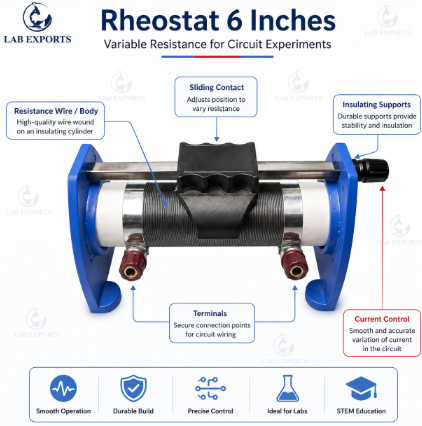
This sliding rheostat is a variable resistor wound with electrically oxidised constantan, also sold as Eureka wire. Constantan changes its resistance very little as it warms, so a setting holds steady through a run of readings. The winding sits on a heat-resistant porcelain tube, with a double-contact phosphor-bronze slider and three brass terminals. Typical models run from 5 Ω at 8 A to 250 Ω at 0.6 A.
Specifications of the constantan rheostat
| Component | Specification |
|---|---|
| Winding | Electrically oxidised constantan (Eureka) wire |
| Former | Special porcelain tube, heat-resistant and insulated |
| Slider contact | Phosphor bronze, double contact, running on a sliding rod |
| Slider block | Heavy brass |
| End supports | Bakelite or aluminium moulded, one at each end of the tube |
| Terminals | Three, brass |
| Typical models (resistance, current rating) | 5 Ω, 8 A; 25 Ω, 3 A; 100 Ω, 1 A; 250 Ω, 0.6 A |
| Tube length | About 300 mm on the 5 and 25 Ω models; about 250 mm on the 100 and 250 Ω models |
| Heat at rated current, whole winding in circuit | 320, 225, 100 and 90 W respectively |
| House code | EL-EAE-10287 |
| Manufacturer | Lab Exports, Delhi |
Two ways to wire the constantan rheostat
Through one end terminal and the slider terminal, the rheostat is a variable resistance in series with the load. Across both end terminals, with the output taken between one end and the slider, it is a potential divider. The oxide skin on the wire insulates neighbouring turns from each other, so the turns can lie close without shorting. For long runs, the continuous limit is set by the winding size, ventilation and slider temperature, not by tube length alone.
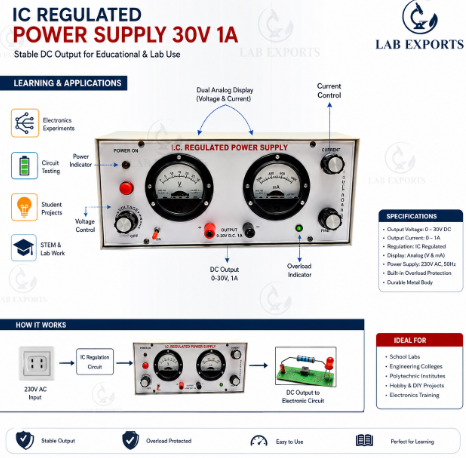
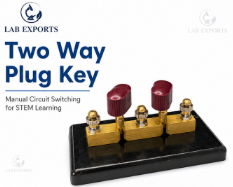
- Steady current for a potentiometer wire. Put the rheostat in series with an IC regulated battery eliminator, a key and the wire of a potentiometer. Set the slider so that the balance point falls on the scale. Because constantan barely changes with temperature, the current and the fall of potential per centimetre stay steadier while readings are taken.
- Forward characteristic of a diode. Use the rheostat as a potential divider across a battery eliminator. Feed a PN junction diode unit from the slider, with an ammeter in series and a voltmeter across the diode. Move the slider in small steps and plot current against voltage.
Choosing and starting the rheostat
- Pick a model whose current rating is above the highest current the circuit will carry, and whose resistance gives the control range you need.
- As a series resistance, start with the slider at the end that puts the whole winding in the circuit.
- As a potential divider, start with the slider at the end where the output is zero.
- Switch on, then move the slider slowly until the meter shows the reading you need.
Frequently Asked Questions
Why is constantan wire used for making a rheostat?
Constantan is a copper-nickel alloy of fairly high resistivity, and its resistance barely changes with temperature. A coil of it gives a useful resistance in a small space. Its value also hardly drifts as the coil warms under load.
Why does a rheostat have three terminals?
Two terminals are joined to the ends of the winding and the third to the slider. One end and the slider give a variable resistance. Both ends across a supply, with the output from the slider, give a potential divider.
How can a rheostat be tested before a practical?
Check it with a multimeter on a resistance range. Across the two end terminals you should read the full coil resistance of the model, for example 5, 25, 100 or 250 Ω. Between one end and the slider terminal, the reading should change smoothly as the slider moves. A jump or an open reading points to a broken turn or a poor slider contact.
Other parts for a current-control circuit
More apparatus is in the Electrical and Electronics section of the Physics Lab range.
To enquire, email [email protected] with the house code EL-EAE-10287 and the quantity, or use the Add To Cart button on this page.
Last updated: 23 November 2026