Two Stroke Diesel Engine
Product Code : SCL-H-11192
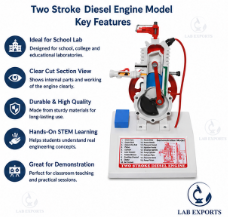
This two-stroke diesel engine model is a sectional cutaway worked by a hand crank wheel. As the piston moves, students watch it cover and uncover the ports, and a small built-in light flashes at the moment of fuel ignition. The cylinder, piston crown, scavenge ports, connecting rod, wrist pin and counterweighted crankshaft are all on view.
Specifications of the two-stroke diesel engine model
| Component | Specification |
|---|---|
| Model type | Sectional cutaway demonstrator |
| Materials | Cast metal alloy and rigid polymers |
| Operation | Hand crank wheel |
| Ignition indication | Small built-in light, powered from a low-voltage supply through the model terminals |
| Visible parts | Cylinder, piston crown, scavenge ports, connecting rod, wrist pin, counterweighted crankshaft |
| Mounting | Pre-assembled on a stable desktop support base |
| Supplied with | Basic instructional guide to the engine stages |
| Lamp supply rating and base material | Available from [email protected] |
| House code | SCL-H-11192 |
| Manufacturer | Lab Exports, Delhi |
Following the diesel cycle on the cutaway
One turn of the crankshaft takes this engine through its whole cycle. Compression alone heats the air enough to set the injected fuel alight, so there is no spark plug. Ports in the cylinder wall take the place of inlet valves.
- Ports on the downstroke. Turn the hand wheel slowly from the top of the stroke. Stop each time the piston crown uncovers a port, and ask students which gas moves through that port at that moment.
- Heat from compression. Connect a low-voltage supply to the model terminals. The light flashes as the piston nears the top of its compression stroke, where the squeezed air is hottest. Rapid compression with no time for heat to escape is an adiabatic change, the kind of change studied with the Clement and Desormes Apparatus.
- Ports against valves. Stand this model next to the Diesel Engine Model Four Stroke. On each one, find the parts that let air in and burnt gas out: ports in the cylinder wall here, valves on the four-stroke.
Documentation and supply
A basic instructional guide is supplied with the model. Most Lab Exports products carry a one-year manufacturer warranty.
Lab Exports manufactures the Two Stroke Diesel Engine model at its works in Laxmi Nagar, Delhi, and supplies it to schools, colleges and technical institutes in India and 60+ countries, handling the export documents for each shipment. More about the company is on the About Lab Exports page.
Frequently Asked Questions
How is fuel ignition shown on a two-stroke diesel cut-section model?
Usually by a small lamp that lights at the ignition point, because a teaching model burns no fuel. On this model a built-in light, fed from a low-voltage supply through the model terminals, flashes as the piston nears the top of its compression stroke.
What should a lab look for in a two-stroke diesel cut-section model?
Look for a hand crank that moves the parts slowly, a cutaway that shows the ports and moving parts clearly, and a steady base that a group can stand around. This model has a hand crank wheel, an open sectional view of the cylinder and ports, and comes pre-assembled on a support base.
Why is scavenging needed in a two-stroke diesel engine?
Because the engine has no separate exhaust and suction strokes. Near the bottom of each stroke, fresh air entering through the ports must push out the burnt gas and refill the cylinder. If scavenging is poor, leftover exhaust dilutes the air charge and the next combustion is weaker.
Why does the exhaust port open before the scavenge ports?
So that the burnt gas, still at high pressure, can rush out first. Once the cylinder pressure has fallen below the pressure of the incoming air, the scavenge ports open and fresh air enters without hot exhaust blowing back into the air supply.
Why does a two-stroke diesel scavenge with air alone and not a fuel-air mixture?
Because the fuel is injected straight into the cylinder near the top of the compression stroke. Some scavenge air always escapes through the open exhaust port, so using air alone means no fuel is lost that way.
Engine models for comparison lessons
More apparatus is in the Heat section of the Physics Lab range.
To enquire, email [email protected] with the house code SCL-H-11192 and the quantity, or use the Add To Cart button on this page.
Last updated: 24 November 2026