Loading Rheostat 12KW
Product Code : SCL-EAE-11303
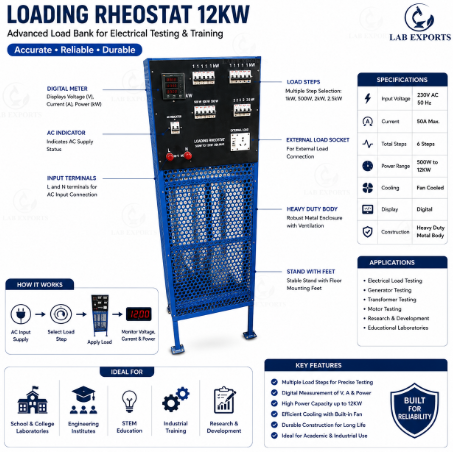
This loading rheostat is a large variable resistor with a rated loading capacity of 12 kW. Lowering its resistance raises the current drawn, and so the load placed on a generator, motor or test circuit. The power it absorbs is given off as heat. It serves load-characteristic, efficiency and regulation practicals in electrical machines labs.
Specifications of the 12 kW loading rheostat
| Component | Specification |
|---|---|
| Equipment type | Variable resistive loading unit |
| Rated loading capacity | 12 kW |
| Control | Integrated resistance-control arrangement; gradual or stepped load variation, depending on the supplied configuration |
| Connections | Electrical input and output terminals |
| Construction | Supporting frame, enclosure or mounting base as applicable |
| Resistance range, current and voltage ratings, phase and cooling | Confirmed in the technical quotation |
| House code | SCL-EAE-11303 |
| Manufacturer | Lab Exports, Delhi |
Machine tests that use the 12 kW rheostat
Connected across a generator output, the rheostat sets the current drawn. The power it absorbs is P = I2R. Here I is the rheostat current and R the resistance in circuit. The 12 kW rating is the most power the unit is intended to absorb.
- Load characteristic of a DC generator. Join the rheostat to the generator output through an analog ammeter panel, with an analog voltmeter panel across the terminals. Reduce the resistance step by step and plot terminal voltage against load current.
- Loading a DC motor. Couple the motor to a generator and load the generator with the rheostat. Each lower resistance setting makes the motor work harder, so its input current and speed can be recorded against load.
- Efficiency and regulation. At several load settings, compare the input power to the machine with the output power taken by the rheostat. Read the voltage change from no load to full load for the regulation.
Loading a machine in steps
- Check that the current, voltage and power ratings of the rheostat suit the machine under test.
- Set the unit on a bench or floor position with space around it for heat to escape.
- With supplies off, connect it to the machine output through an ammeter and voltmeter.
- Start at maximum resistance (minimum load) and run the machine up to rated speed. Then reduce the resistance in steps and record the readings at each step.
Documentation and supply
Most Lab Exports products carry a one-year manufacturer warranty.
Lab Exports manufactures the 12 kW loading rheostat at its works in Laxmi Nagar, Delhi, and supplies it to engineering colleges, polytechnics and universities in India and 60+ countries, handling the export documents for each shipment. More about the company is on the About Lab Exports page.
Frequently Asked Questions
What is the difference between a lamp load and a rheostat?
A lamp load uses lamps as its resistive elements and changes the load by switching lamps on or off, giving off light as well as heat. A loading rheostat uses resistance elements set by its control, gradually or in steps, and gives off the absorbed power as heat.
How does a loading rheostat work?
It follows Ohm's law. From a source at a fixed voltage, lower resistance draws more current, so the load on the source rises. The electrical energy drawn is turned into heat in the resistance elements.
Why is the load rheostat kept at maximum resistance before starting a load test?
So that only a small current flows when the load is first connected. The load can then be added gradually, which avoids a sudden voltage dip, a surge of armature current and a jolt to the machine driving the generator.
Why must the prime mover speed be kept constant during the load test?
Because the generated voltage depends on speed as well as field flux. If the speed changed between readings, the voltage would change for that reason too, and the effect of the load alone could not be seen.
How are the meter ratings selected for this experiment?
From the nameplate of the machine under test. The ammeter must cover the full-load current and the voltmeter the rated voltage. The current and voltage ratings of the rheostat must suit the same values.
Other units for loading machines under test
More apparatus is in the Electrical and Electronics section of the Physics Lab range.
To enquire, email [email protected] with the house code SCL-EAE-11303 and the quantity, or use the Add To Cart button on this page. Tender buyers can also see the Tenders and OEM page.
Last updated: 23 November 2026